Leitrim was not just the place they left. It was a place they lived again.
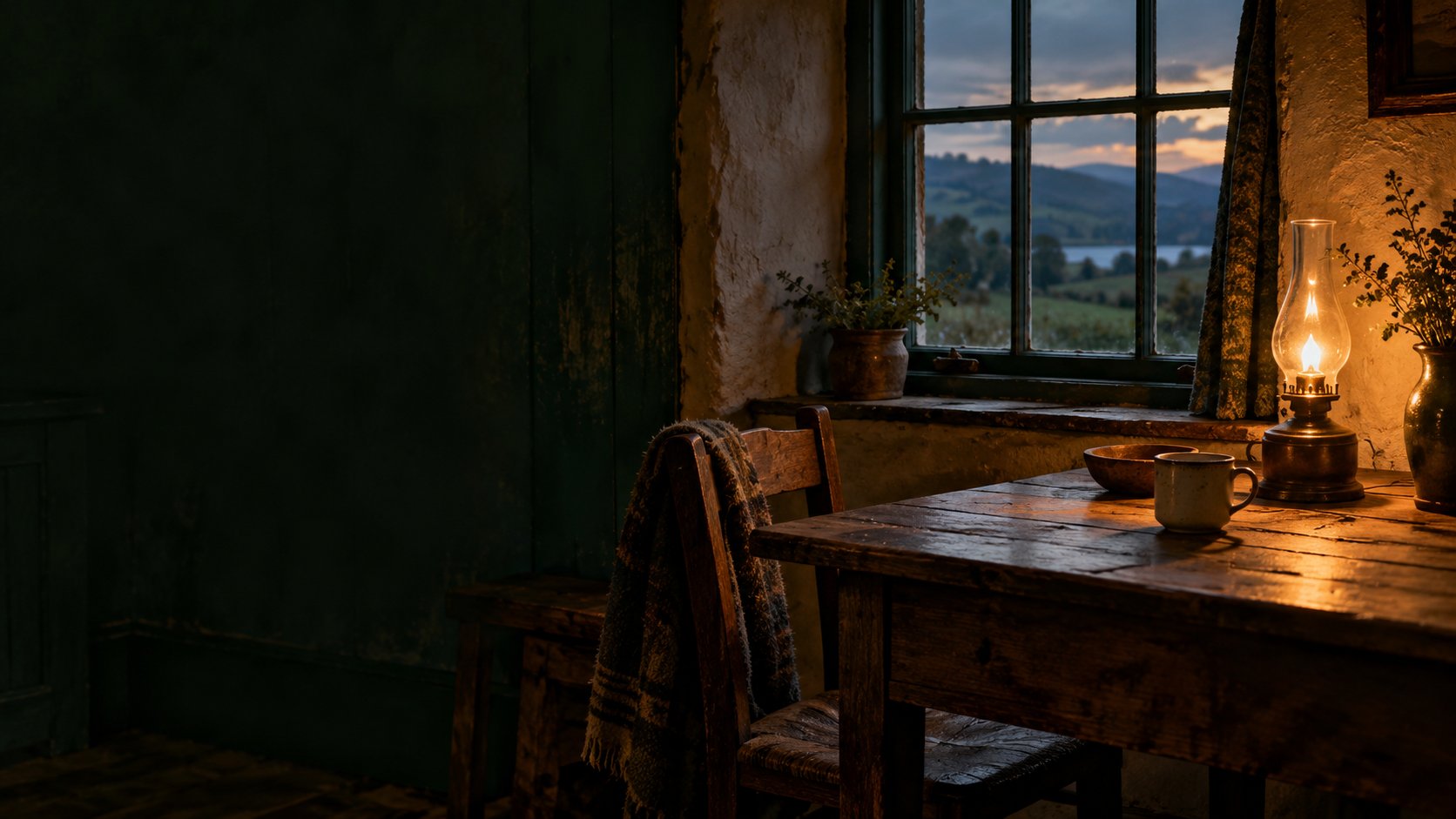
AI-generated illustration · Imagined atmosphere Not their home or Mary’s land.
One household · Six individual lives
Not just a count. A family.
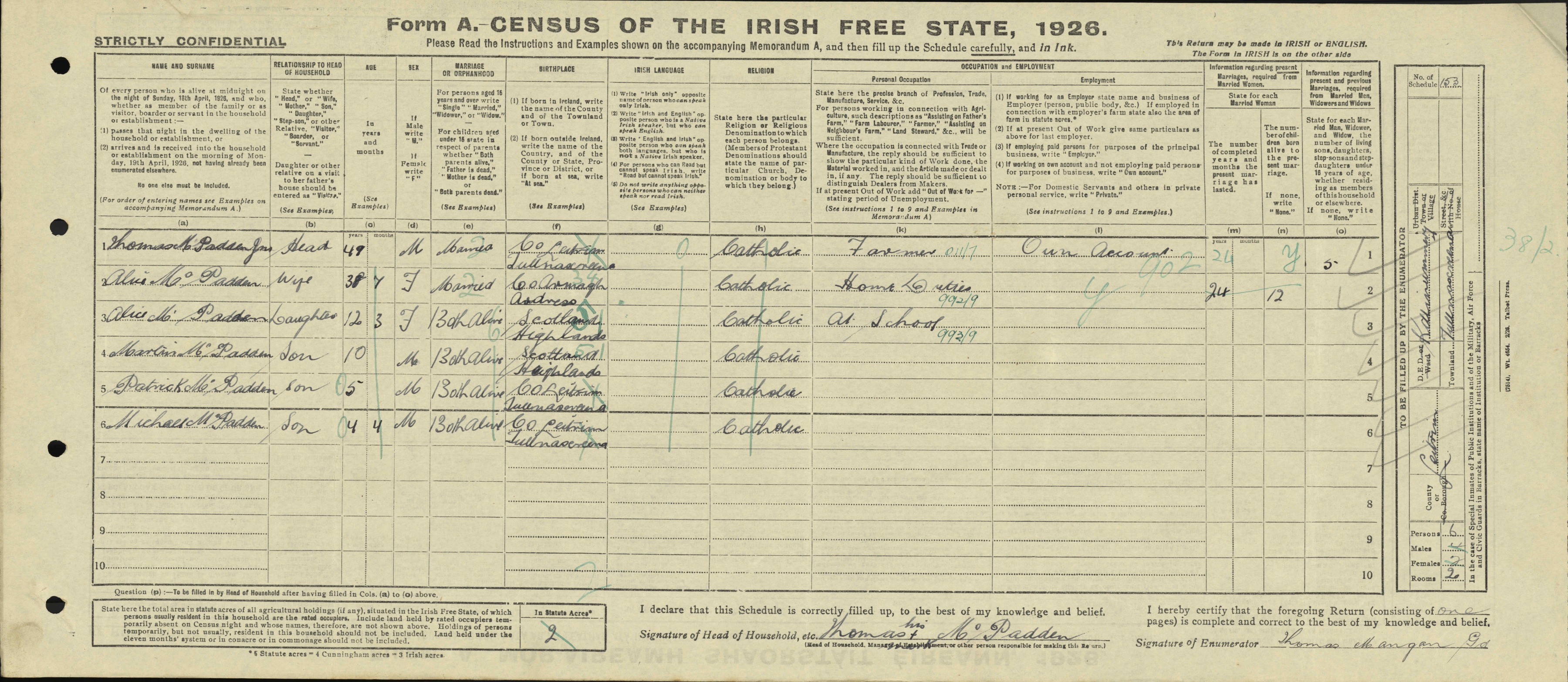
Thomas and Alice. Their daughter Alice. Their sons Martin, Patrick and Michael. The return brings them together at Tullynascreen on one particular night.
Choose a name to follow the person behind the entry.
Father · Head of household
ThomasMcPadden
Age entered in the return
49
Birthplace entered
County Leitrim
Occupation entered
Farmer · Own account
The quarryman. The soldier. Now a farmer.
Thomas is recorded at Tullynascreen, his birthplace, working on his own account as a farmer. At forty-nine, he appears here in a different working life from the quarry and army records.
“Own account” describes his work, not ownership of the land. His December 1876 birth agrees with the age of 49 on census night.
1926 census · Form A · Schedule 153 · SRC-050 Birth and marriage correlations explained below
Project typography from the held return, not a facsimile. Ages are reported readings; an asterisk marks a conflict or provisional reading.
Read the original · 1926 household return
Six lives, in their own record.
Open the household return behind this chapter. The names are on the page; the gaps and conflicting details remain part of the evidence.
Complete preserved image · no highlights added
Choose a detail, then zoom to read the handwriting. Swipe or scroll within an enlarged image; keyboard users can focus the image and use the arrow keys. The record itself does not animate.
Project reading · separate from the original
Start with the whole page.
Select a detail above for a reading of the relevant columns and the limits of what they tell us. These notes are selected readings, not a complete transcription.
National Archives of Ireland · 1926 Census · CC BY 4.0.
This work includes content from records of the 1926 Census of Ireland, made available by the National Archives of Ireland under the Creative Commons Attribution 4.0 International (CC BY 4.0) licence. Please see further: the formal National Archives reuse notice and the archive record.
SRC-050 · National Archives of Ireland, Census 1926, Form A, schedule 153, McPadden household, Tullynascreena, Killanummery DED, County Leitrim, 18 April 1926. Archive person a_id=1132478; image Tullynascreena_2477_0014_0012_0_00023.pdf. Official PDF verified byte-identical to the preserved copy on 22 October 2026. Schedule number is not a parcel identifier.
JPEG reading copy rendered from the official PDF; no retouching or recolouring. Selected viewing windows and separate project reading notes are additions, not marks on the original. The unchanged archive PDF is also available.
The National Archives of Ireland authorises reuse of 1926 census images and data under CC BY 4.0, including sharing and adaptation with attribution and changes identified. No individual permission request is needed. The census licence does not apply to the Scottish register or other project sources. No archive endorsement is implied.
Small numbers, with whole lives behind them. These are the return’s entries—not a floor plan, a measure of happiness, or proof of ownership.
6
People listed
Two parents and four children in this household. Not everyone ever born into the family.
2
Rooms entered
The summary records two rooms. It does not show their arrangement, furnishings or sleeping places.
2
Statute acres reported
The agricultural holding is recorded in standard acres. It is not a title deed, a surveyed boundary or a statement that Thomas owned it.
What work looks like on the page
“Farmer.” “Home duties.”
These are the occupations entered for Thomas and Alice in 1926. Earlier records had shown an engine-works labourer and a soap boiler, then quarry work and military service. Here the census records farming and home duties.
Those few words are not a complete account of either life. They tell us how work was recorded that night, not how the family divided its days or made ends meet.
Quoted occupation entries, typeset by the project. No household income or daily routine inferred.
The question carried over from chapter 6
Two acres. But whose ground?
The census gives the household an acreage. It does not give us the missing link to Mary’s holding.
A dated household, with a reported two-acre agricultural holding.
What we cannot yet join
The household and Mary’s parcel.
Similar acreages and the later valuation name Thomas McFadden are clues—not an identified person-and-boundary match.
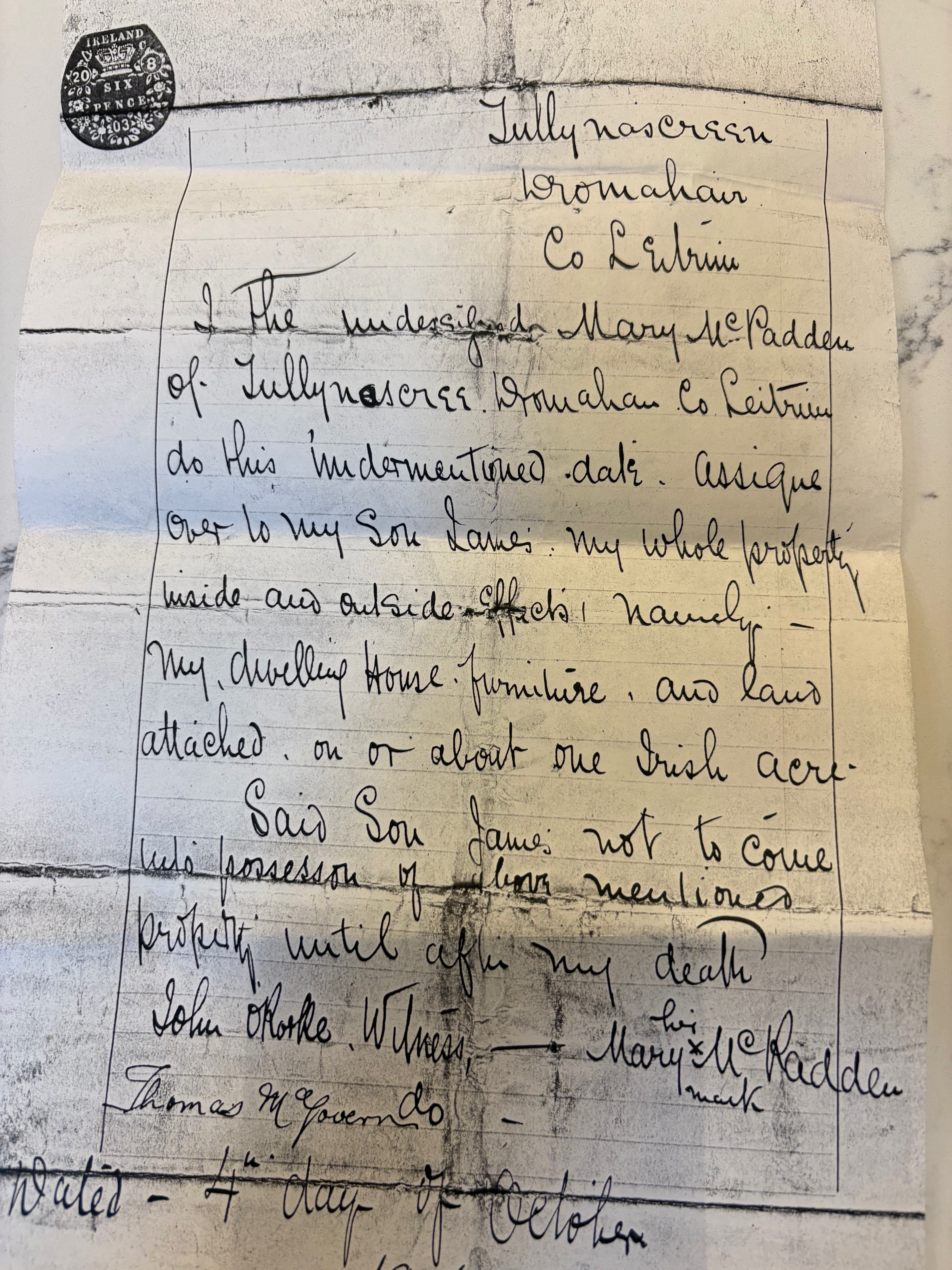
Mary’s 1904 document names her son James, not Thomas. Neither this census nor the folios reviewed so far establishes that Thomas inherited her land. We also do not know whether Mary was alive when the family returned.
A census is a moment, not the whole family
Who is on the page. Who is still out of view.
Four children are listed here. But we already have a birth record for another son, Thomas, born at Bonawe in 1908, and the death record of the infant Patrick in 1917.
Thomas junior is not listed in this household. That does not tell us where he was, or establish whether he was alive or dead. The infant Patrick and the younger Patrick listed here are different children.
Why the children’s totals need careful reading
Our working reading of Alice’s row is 12 children born alive to the present marriage. That is not a count of surviving children. A separate entry of 5 for living children under 16 appears on Thomas’s row; that column can include children residing elsewhere.
Four children are individually listed here. The totals are a reason to keep researching—not permission to invent additional children, assign an identity to an absent child or assume that all twelve survived.
Beyond the census
The page ends. Their lives do not.
The reported later return to Scotland is the next thread to follow. For now, this return gives us a firm place to stand: Thomas, Alice and four children at Tullynascreen in April 1926.
1926 Census of the Irish Free State, census night 18 April 1926, Form A, schedule 153, Tullynascreen, Dromahair, County Leitrim: Thomas and Alice McPadden’s household (held source SRC-050). The preserved image was checked against the project transcription. It lists Thomas, Alice his wife, Alice their daughter, Martin, Patrick and Michael; six persons, two rooms and an agricultural holding of two statute acres.
Schedule 153 is a census identifier, not a land-parcel number. “Own account” belongs to Thomas’s employment entry, not a statement of land ownership. The original census can now be explored above, separately from our typeset readings, with its National Archives credit and CC BY 4.0 terms. Other records have their own image-review status.
Ages, names and conflicting entries
Thomas reads 49, consistent with his 11 December 1876 birth, not the earlier project reading of 48. Michael reads 4 years 4 months, not four months. Wife Alice’s age is provisionally read as 38 years 7 months; this conflicts with age 21 at her 26 October 1900 marriage. Her County Armagh birthplace is clear, while Ardmore remains a working locality reading.
Daughter Alice’s reported age of 12 years 3 months differs from her 2 December 1912 birth registration; Patrick’s reported 5 differs from his 3 March 1920 birth. Birth registrations remain the stronger birth-date anchors. The reported 24 completed years of marriage also differs from the approximately 25 years 6 months since October 1900. We do not replace the marriage date or invent a second couple to resolve these discrepancies.
Correlations use the 1900 Kinning Park marriage (644/14/331); Muckairn births for Thomas, 1908 (529/18), Alice, 1912 (529/28), and Martin, 1915 (529/20); and Dromahaire civil births for Patrick, 1920 (page 202, entry 426, SRC-062/063), and Michael Stephen, 1921 (page 87, entry 90, SRC-060/061). The two Patricks and the two Alices are kept distinct.
Why Mary’s land remains an open question
Mary’s document of 4 October 1904 (SRC-041/042) names James as the intended beneficiary of her house, effects and about one Irish acre after her death. The valuation material tracks a holding of 1 acre 3 roods 29 perches, approximately 1.93 statute acres; a 1931 revision names Thomas McFadden. We have not established that this was Alice’s husband or connected the census household to the parcel boundaries.
The folios already held have been consulted privately. Close areas are compatible with the hypothesis but do not prove it. Rated occupation, census residence and legal ownership are different kinds of evidence. Mary’s death remains unresolved; neither a valuation revision nor a continuing registry entry supplies it. Modern owner details and title plans are not shown.
Illustration and interpretation limits
The opening is an AI-generated illustration made for this chapter, not a photograph, Thomas and Alice’s home, Mary’s land or a reconstruction of census night. Its room, furniture, lamp, window view and lighting are imagined. No family member is depicted, and it makes no claim about their possessions, living conditions or feelings.
The image is displayed with cropping, shading and optional slow pan/zoom. Shared Reading preferences, Pause motion and reduced-motion support remain available. Illustration provenance note.
The documentary trail
Follow the records.
The registers, returns and papers behind this chapter. Open a card for its evidence and limits, or follow it into the Research Library.
These are record summaries, not recreated documents. The marriage, three Scottish birth entries and census have original-record views with their own reuse terms. Other scans remain private where clearance or identification is unresolved. Family-history leads are labeled separately.
Civil registration · 26 October 1900Thomas McFadyen and Alice Hendry’s marriageOriginal image available · read & explore +
Thomas, 23, an engine-works labourer, with an address provisionally read as 17 Vulcan Street, Kinning Park; street identification unresolved. Alice, 21, a soap boiler of 55 West Scotland Street. Thomas’s parents are Michael, deceased, and Mary Conlon; Alice’s parents are Hugh Hendry and Elizabeth, formerly Treanor (working reading).
What this does not establishThe entry does not explain how they met or when either arrived in Scotland. Alice’s recorded age conflicts with the later census; her mother’s maiden surname remains a qualified reading.
SRC-052 · National Records of Scotland, statutory marriages, Kinning Park, 1900, 644/14/331, entry 331, page 166. Preserved Scotland’s People viewer copy. Page number corrected from 168 after image review, 22 October 2026.
Original record available · source-specific reuse terms
A son Thomas born to Thomas McFadyen and Alice, maiden surname Henry; the entry records their marriage as 26 October 1900 in Glasgow.
What this does not establishThis is the son, not his father. It conflicts with the June 1909 birth notation in the school-register lead; it does not establish a family arrival date at Bonawe.
SRC-530 · National Records of Scotland, statutory births, Muckairn, Argyll, 1908, 529/18, page 6, entry 18. Original Scotland’s People JPEG; downloaded 21 October 2026 UTC.
Original record available · source-specific reuse terms
Alice born to Thomas McFadyen, quarry labourer, and Alice Hendry. The register repeats the parents’ October 1900 marriage.
What this does not establishThe child and her mother are different Alices. This birth does not verify the daughter’s reported 1932 marriage or her parents’ later residence.
SRC-055 · National Records of Scotland, statutory births, Muckairn, Argyll, 1912, 529/28, page 10, entry 28. Preserved Scotland’s People image in PDF.
Original record available · source-specific reuse terms
Martin’s parents, Thomas McFadyen and Alice Hendry, their marriage date, and Thomas’s occupation as quarry labourer, “now in Territorial Force”. Registered 24 May 1915.
What this does not establishThe words document military involvement, not a campaign, battle or departure date.
SRC-529 · National Records of Scotland, statutory births, Muckairn, Argyll, 1915, 529/20, page 7, entry 20. Original Scotland’s People JPEG; downloaded 21 October 2026 UTC.
Original record available · source-specific reuse terms
Civil registration · 3 March 1920The younger Patrick’s birth at TullynascreenRead the record summary +
Patrick born to Thomas McFadyen, farm labourer, and Alice formerly Henry. Thomas was the informant; registered 5 March.
What this does not establishThis is a different son from the infant who died in 1917. The birth establishes a dated Irish family presence, not the crossing date or a reason for reusing the name.
SRC-062, Irish civil births, Dromahaire district, Manorhamilton registration area, 1920, page 202, entry 426; Patrick McFadyen. Original image acquired from IrishGenealogy. SRC-063 is the project transcription, not a second independent record.
Original preserved privately · image reuse not yet cleared
Civil registration · 25 December 1921Michael Stephen’s birth at TullynascreenRead the record summary +
Michael Stephen born to Thomas McFadyen, quarry man, and Alice formerly Hendry; Thomas was the informant. Registered 9 January 1922.
What this does not establishThe occupation does not identify a particular quarry. The birth helps interpret the census age but does not date the family’s return journey.
SRC-060, Irish civil births, Dromahaire district, Manorhamilton registration area, page 87, entry 90; Michael Stephen McFadyen, born 25 December 1921, registered 9 January 1922. Original from IrishGenealogy; SRC-061 is the project transcription.
Original preserved privately · image reuse not yet cleared
Thomas, Alice and four resident children; six people, two rooms and two statute acres. Thomas is 49 and farming on his own account. Michael reads four years four months, not four months.
What this does not establishCensus ages and marriage duration conflict with some civil entries. Twelve children born alive is not twelve surviving children; five under sixteen is not the four children at home. Own-account farming is not proof of land ownership, and schedule 153 is not a parcel number.
SRC-050 · National Archives of Ireland, Census 1926, Form A, schedule 153, McPadden household, Tullynascreena, Killanummery DED, County Leitrim, 18 April 1926. Archive person a_id=1132478; image Tullynascreena_2477_0014_0012_0_00023.pdf. Official PDF verified byte-identical to the preserved copy on 22 October 2026. Schedule number is not a parcel identifier.
Original record available · source-specific reuse terms
Land research · 1904; 1926; 1931 revisionMary’s holding and Thomas’s household — an unfinished comparisonRead the record summary +
Mary’s family-held page names James and about one Irish acre. The historical valuation holding 30Ca/30D measures 1 acre 3 roods 29 perches (about 1.93 statute acres); a 1931 revision names Thomas McFadden. The separate 1926 household reports two statute acres.
What this does not establishNeither similar areas nor a repeated name identifies that rated occupier as Alice’s husband. Valuation, census and registered title describe different things. Held folios do not yet prove this household occupied Mary’s parcel, that Thomas inherited it, or when Mary died.
Comparison of Mary’s family-held 4 October 1904 page (SRC-041/042); held Tullynascreen valuation revisions for historical holding 30Ca/30D, including 1931 change; and 1926 household return (SRC-050). Acquired land folios consulted privately. This is a project comparison, not a new original record; a full publication-ready valuation citation remains pending.
Project comparison · underlying copies and modern land-title material withheld
A family memory or a document with a name, date or place could help us follow Thomas and Alice further.
What became of the children?
Later records for Thomas junior, Alice, Martin, Patrick or Michael Stephen could help follow this family beyond 1926. Do you know of other children of Thomas and Alice? Please distinguish a dated record from a family memory, and keep living people’s details private.
Email opens a private conversation with Ed. Please keep living people’s personal details out of your first message. We will discuss permission and credit before sharing anything on the site.