The records do not take us all the way. That is where another family’s knowledge may begin.
AI-generated illustration · Imagined coast Not their route or a known family address.
Where the record gives way to a lead
One firm anchor. Two threads to follow.
We leave the family at Tullynascreen in April 1926. Beyond that night, family research points toward Scotland again. The next two dates are leads, not established milestones.
Choose a date to see what supports it—and what remains open.
Documented household
A place we can put our finger on.
The census lists Thomas and Alice with their daughter Alice and their sons Martin, Patrick and Michael at Tullynascreen. Six people, two rooms, and an agricultural holding reported as two statute acres.
1926 Census of the Irish Free State · Form A · Schedule 153 · SRC-050
What this does not establish
It records this household on census night—not how long they stayed afterward. It does not establish that the holding was Mary’s land.
What could help next
A later dated address would begin to bridge the gap beyond this return.
Solid border: a held contemporary record. Dashed borders: reported leads awaiting verification. This is an evidence sequence, not a confirmed itinerary.
Both lives belong in the story
Tommy the Soldier. Alice, too.
Thomas is remembered by a name that carries a story: Tommy the Soldier. Alice appears through quieter entries—the soap boiler at Kinning Park, the mother present with Patrick in Glasgow, the woman listed with her family at Tullynascreen.
Neither life ends with the last record we have found. The children have stories beyond these pages too. A later address or a remembered name may be the first step toward bringing one of those lives into view.
Their later addresses and deaths remain unresolved. We have not attached same-name records without identifying family evidence.
Between two homes · Tullynascreen
Ireland was not just the place they left.
It was the place they came back to. Where children were born. Where a family made a home again.
Whatever the later records reveal, the Tullynascreen years belong at the heart of this story—not in the space between two departures.
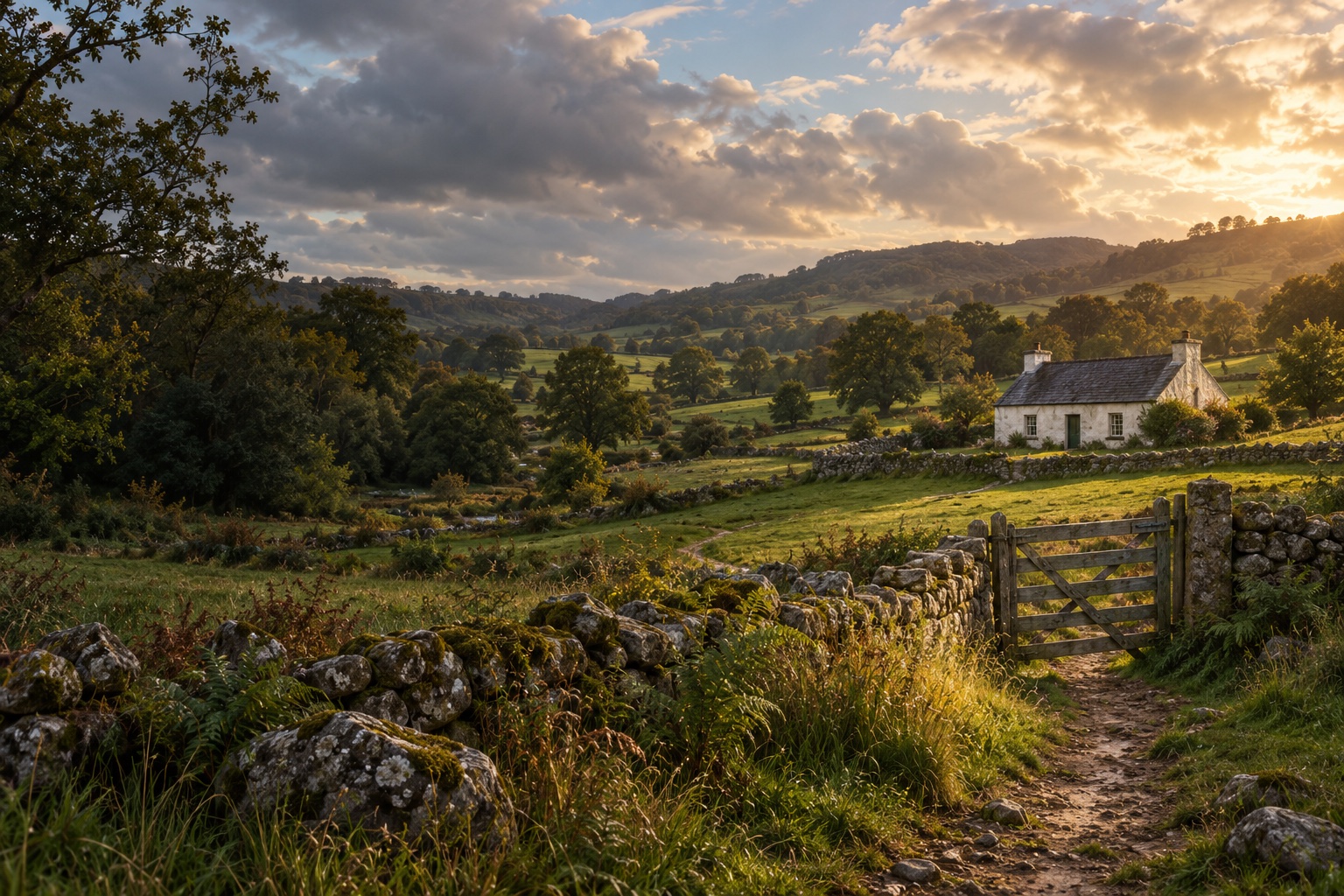
AI-generated illustration · An imagined rural Irish home. Not their house, Tullynascreen as recorded, or Mary’s land. Image note
The landscape is imagined. These dates are documented.
Three dated records—not proof of uninterrupted residence, the same house throughout, or a connection to Mary’s holding. The later return to Scotland remains a reported lead.
An open ending · An invitation
Your family may hold the next part.
A name on the back of a photograph. A letter kept in a drawer. A story told at home. You do not need a finished family tree to help.
Tell us what you know, who it concerns and where it came from. A memory is welcome as a memory; we will work carefully to connect it with the records.
The held 1926 census (SRC-050), Form A, schedule 153, establishes Thomas and Alice’s household at Tullynascreen on 18 April. It is not evidence of their residence in 1928. The later return to Scotland around 1928 comes through family correspondence reported in Anne Burgess’s research, preserved as the project’s SRC-054 lead. The underlying correspondence is a derivative source here; a directly inspected crossing record or later address has not established that journey.
The similar acreage of Mary’s holding remains a separate unresolved question. Neither the reported Scottish return nor the 1926 census proves that Thomas inherited Mary’s land.
Why the 1932 marriage remains a question
The July and October 2026 versions of Anne’s family-history report give a marriage of daughter Alice McPadden to Patrick Joseph Mullaney on 23 September 1932 in Glasgow. These are two versions of a compilation, not two independent records. We have not inspected an original marriage entry or established its district reference.
Daughter Alice’s 2 December 1912 birth at Bonawe is independently documented by the Muckairn registration, 529/28 (SRC-055). That confirmed birth does not itself verify the reported marriage. Even a matching marriage would need careful reading: a daughter’s address is not automatically her parents’ address, and it would not date a 1928 crossing.
What remains private—and what this illustration means
Private correspondence, paid record images, living people’s details and modern land-title information are not reproduced in this chapter. Its historical summaries keep source facts, family reports and open questions distinct. Any newly contributed material will be discussed for permission and credit before publication.
The coastal opening is an AI-generated imagined landscape, not a photograph, a known crossing, an identified family address or Mary’s land. No route, weather, transport, travel companions or feelings can be inferred from it. Display shading, cropping and optional slow pan/zoom are applied; shared Reading controls and reduced-motion support remain available. Illustration provenance note.
The documentary trail
Follow the records.
The registers, returns and papers behind this chapter. Open a card for its evidence and limits, or follow it into the Research Library.
These are record summaries, not recreated documents. The marriage, three Scottish birth entries and census have original-record views with their own reuse terms. Other scans remain private where clearance or identification is unresolved. Family-history leads are labeled separately.
Civil registration · 2 December 1912Daughter Alice’s birth at Bonawe QuarriesOriginal image available · read & explore +
Alice born to Thomas McFadyen, quarry labourer, and Alice Hendry. The register repeats the parents’ October 1900 marriage.
What this does not establishThe child and her mother are different Alices. This birth does not verify the daughter’s reported 1932 marriage or her parents’ later residence.
SRC-055 · National Records of Scotland, statutory births, Muckairn, Argyll, 1912, 529/28, page 10, entry 28. Preserved Scotland’s People image in PDF.
Original record available · source-specific reuse terms
Thomas, Alice and four resident children; six people, two rooms and two statute acres. Thomas is 49 and farming on his own account. Michael reads four years four months, not four months.
What this does not establishCensus ages and marriage duration conflict with some civil entries. Twelve children born alive is not twelve surviving children; five under sixteen is not the four children at home. Own-account farming is not proof of land ownership, and schedule 153 is not a parcel number.
SRC-050 · National Archives of Ireland, Census 1926, Form A, schedule 153, McPadden household, Tullynascreena, Killanummery DED, County Leitrim, 18 April 1926. Archive person a_id=1132478; image Tullynascreena_2477_0014_0012_0_00023.pdf. Official PDF verified byte-identical to the preserved copy on 22 October 2026. Schedule number is not a parcel identifier.
Original record available · source-specific reuse terms
Family-history lead · c.1928, reportedA return to Scotland around 1928 — family-history leadRead the record summary +
Anne Burgess’s research preserves a reported later return to Scotland, through a family-correspondence account.
What this does not establishThis is a derivative family-history lead, not an inspected travel record or confirmed later address. It does not establish who travelled together, a motive or an exact year.
SRC-054, project provenance note for the Thomas McPadden leads in Anne Burgess’s research, including her reported family-correspondence account of a return around 1928. Underlying correspondence retained privately.
Private research compilation · underlying event still to be verified
Family-history lead · 23 September 1932, reportedDaughter Alice’s reported Glasgow marriage — unverifiedRead the record summary +
Anne Burgess’s July and October 2026 report versions give daughter Alice McPadden’s marriage to Patrick Joseph Mullaney on this date in Glasgow.
What this does not establishThe original marriage entry has not been inspected and its district reference is not established. Two report versions are not independent corroboration. SRC-055 confirms her birth, not this marriage; her address would not automatically locate her parents.
Anne Burgess family-history report compilations, July and October 2026 versions, daughter Alice McPadden and Patrick Joseph Mullaney marriage lead. Compare independently inspected birth SRC-055. Original 1932 marriage registration still sought.
Private research compilation · underlying event still to be verified
A family memory or a document with a name, date or place could help us follow Thomas and Alice further.
Where did Thomas and Alice live after 1926?
A later address, letter, death or burial record could help trace their lives and test the reported return to Scotland around 1928. A memory is welcome too—please tell us who it concerns, the approximate date and where the information came from.
Do you recognise Alice McPadden and Patrick Joseph Mullaney?
Family-history reports give a marriage in Glasgow on 23 September 1932 for Thomas and Alice’s daughter, born at Bonawe in 1912. We have not yet seen the marriage entry. A copy or reference could help verify it. This is daughter Alice, not her mother Alice Hendry; the reported marriage does not establish her parents’ whereabouts.
Email opens a private conversation with Ed. Please keep living people’s personal details out of your first message. We will discuss permission and credit before sharing anything on the site.