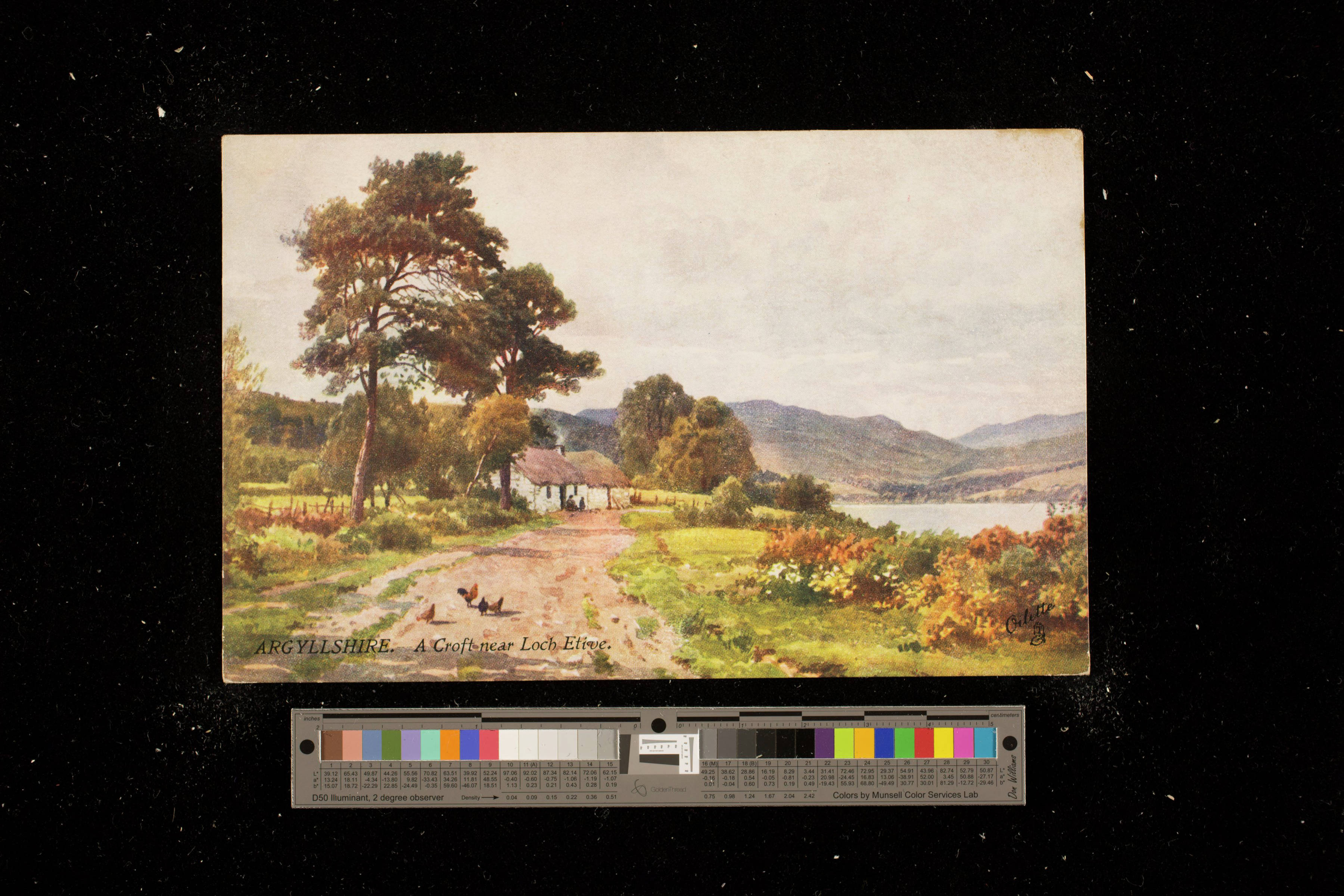
A Croft near Loch Etive · Early-1900s illustrated postcard · Newberry LibraryRegional context—not their home, the quarry or a photograph.
After the Glasgow marriage · A later move, date unknown
Beyond the city. Toward a home in Argyll.
Their marriage places them in Glasgow in 1900. A son’s birth places the family at Bonawe Quarries in 1908. Between those records is a move whose date and route we have not recovered.
This is a separate, later movement—not the last leg of Thomas’s first crossing from Ireland. Stay for the three-stage exploration, or continue straight to the children’s records.
A possible journey, not a recovered itinerary.Three stages of exploration, not three confirmed legs. The railway and ferry are period possibilities, not the family’s identified connections. The Irish crossing and the move to Argyll are not one continuous trip.
Later geographic sketch · Glasgow → Taynuilt≈ 90 miles / 150 km
Map-sketch scale, not track mileage. A real 1897 train example took 4 hr 6 min; local approach additional.
These are approximate model distances, dominated by our hand-drawn sea and Scottish route sketches—not recovered travel mileages. They must not be added into one continuous travel day. See the measurements and assumptions.
Glasgow · Loch Etive · BonaweGlasgow → Taynuilt · later movement
Recorded place Example connectionLinks are sketches, not roads, rails or sailing tracks.
Journey exploration1 / 3 stages
Motion paused · All geographic links shown.
01 / A possible train · via Callander and Crianlarich
The moving date is not known
Another journey. Toward the Highlands.
From a summer timetable · 1897
7:15Glasgow Buchanan St.11:21Taynuilt
Callander · Crianlarich · Dalmally
Period example—not an identified family journey
An 1897 guide lets us picture a different travel day: a morning departure from Glasgow Buchanan Street, through Callander and Crianlarich, reaching Taynuilt before noon. This is a period alternative—not today’s Glasgow–Oban routing or journey time.
Distance
≈ 90 miles / 150 km on the sketchCoarse links through period route places; not railway track mileage
A real period service—not the family’s identified train
The guide supplies an advertised service, not proof that Thomas and Alice used it. Their move could have happened years after the marriage. Sketch mileage and timetable time come from different methods; one was not calculated from the other.
02 / On foot · a possible ferry · a final local approach
The last connections still need research
The railway was not the doorstep either.
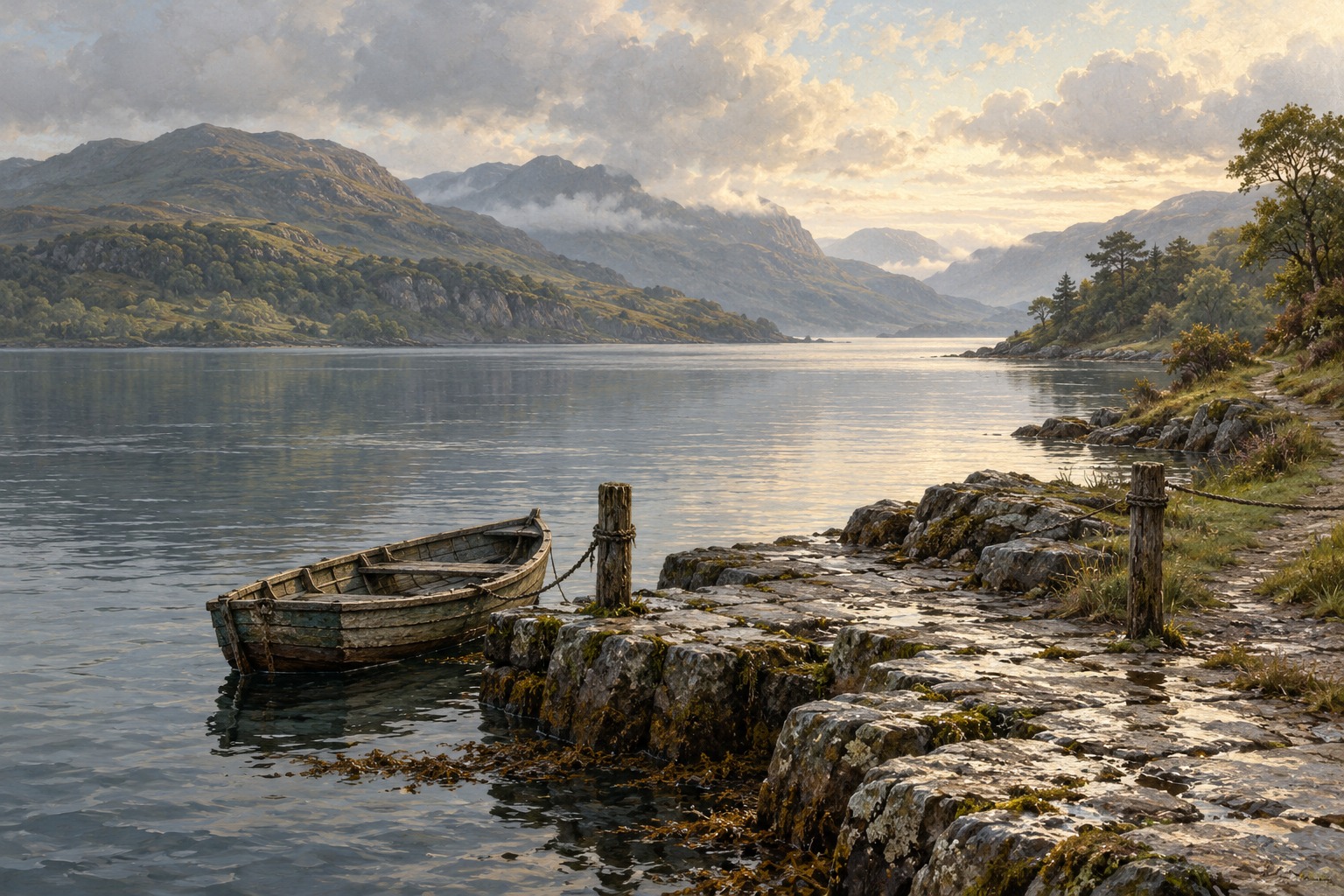
The last local connection · AI-generated illustration
An imagined Scottish loch-side landing around 1900. Not Bonawe’s identified pier, the family’s ferry or a recovered view of their route.
Built-in OpenAI image generation without a reference image. Responsive crop and gentle pan; invented atmosphere, not a historical record. Reuse statement.
The 1897 guide places Bonawe pier less than a mile from Taynuilt station and records a ferry across Loch Etive. A rail-and-ferry approach is worth exploring: reaching the pier, crossing the water and finding the family dwelling were separate tasks.
Distance
Pier walk: under 1 mile / 1.6 km1897 guide’s station-to-pier description; not the whole final approach
Time
Walk: under ≈ 20 min at an assumed 3 mphFerry wait, crossing and onward approach are not yet timed
Period ferry context, not a family itinerary
The south-shore furnace area is not the quarry settlement across the loch. The family’s landing, ferry, exact house and arrival date remain unresolved. The illustration evokes a local connection; it does not reconstruct the actual pier, ferry or family route.
03 / Back to a dated family record
31at his son’s birth · 29 July 1908
Thirty-one. A family at Bonawe.
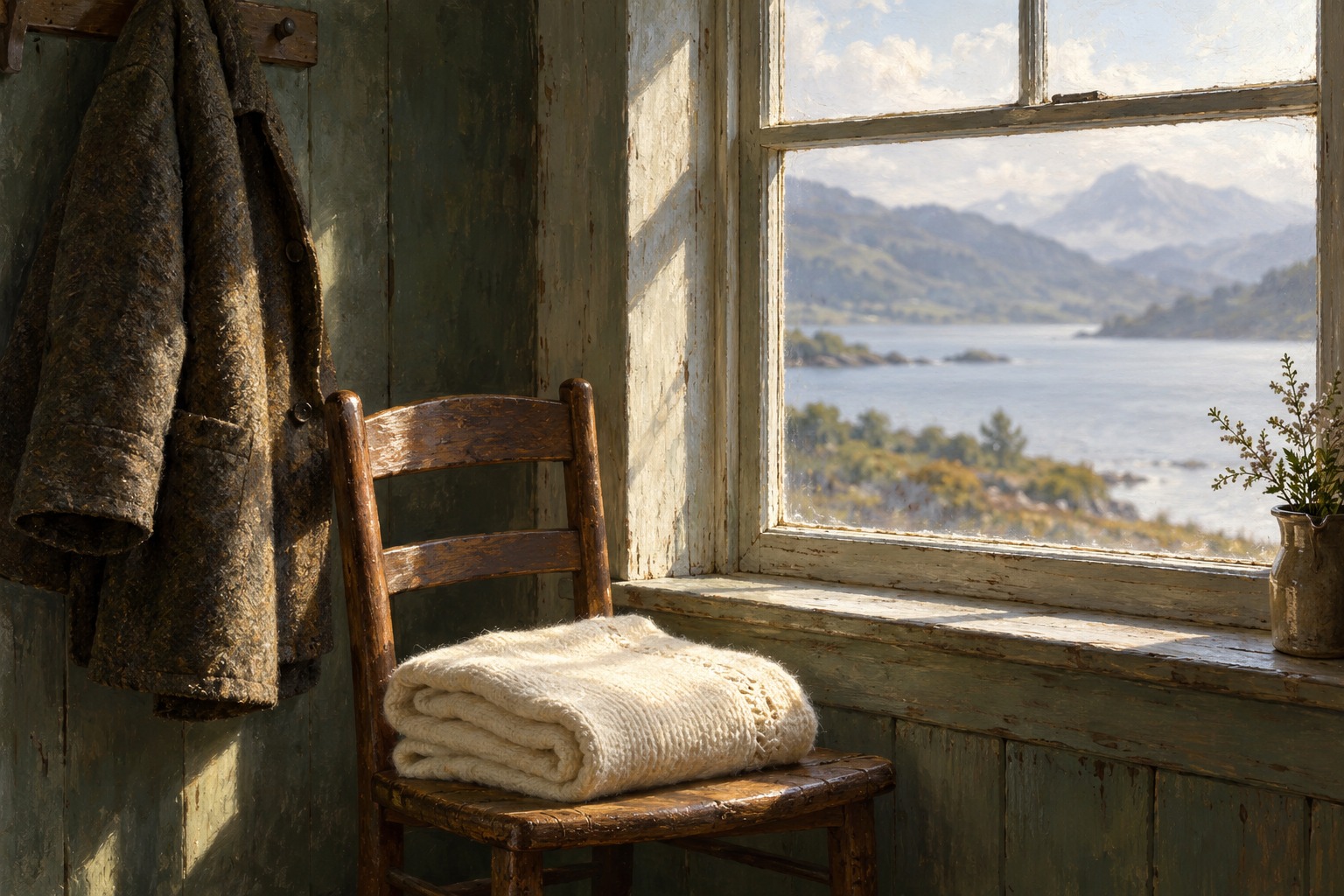
A working life. A growing family. · AI-generated illustration
A symbolic vignette beside a documented birth. The home, clothes, blanket and window view are imagined—not evidence of the family’s possessions or living conditions.
Built-in OpenAI image generation without a reference image. No family member depicted. Responsive crop and gentle pan; invented atmosphere, not a historical record. Reuse statement.
Their son Thomas was born at Bonawe Quarries on 29 July 1908. His father was 31. Between the known addresses lie roads, working ports, possible trains and boats—and years of life we are still piecing together.
Two movements—not one journeyIrish example ≈ 550 km; later Scottish sketch ≈ 150 km, with local gaps
Time
No known end-to-end travel timeThe family records span years, not a continuous journey
Documented milestone
This is his age at his son’s birth, not a known arrival age. The distances help us feel the scale of an example; they do not recover the family’s actual travel.
What supports the images, distances and times?
Thomas’s 11 December 1876 birth, 26 October 1900 marriage and his son’s 29 July 1908 birth anchor the places and ages. We do not have a departure date, ticket, chosen Irish port, confirmed ship, Scottish train or exact local approach.
The project’s public-road comparison: about 5.6 km / 3.5 miles, excluding private approach and station entrance. Modern OSM geometry; period alignment incompletely validated. The earlier James study does not establish Thomas’s use of the same road.
Mackay’s Complete Tourists’ Guide to Oban (1897): printed p.128, July–September arrivals table, Glasgow Buchanan Street 7:15 a.m. to Taynuilt 11:21 a.m.; printed p.81 describes the station–pier distance and a Bonawe ferry. Original page images checked, not merely OCR columns. The guide is not evidence that the family used these connections.
The coastline is generalized, public-domain Natural Earth geography, reused from the project’s existing source. Places are regional reference points, not private homes. The offshore corridor is hand-selected to illustrate a connection around northern Ireland, not recovered from a ship’s log or navigation chart. Other dotted links are geographic connections, not traced roads or railway alignments.
How the model is calculated. Road: 5.6 km from the existing road comparison. Irish rail: 15 miles × 1.609344. Sea: about 518 km measured along our hand-selected offshore sketch. Scotland: about 148 km between coarse route-place points via Stirling, Callander and Crianlarich. The last two are sketch lengths, not charted sea miles or traced railway mileage; changing the drawing changes those estimates. The displayed totals are deliberately rounded.
Time assumptions, not historical performance claims. Walk at 3 mph; cart at 3–4 mph; Irish train at an assumed 15–20 mph average; steamer at an assumed 8–10 knots (1 knot = 1.852 km/h). Distance divided by speed gives running time only. These chosen speeds are not evidence about Thomas’s vehicles. The Scottish 4 hr 6 min comes independently from a real 1897 timetable. No departure date, fare, sailing calendar, port call, weather delay, ferry time or total elapsed time is established. Local transfers remain additional and unmeasured.
The Irish example is about 340 miles / 550 km in this model; the later Scottish sketch is about 90 miles / 150 km before its local approach. Do not combine them into one journey or one travel day. The progress bar measures the reader’s exploration only. Image captions distinguish historical views, later photographs and newly generated illustrations. None identifies Thomas, a ship he took or his house; the illustrations are atmosphere, not records.
A quarry address tells us more when we understand what the quarry supplied. Here is one connection: granite became shaped blocks for street paving. Extracting the rock, dividing it and finishing it required different work.
Follow the material · A simplified explanation
Project-drawn diagrams. Industry comparison, not a reconstruction of Bonawe’s machinery.
First, free the rock.
Writing about Scottish granite quarrying in 1869, David Bremner described blasting rock from the quarry face. It was the beginning of a sequence of different jobs, not a finished product.
An earlier Scottish industry comparison. It does not establish Bonawe’s exact equipment or Thomas’s duties in 1908–1915.
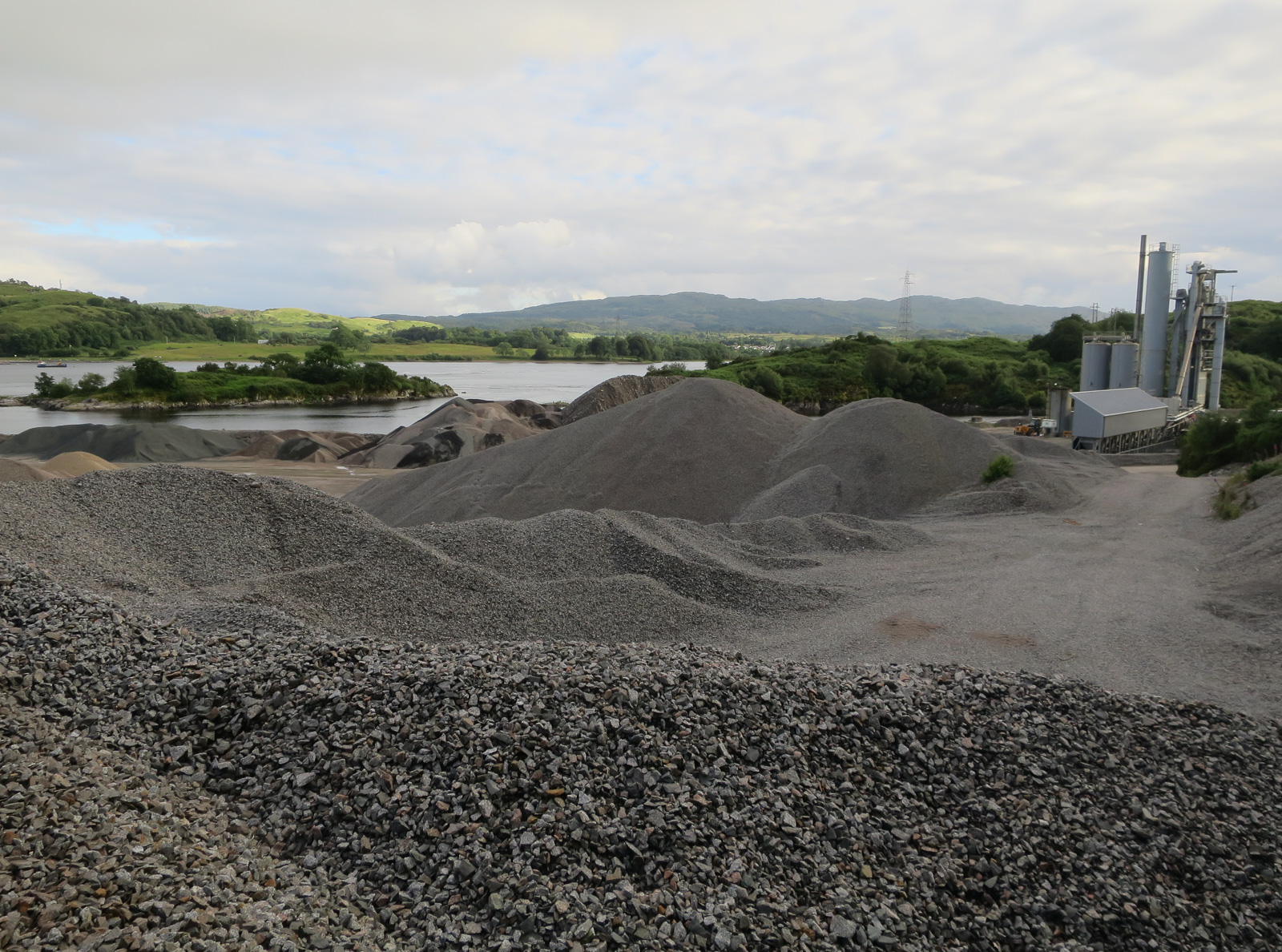
The quarry settlement and the historic iron furnace near Taynuilt are different industrial settings. The furnace made iron and ceased firing in the 1870s, before this family’s documented quarry years. Its charcoal workers, housing and routines cannot stand in for Thomas’s workplace.
The next records bring us back from the industry to the family: three births, each with its own date and names.
Bonawe Quarries · Three dated glimpses
A place becomes a family home.
Here, the quarry was part of the family’s address as well as Thomas’s working life. Three birth registrations bring their children into view.
From the birth registration
Thomas · 29 July 1908
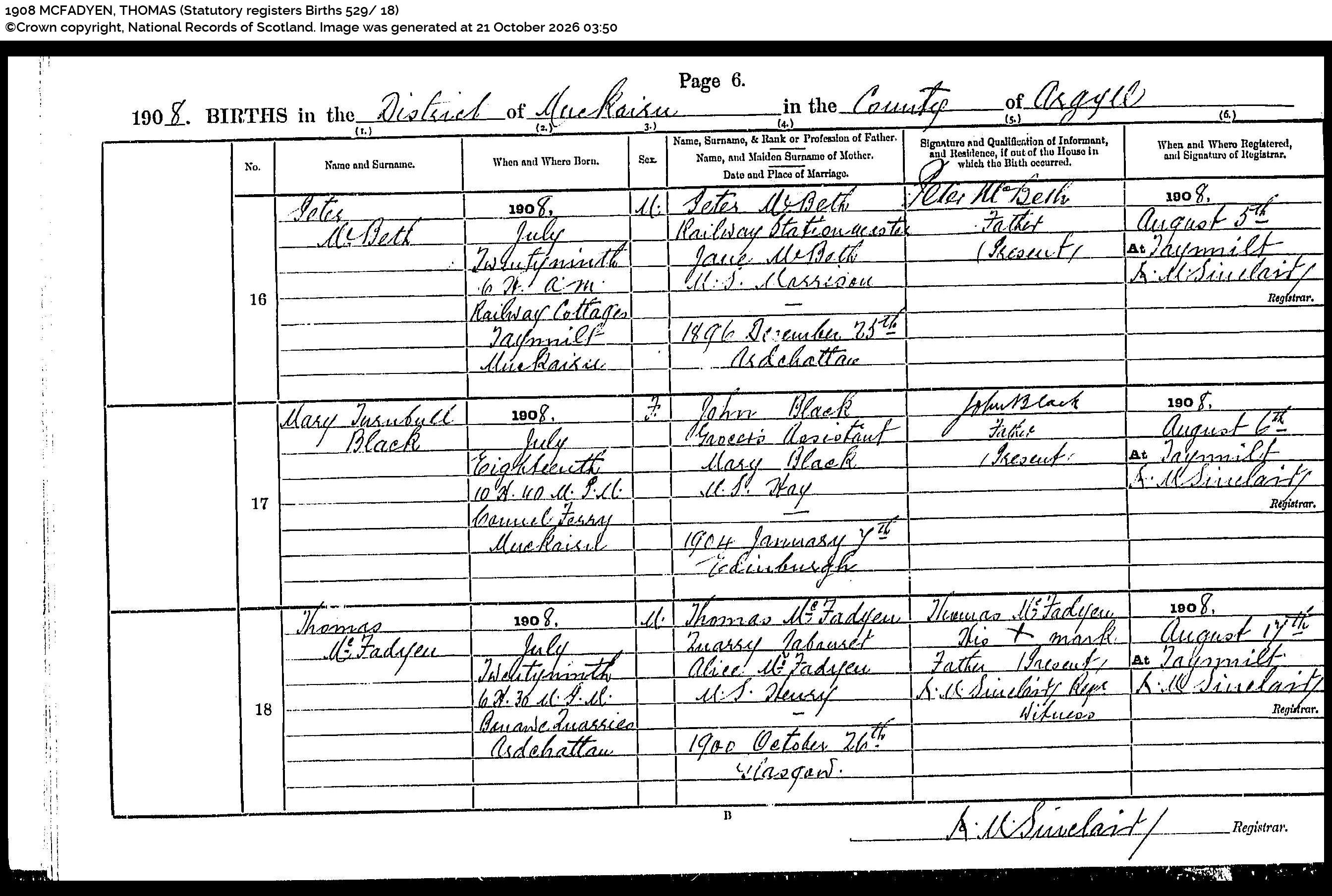
A son named Thomas was born at Bonawe Quarries. His birth registration names Thomas McFadyen and Alice, with her maiden surname written Henry, and gives their marriage as 26 October 1900.
This is Thomas junior, not his father. Alice’s maiden surname is written Hendry in the later birth records.National Records of Scotland · Statutory births · Muckairn, 1908 · 529/18 · entry 18, page 6
Read the original · 1908 birth register · Thomas junior
A son, and a place to call home.
The bottom entry places this family at Bonawe Quarries in July 1908. Thomas junior is the child; Thomas, the quarry labourer, is his father.
Selected viewing window · original lettering unchanged
Choose a detail, then zoom to read the handwriting. Swipe or scroll within an enlarged image; keyboard users can focus the image and use the arrow keys. The record itself does not animate.
Project reading · separate from the original
29 July 1908 · Bonawe Quarries
Entry 18 is Thomas junior’s birth, not his father’s. It places the family at Bonawe on this date, but does not establish when they arrived or uninterrupted residence afterwards.
SRC-530 · National Records of Scotland, statutory births, Muckairn, Argyll, 1908, 529/18, page 6, entry 18. Original Scotland’s People JPEG; downloaded 21 October 2026 UTC.
Unchanged original downloaded JPEG, including its NRS copyright header and neighbouring entries. Focus views alter the viewing window only. Project readings are separate; no lettering has been retouched, generated or recoloured.
Displayed under NRS’s published allowance for up to 20 NRS Crown-copyright images per website, with accurate reproduction and acknowledgment. Four distinct NRS register images are currently selected for this story: the marriage and three births. Repeated story/library views do not represent additional documents. No Creative Commons licence or unrestricted redistribution right is claimed; consult NRS for your intended reuse.
Three children we can place here, not a complete list of the family. These records give dated glimpses of home; they do not establish uninterrupted residence from 1908 to 1915.
Around the household · Work, home and company
More than a place to work.
Those birth registrations sit within the history of a settlement. Local historian Beth Morse’s account combines earlier records with later village and family memories. It helps explain the connections around a quarry household, without identifying this family’s rooms or routines.
A home tied to work
Morse dates two additional tenement blocks to 1910 and describes homes tied to quarry employment. Losing work could therefore threaten the roof overhead as well as the wage. We have not identified Thomas and Alice’s building or tenancy.
Local history · housing expansion, 1910
The company’s shop
Her account describes a company shop and bakehouse, with coal brought by company boats. That helps explain how dependence could extend beyond the workplace. These recollections span different decades; they are not this household’s shopping record.
Village recollections · dates vary
A reason to gather
Morse places a village hall near the ferry at about 1910 and recalls dances, whist and weddings. Work did not exhaust the life of the village. We cannot place Thomas or Alice at a particular gathering.
In Parliament, an MP challenged funding for an Episcopal school at Bonawe Quarries, arguing that a board school already had room for the children. The Lord Advocate confirmed the board had given notice of resignation over the issue; he did not settle the competing claims, saying correspondence was continuing.
The exchange shows that schooling involved public money, religious institutions and local disagreement. It predates the family’s documented years here and does not establish which school their children attended.
“Episcopal” here refers to a Scottish Anglican tradition, not the Roman Catholic Church in which Thomas and Alice married. A religious institution in a locality does not establish a family’s membership, worship or school choice.
We have not securely identified their Bonawe dwelling, parish attendance, children’s school, pay or working hours. Those questions need family-period records. The dated births remain the firm anchors, and in Martin’s entry the quarry and military worlds meet.
Martin’s birth registration · April 1915
Beside “quarry labourer”, something new appears.
“Now in Territorial Force.”
The quarry labourer had become a soldier too. The next chapter follows the surviving papers that connect this family to the man remembered as “Tommy the Soldier”.
Typeset quotation from the held birth transcription, not a facsimile of the register.
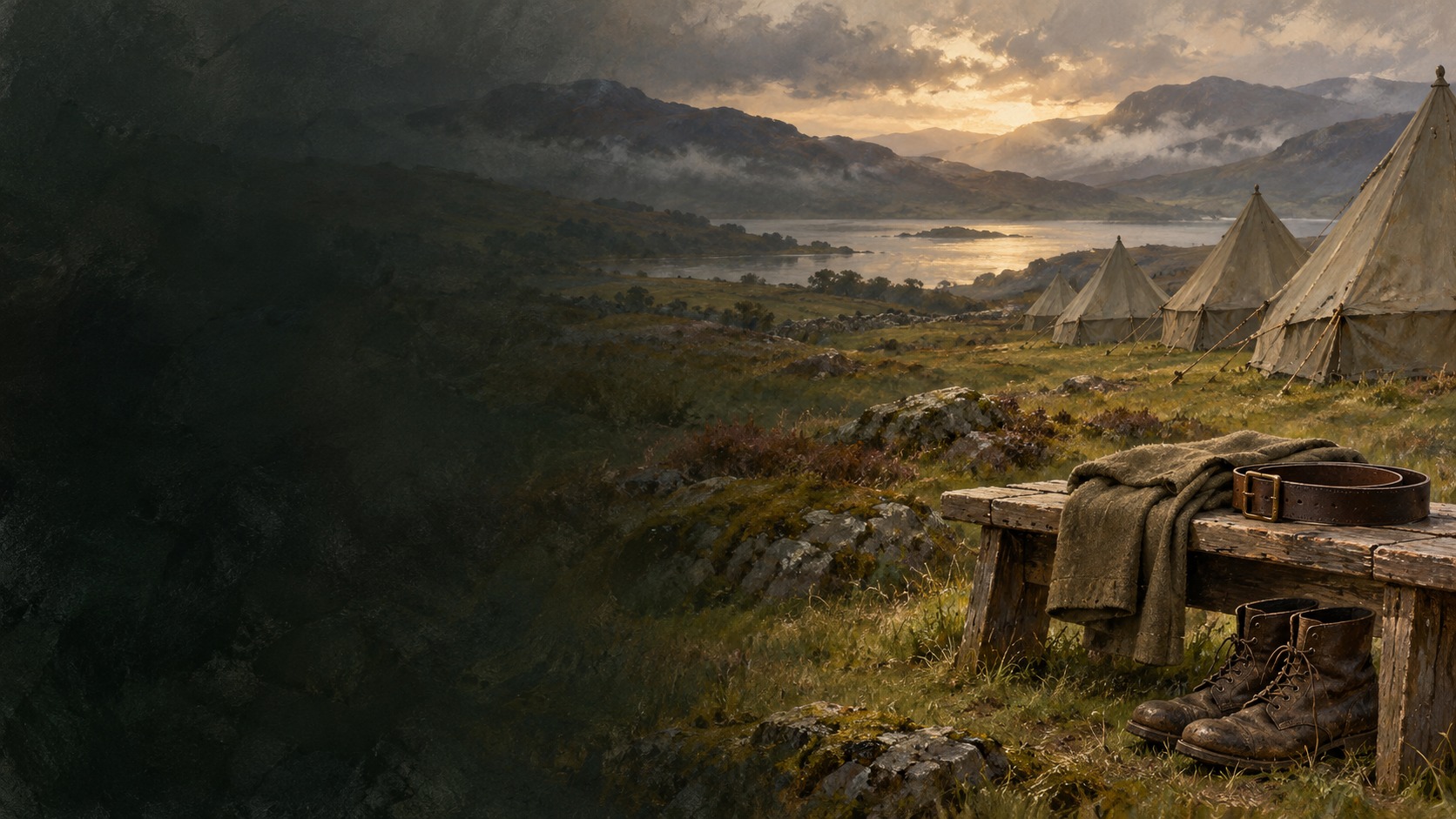
An imagined military camp—not Thomas’s identified camp, uniform, possessions or unit. The register establishes service in 1915; it does not locate him in this scene.
The people are documented. The landscape is context.
What connects the Bonawe records to this family?
The 1908, 1912 and 1915 birth registrations name Thomas and Alice and refer to the same 26 October 1900 marriage. Alice’s maiden surname is written Henry in 1908, Hendry in the later entries. The 1900 marriage identifies Thomas through his parents, Michael McPadden and Mary Conlon. Surname spelling alone is not the identification.
Explore the marriage in chapter 2, the three Scottish births in chapter 3, Martin’s military clue in chapter 4 and the census in chapter 7. All five originals are also in the Research Library. Other scans remain private where publication clearance or identification is unresolved.
Image, credit and reuse
Argyllshire. A Croft near Loch Etive, Raphael Tuck & Sons postcard, production no. 7345. Newberry Library, Leonard A. Lauder collection, image 442908. The catalogue groups it in 1900–1909; its exact publication year and artist are not established here. Wikimedia Commons identifies the image as public domain; the Newberry’s open-access policy imposes no library licensing fee. This is a historical illustration, not AI imagery or a photograph. The croft is not identified as Thomas and Alice’s home, and the image does not show Bonawe Quarries. View the complete, uncropped archive scan.
Display crops, shading and optional pan/zoom are applied to the opening image. No depicted objects in that source image were generated, removed or reconstructed. The source rights statement remains separate from the site’s writing.
The loch landing, family-life vignette and military camp further down this chapter are newly generated, period-inspired illustrations, not archival evidence. They do not identify the family’s pier, home, possessions, unit or service location. Illustration provenance, full prompts and limitations.
The documentary trail
Follow the records.
The registers, returns and papers behind this chapter. Open a card for its evidence and limits, or follow it into the Research Library.
These are record summaries, not recreated documents. The marriage, three Scottish birth entries and census have original-record views with their own reuse terms. Other scans remain private where clearance or identification is unresolved. Family-history leads are labeled separately.
Civil registration · 26 October 1900Thomas McFadyen and Alice Hendry’s marriageOriginal image available · read & explore +
Thomas, 23, an engine-works labourer, with an address provisionally read as 17 Vulcan Street, Kinning Park; street identification unresolved. Alice, 21, a soap boiler of 55 West Scotland Street. Thomas’s parents are Michael, deceased, and Mary Conlon; Alice’s parents are Hugh Hendry and Elizabeth, formerly Treanor (working reading).
What this does not establishThe entry does not explain how they met or when either arrived in Scotland. Alice’s recorded age conflicts with the later census; her mother’s maiden surname remains a qualified reading.
SRC-052 · National Records of Scotland, statutory marriages, Kinning Park, 1900, 644/14/331, entry 331, page 166. Preserved Scotland’s People viewer copy. Page number corrected from 168 after image review, 22 October 2026.
Original record available · source-specific reuse terms
A son Thomas born to Thomas McFadyen and Alice, maiden surname Henry; the entry records their marriage as 26 October 1900 in Glasgow.
What this does not establishThis is the son, not his father. It conflicts with the June 1909 birth notation in the school-register lead; it does not establish a family arrival date at Bonawe.
SRC-530 · National Records of Scotland, statutory births, Muckairn, Argyll, 1908, 529/18, page 6, entry 18. Original Scotland’s People JPEG; downloaded 21 October 2026 UTC.
Original record available · source-specific reuse terms
Alice born to Thomas McFadyen, quarry labourer, and Alice Hendry. The register repeats the parents’ October 1900 marriage.
What this does not establishThe child and her mother are different Alices. This birth does not verify the daughter’s reported 1932 marriage or her parents’ later residence.
SRC-055 · National Records of Scotland, statutory births, Muckairn, Argyll, 1912, 529/28, page 10, entry 28. Preserved Scotland’s People image in PDF.
Original record available · source-specific reuse terms
Martin’s parents, Thomas McFadyen and Alice Hendry, their marriage date, and Thomas’s occupation as quarry labourer, “now in Territorial Force”. Registered 24 May 1915.
What this does not establishThe words document military involvement, not a campaign, battle or departure date.
SRC-529 · National Records of Scotland, statutory births, Muckairn, Argyll, 1915, 529/20, page 7, entry 20. Original Scotland’s People JPEG; downloaded 21 October 2026 UTC.
Original record available · source-specific reuse terms
A family memory or a document with a name, date or place could help us follow Thomas and Alice further.
Do you recognise the family at Bonawe?
A named photograph, a memory of their home or quarry work, or a record of another child could add to these three glimpses. We would especially welcome clues to the years between their 1900 marriage and Thomas junior’s birth in 1908.
Email opens a private conversation with Ed. Please keep living people’s personal details out of your first message. We will discuss permission and credit before sharing anything on the site.