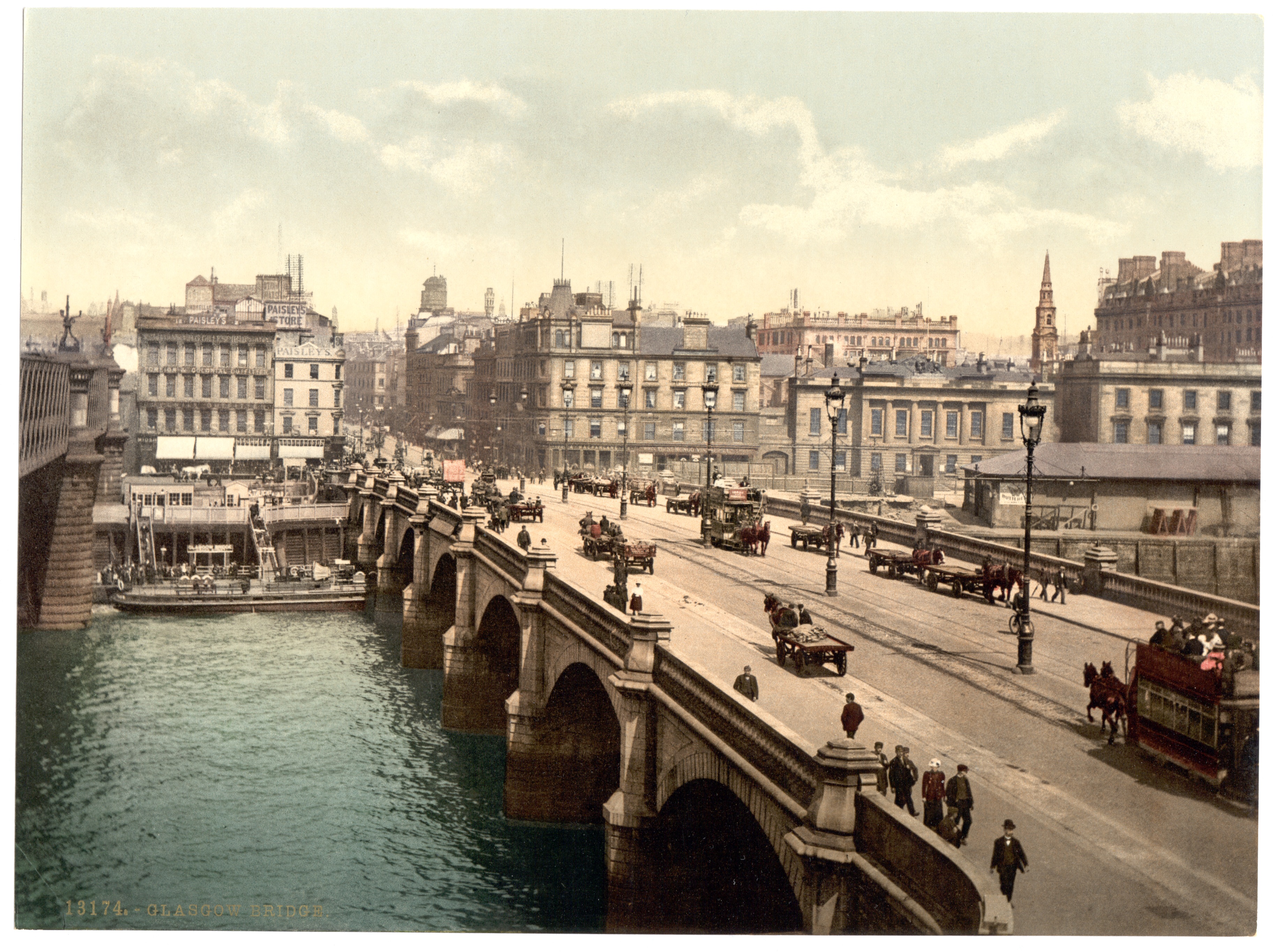
Glasgow Bridge · c.1890–1900 · Period photochrom · Library of CongressCity context, not their street, workplace or wedding church.
Kinning Park · From the marriage register
Before “husband and wife”, two lives already under way.
We meet them not on the day either arrived in Glasgow, but on the day their lives are recorded together. Both had work. Both had an address.
Indexed as Thomas McFadyen
A Leitrim son, working in Glasgow.
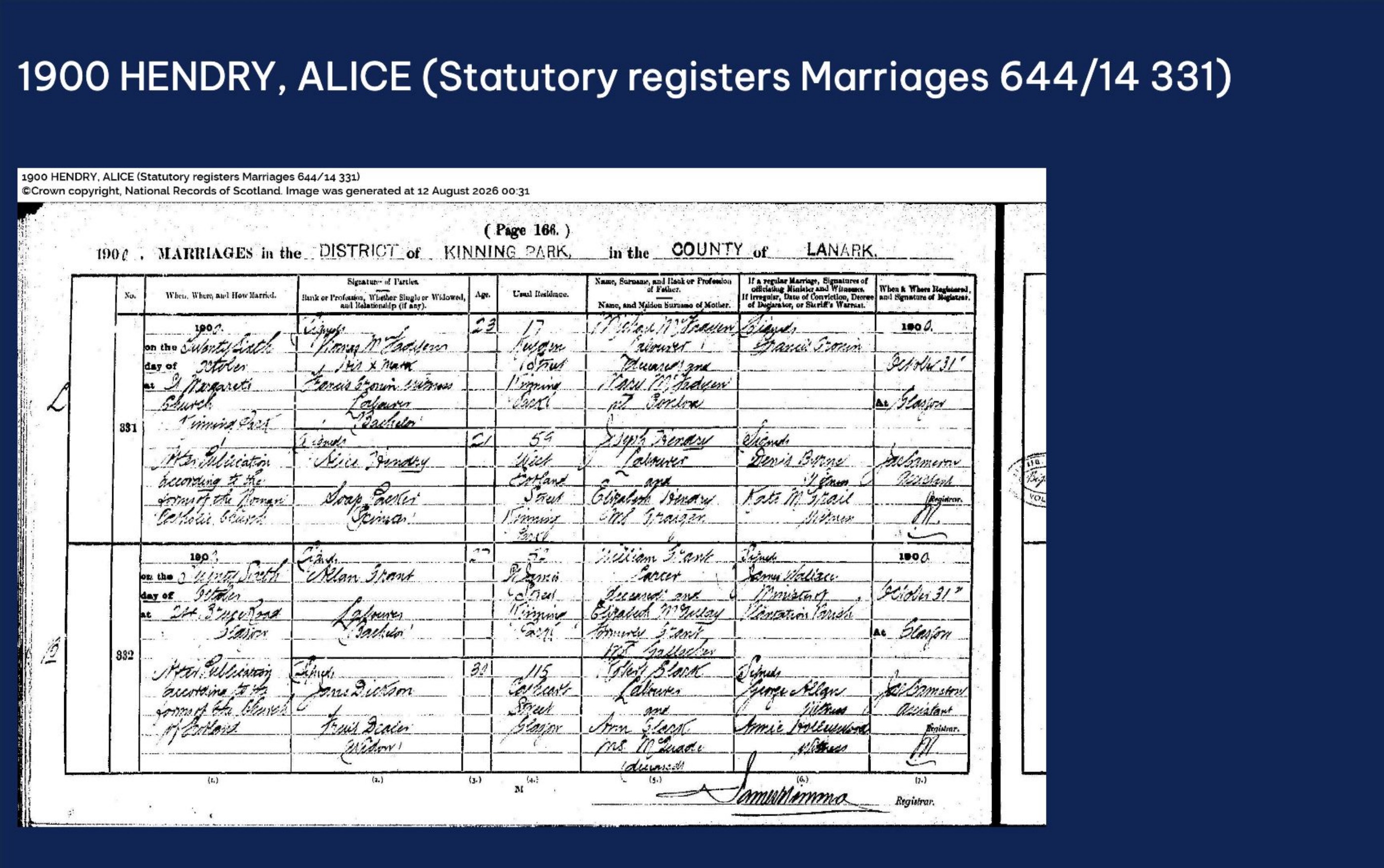
The marriage register gives Thomas a working life and a usual address in Kinning Park. It names his parents as Michael, a farmer already deceased, and Mary, formerly Conlon—the details that connect this Scottish groom to Tullynascreen.
“Vulcan Street” is a provisional handwriting reading, not yet securely located in Kinning Park. The employer and particular engine works are not identified here. His age at the wedding is not his age at his first crossing to Scotland.
Source: National Records of Scotland · Statutory marriages · Kinning Park, 1900 · 644/14/331 · entry 331, p.166. Typeset facts, not a facsimile of the register.
Behind the occupation · Glasgow around 1900
At work in Kinning Park.
Alice · Soap boiler
From the boiling pan to the washstand.
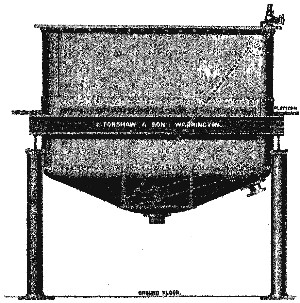
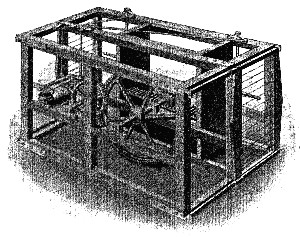
Alice’s occupation appears in two words on the marriage register. Eight years after her wedding, a trade handbook showed how a batch of hard soap went from hot fat and lye to a bar someone could hold. It gives us a way into Alice’s trade. Her factory and the stages she personally handled remain unknown.
From a pan to a bar · A 1908 trade comparison
Project-drawn schematic · not Alice’s workplace
Heat changed the ingredients.
A 1908 trade handbook describes melted fats and oils boiled with an alkaline liquid, or lye, using steam. The reaction made soap: it was more than melting a finished bar.
The pan needed attention. Samples helped the maker judge how the batch was progressing.
The fat itself could carry a smell. The handbook singles out one imported beef tallow for its strong odour. Rendering meant melting fat out of animal tissue. Soap makers could buy tallow already rendered, so the smell at Alice’s station would have depended on the materials her works used.
Even after boiling, some grades were ladled or pumped out at about 66°C (150°F). A splash could scald. The caustic liquid used in boiling could burn skin too. Those hazards give a sense of the care the job demanded. We have no personal account of Alice’s shift.
Drawing off the soap. The winch adjusted the skimmer to draw soap from the right depth. Figure 4.Cutting the block. A slabbing machine divided the cooled mass before the slabs were cut into bars. Figure 10.
Glasgow’s workshops needed people to handle the weight of the work. A local account from 1901 shows the scale of one shop. Descriptions of engineering jobs based on the 1921 census help explain the work a labourer might do there.
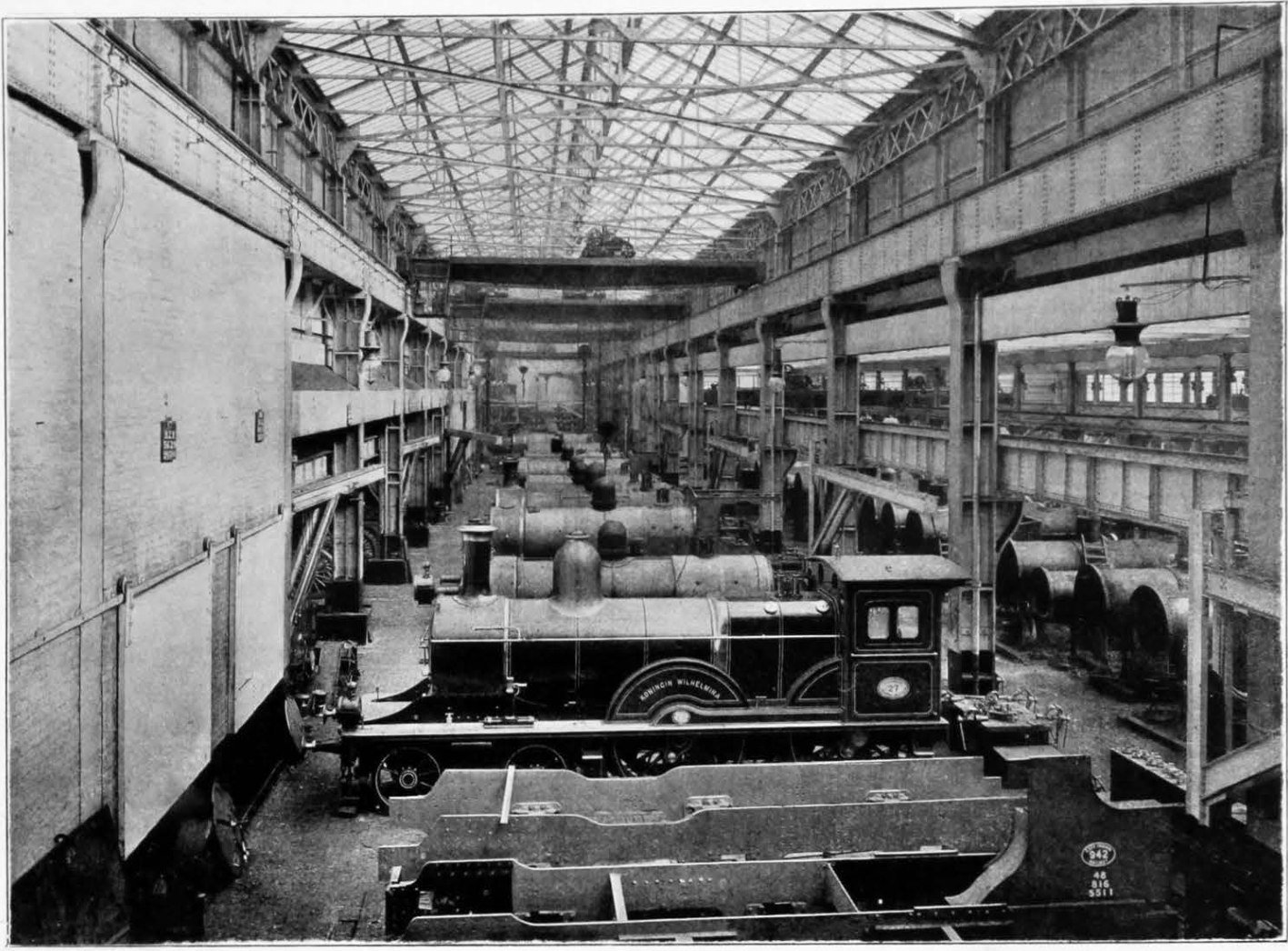
Springburn, Glasgow · Photographed by 1901
Inside Hyde Park Locomotive Works
Across the city from Kinning Park, a photographer recorded the rooms where locomotives took shape. These views give us a Glasgow comparison for Thomas’s occupation. His employer is still unknown.
Erecting shop
Start with the locomotive, then look up. The dark beam spanning the hall is the travelling crane. It could bring heavy parts over the engines being assembled below.
A travelling crane carries a load along its overhead rail. Project illustration.
Even getting a part to the bench took work.
At James Bennie & Sons’ Clyde Engine Works, a railway siding reached the works and two overhead cranes served the fitting and machine shop. Each could lift 25 tons. A heavy piece could travel along the building suspended from above, while smaller pieces still had to be lifted and carried by hand.
How close were their homes? A map from the time brings the district into focus—but we need to resolve Thomas’s street reading and the house numbers before giving an honest distance.
The connecting line above is an editorial motif, not a street map or a measured journey. Explore the actual period map below.Glasgow Bridge and the Clyde, c.1890–1900 · Library of Congress, Photochrom Print Collection.
A Alice · West Scotland Street (house unlocated)C Church · historic Stanley Street site? Thomas · Kinning Park; street unresolved
A city they knew · 1899–1900
Their street. Their church. One neighbourhood.
A marks Alice’s street; C marks the historic church site on Stanley Street. Seeing them together puts the marriage into a real neighbourhood. Thomas’s register also names Kinning Park, but his street remains unresolved.
These are not three confirmed doorsteps. Alice’s marker locates a street, not number 55; the church marker identifies its historic site. Thomas is deliberately not pinned. No house-to-house distance or walking route is claimed.
Reproduced with the permission of the National Library of Scotland · CC BY 4.0. Cropped and proportionally resized; markers and street highlight are separate editorial overlays. No street names or buildings altered.
John Bartholomew & Co., New Plan of Glasgow with Suburbs, constructed for the Post Office Directory, 1899–1900. NLS shelfmark Acc. 10222/PR/30b folio 108; image 109707761. This map places a street, not the occupants of a house. Neither number 55 nor Thomas’s provisional street reading is geolocated here. A period directory, larger-scale plan and a fresh reading of the register are the next checks. Full provenance and crop details.
26 October1900Kinning Park · Lanark, ScotlandStanley Street district, detail from the 1899–1900 Glasgow plan. Reproduced with the permission of the National Library of Scotland · CC BY 4.0.
A documented beginning together
Thomas &Alice.
They married at St Margaret’s Church in Kinning Park, according to the forms of the Roman Catholic Church.
The Scottish index calls him McFadyen; other family records use McPadden or McFadden. His age and named parents, followed by Alice’s name and the exact marriage date in the children’s records, let us follow this family across those spellings.
We know the marriage. We do not yet know their courtship, their first meeting or the circumstances of either person’s arrival in Glasgow.
Project-authored typography from the held transcription—not a wedding photograph, a recreated certificate or a facsimile.
Read the original · 1900 marriage register
Their names. Their work. Their families.
The marriage entry itself—not a recreated certificate. Follow the handwriting that connects a Glasgow wedding to the family in Leitrim.
Selected viewing window · original lettering unchanged
Choose a detail, then zoom to read the handwriting. Swipe or scroll within an enlarged image; keyboard users can focus the image and use the arrow keys. The record itself does not animate.
Project reading · separate from the original
26 October 1900 · Kinning Park
Entry 331 records a marriage at St Margaret’s Church after publication according to the forms of the Roman Catholic Church. It documents the wedding—not the courtship or either person’s first arrival in Glasgow.
SRC-052 · National Records of Scotland, statutory marriages, Kinning Park, 1900, 644/14/331, entry 331, page 166. Preserved Scotland’s People viewer copy. Page number corrected from 168 after image review, 22 October 2026.
JPEG reading copy rendered from the preserved viewer PDF. Focus views change the visible window only; no handwriting has been retouched, generated or recoloured. The full preserved view includes the archive credit and an adjacent marriage. This is not a newly certified extract.
Displayed under NRS’s published allowance for up to 20 NRS Crown-copyright images per website, with accurate reproduction and acknowledgment. Four distinct NRS register images are currently selected for this story: the marriage and three births. Repeated story/library views do not represent additional documents. No Creative Commons licence or unrestricted redistribution right is claimed; consult NRS for your intended reuse.
By 29 July 1908, a son’s birth places Thomas and Alice at Bonawe Quarries in Argyll. We have not established when they moved there or filled all the years between.
The people are documented. The landscape is context.
What does the marriage record establish—and what remains open?
The 26 October 1900 marriage (National Records of Scotland, Kinning Park, 644/14/331, entry 331, page 166) records the couple’s ages, occupations, usual residences and parents. Thomas’s parents match his 1876 Irish birth record. Later children’s registrations repeat Alice’s name and this marriage date. The evidence does not establish their first arrival dates, their employers or how they met. Alice’s marriage age conflicts with the later census, and her exact origins remain under investigation.
Explore the marriage in chapter 2, the three Scottish births in chapter 3, Martin’s military clue in chapter 4 and the census in chapter 7. All five originals are also in the Research Library. Other scans remain private where publication clearance or identification is unresolved.
Image, credit and reuse
Glasgow Bridge, Glasgow, Scotland, c.1890–1900. Photochrom Print Collection, Library of Congress, LC-DIG-ppmsc-07598. The Library’s rights advisory states “No known restrictions on reproduction”; this is not a new Creative Commons license. Period city context, not either person’s identified street, employer or wedding church. The colour comes from the historical photochrom, not modern AI colourization.
Display crops, shading and optional pan/zoom are applied to the opening image. No depicted objects in that source image were generated, removed or reconstructed. The source rights statement remains separate from the site’s writing.
The documentary trail
Follow the records.
The registers, returns and papers behind this chapter. Open a card for its evidence and limits, or follow it into the Research Library.
These are record summaries, not recreated documents. The marriage, three Scottish birth entries and census have original-record views with their own reuse terms. Other scans remain private where clearance or identification is unresolved. Family-history leads are labeled separately.
Civil registration · 11 December 1876Thomas McPadden’s birth at TullynascreenRead the record summary +
Thomas’s birth date and place, with Michael McPadden and Mary formerly Conlon named as his parents. The parents also appear in his 1900 marriage entry.
What this does not establishIt does not date his first departure from Ireland or identify a route to Scotland.
SRC-010, Irish civil birth register, Dromahair district, County Leitrim, 1876, entry 445: Thomas McPadden, born 11 December at Tullynascreen. Preserved original-image copy; exact external item link still to be recovered.
Original preserved privately · image reuse not yet cleared
Thomas, 23, an engine-works labourer, with an address provisionally read as 17 Vulcan Street, Kinning Park; street identification unresolved. Alice, 21, a soap boiler of 55 West Scotland Street. Thomas’s parents are Michael, deceased, and Mary Conlon; Alice’s parents are Hugh Hendry and Elizabeth, formerly Treanor (working reading).
What this does not establishThe entry does not explain how they met or when either arrived in Scotland. Alice’s recorded age conflicts with the later census; her mother’s maiden surname remains a qualified reading.
SRC-052 · National Records of Scotland, statutory marriages, Kinning Park, 1900, 644/14/331, entry 331, page 166. Preserved Scotland’s People viewer copy. Page number corrected from 168 after image review, 22 October 2026.
Original record available · source-specific reuse terms
A family memory or a document with a name, date or place could help us follow Thomas and Alice further.
Where in County Armagh did Alice grow up?
Her marriage names her parents as Hugh and Elizabeth Hendry. Do you recognise that family, or have a birth or baptism record for Alice? Her surname also appears as Henry.
Email opens a private conversation with Ed. Please keep living people’s personal details out of your first message. We will discuss permission and credit before sharing anything on the site.