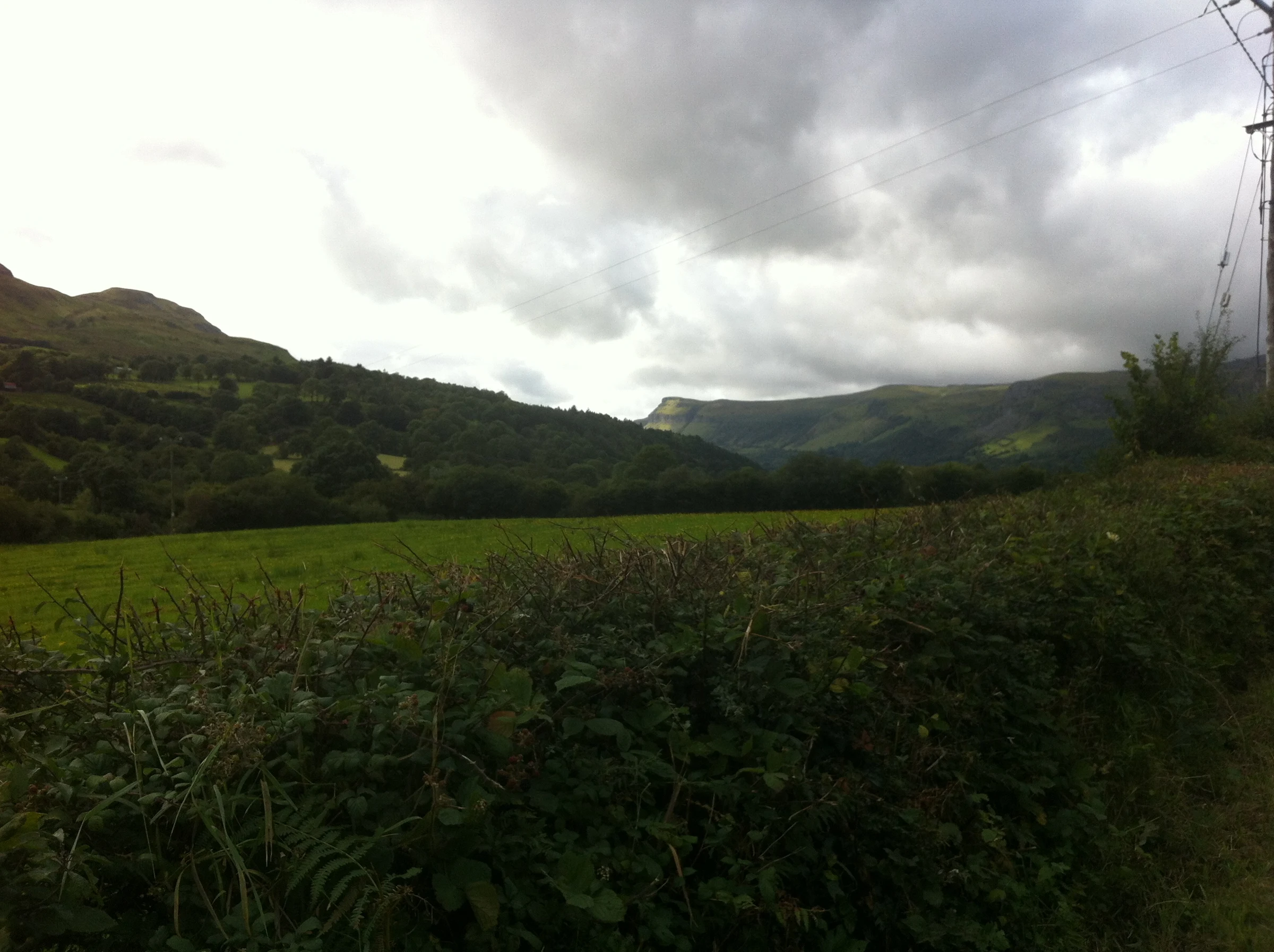
Glencar Road, Leitrim · 2013 · Darrin Antrobus · CC BY-SA 2.0Modern regional context—not Tullynascreen, Mary’s land or a view of the family’s arrival.
From army papers to family records
The crossing is missing. The Irish home is not.
In February 1919, Thomas was passing through the army’s dispersal process in Scotland. By March 1920, a birth registration places Thomas and Alice’s family at Tullynascreen.
The records give us places on either side. They do not give us the journey between.
Scotland · 6 February 1919Thomas at dispersalGeorgetown, Paisley · SRC-560
Between the recordsA crossing not recoveredDate, route and travelling companions unknown
Leitrim · 3 March 1920A son at TullynascreenPatrick’s birth · SRC-062
AI-generated illustration · Imagined sea and shore, not their crossing, a known route or Mary’s land.
Read the dated anchors—not a recovered itinerary.
6 February 1919 · Scotland
Georgetown, Paisley
A protection and identity certificate was issued to Thomas during dispersal. Bonawe Quarries was still the address entered for his pay.
SRC-560 · Certificate and 28 days’ furlough
5 March 1919 · Service record
Released from service
The formal disembodiment date in the papers is 5 March. It is a different stage from February’s dispersal certificate.
SRC-531 & SRC-540 · Corroborating entries
The journey · Date unknown
Across the water
We have not established the route, the crossing date, or which family members travelled together. These records do not explain why they returned.
No ship, shared itinerary or arrival day inferred
3 March 1920 · County Leitrim
A birth at Tullynascreen
Patrick’s birth records Thomas and Alice as his parents, and Thomas’s residence as Tullynascreen.
SRC-062 · Irish civil birth register
These dates follow the documents, not a proven journey taken together. A pension decision also records malaria; illness is not assumed to explain the return.
Two births · The same townland
Not just a return. A family life.
These are not passenger records. They are something more intimate: two children born in Tullynascreen, with Thomas named as father and informant.
Born at Tullynascreen1920
PatrickA son of Thomas & Alice
Thomas and Alice’s son Patrick was born at Tullynascreen. Thomas, recorded as a farm labourer, was the informant and made his mark.
Father’s recorded occupation
Farm labourer
Mother’s name in this entry
Alice, formerly Henry
Registered
5 March 1920
This is the younger Patrick, not the infant who died in Glasgow in 1917. The records do not explain the reuse of his name.
Project typography from the recorded facts, not a register facsimile. The Henry / Hendry spellings are connected through the couple’s marriage and other family records.
Ireland was home again
For Thomas, a birthplace. For the family, a home.
Thomas had been born in Tullynascreen in 1876. His children’s births now place family life in that same townland, on the other side of years of work and war.
Alice’s own roots were Irish too: the later census records her birthplace as County Armagh. Their daughter Alice and son Martin were born at Bonawe; Patrick and Michael Stephen were born here. This family connected more than two points on a map.
Birth records establish these dated family connections, not uninterrupted residence or a complete account of every child.
County Leitrim countryside, 2006 · RedHotHeat · CC BY-SA 2.5. Modern regional view, cropped and shaded. Photograph and licence ↗
A possible connection · Not yet proved
Back to the townland. Back to Mary’s land?
It is a compelling possibility. Thomas had come back to the place where his mother had lived. The acreage gives us a clue—but not yet an address.
Start with Mary’s page, then compare what the later records can—and cannot—tell us.
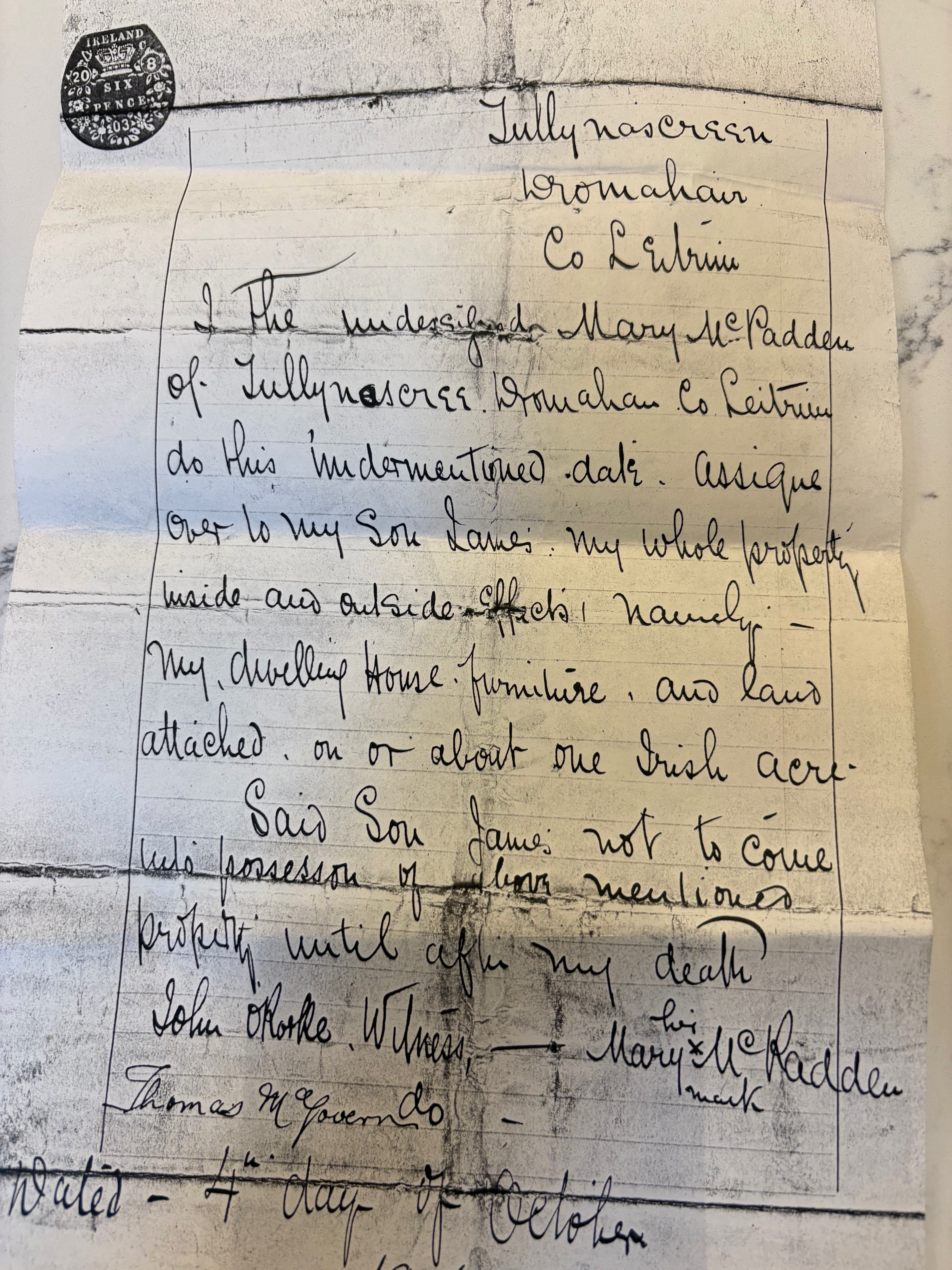
McPadden family collection · Supplied photograph, shown unchanged. The lower date is partly clipped; the paper’s original-versus-reproduction status is unresolved.
The question begins with Mary’s own page
A house and land. But the son named is James.
The family-held document often called Mary’s will is dated 4 October 1904. It names Thomas’s older brother James, not Thomas, as the son to receive her house, effects and attached land after her death.
“on or about one Irish acre”
Could Thomas and Alice later have made their home on that same holding?
It is a question to investigate—not an inheritance we can narrate. The page does not explain a later arrangement for Thomas, and we have not established that its intended provision for James took effect.
SRC-041 / SRC-042 · Family permission for this educational display. Source and reuse note. No present ownership, entitlement or property-access claim.
Family-held 1904 document · SRC-041 / SRC-042
“on or about one Irish acre”
An approximate description in a family-held document—not a surveyed boundary.
A house. Some land. A son named James.
In the document dated 4 October 1904, Mary McPadden names her dwelling, furniture and attached land for her son James, with possession to follow her death.
James is Thomas’s older brother. This document is not evidence that Thomas inherited the holding, or that its intended arrangement was carried out.
Similar size is a clue. It is not a match.
One Irish acre is larger than a statute acre—about 1.62 statute acres. Mary wrote “on or about”, not an exact surveyed area. We cannot assume that her description was rounded to the two acres reported in 1926.
Why not simply join the three records?
The places, people and boundaries must each be connected. We need evidence that the later valuation’s Thomas was Alice Hendry’s husband, and that their census household occupied this particular holding. The folios already held by the project help frame the land research, but do not yet supply those missing links.
Even a confirmed occupancy would leave a separate question: how did it relate to Mary’s intended provision for James? Names and acreages alone cannot answer that.
The next record · Tullynascreen, 1926
A home takes shape. A household comes into view.
The next chapter brings the family together on census night: parents, children born on both sides of the water, and life on a small holding.
Thomas’s protection and identity certificate, Army Form Z.11, was issued at Georgetown (Paisley) on 6 February 1919; it gives Bonawe Quarries as the pay address and 28 days’ furlough (SRC-560). The uncancelled disembodiment stamp and pension record corroborate 5 March 1919 as the formal release date (SRC-531 and SRC-540), correcting an earlier provisional reading of 15 March.
The papers are in the National Archives WO 363 service file accessed through Findmypast, linked provider record GBM/WO363-4/7379637/25/840; viewer pages 00868, 00840 and 00845 respectively. These provider identifiers are not a complete archive piece-level reference. The pension decision records malaria, but neither its place of contraction nor a reason for the return to Ireland is inferred.
A June 1919 school-register lead may narrow the return further, but the pupil’s identity and birth-date discrepancy remain unresolved. It is not used here as a firm arrival date for the family. The original scans remain in private research.
The Irish children and the household connection
Patrick McFadyen’s birth, 3 March 1920, is recorded in Dromahaire district, Manorhamilton registration area, page 202, entry 426; registered 5 March (SRC-062 / SRC-063). Michael Stephen McFadyen’s birth, 25 December 1921, appears on page 87, entry 90; registered 9 January 1922 (SRC-060 / SRC-061).
Both name Thomas and Alice and Tullynascreen. Henry in Patrick’s entry and Hendry in Michael’s are correlated with the proved 1900 marriage and other family registrations—not joined on surname resemblance alone. The 1926 household (SRC-050) supplies Alice’s County Armagh birthplace. No paid or permission-pending register images are reproduced.
Mary’s document, the valuation, the census and the folios
Mary’s family-held document, dated 4 October 1904 (SRC-041 / SRC-042), names James and describes her dwelling and land “on or about one Irish acre”, with possession to follow her death. It does not establish an executed inheritance or Thomas’s occupation.
The held valuation material follows Michael, then Mary, on a 1 acre, 3 roods, 29 perches holding (about 1.93 statute acres); a 1931 revision names Thomas McFadden. The 1926 census’s two-acre report is a separate household record, not a parcel identification. We have not identified the valuation’s Thomas as Alice’s husband. Valuation changes, census residence and registered ownership answer different questions.
The folios already acquired have been consulted privately. They help trace the property history, but do not yet connect the 1926 household to the historical boundaries. Modern owner details, precise parcel locations and title-plan images are not included here. Mary’s death and the arrangement behind James’s intended provision remain unresolved.
A statute acre is the standard acre used in this comparison. The approximate 1.62 conversion for an Irish acre is explained by the Irish Genealogical Research Society’s townland-index guide. It is a unit conversion, not proof that Mary’s approximate wording describes the census holding.
The sea illustration and Mary’s document photograph
The sea-and-shore scene is a new AI-generated illustration. Its coast, light and weather are imagined; it identifies no crossing, port, date or family experience. It is not Tullynascreen or Mary’s land. Optional slow pan/zoom follows shared Reading preferences, pauses offscreen and respects reduced motion. All dates and text remain still. Full generation prompt, provenance and limits.
Mary’s page is the already-reviewed photograph supplied from the McPadden family collection, with family publication consent for this educational display. The image is unchanged and can be opened at full size. Its lower date is partly clipped and the underlying paper’s original-versus-reproduction status is unresolved. Showing it does not certify legal effect, an executed inheritance or a present property claim. This is not an open image license or commercial-book clearance. Family-image source and reuse note.
Landscape, credit and reuse
Countryside on the Glencar Road, Darrin Antrobus, 10 September 2013. CC BY-SA 2.0. Modern Leitrim regional context—not Tullynascreen, an identified McPadden holding or evidence of the landscape in 1920.
Responsive copies, display cropping, shading and optional pan/zoom are used. No depicted objects were generated, removed or reconstructed. Photograph and image adaptations retain CC BY-SA 2.0, separately from the project’s writing. Image provenance and reuse note. The land comparison is explanatory typography, not a map or boundary reconstruction.
The documentary trail
Follow the records.
The registers, returns and papers behind this chapter. Open a card for its evidence and limits, or follow it into the Research Library.
These are record summaries, not recreated documents. The marriage, three Scottish birth entries and census have original-record views with their own reuse terms. Other scans remain private where clearance or identification is unresolved. Family-history leads are labeled separately.
Civil registration · 29 July 1908Thomas junior’s birth at Bonawe QuarriesOriginal image available · read & explore +
A son Thomas born to Thomas McFadyen and Alice, maiden surname Henry; the entry records their marriage as 26 October 1900 in Glasgow.
What this does not establishThis is the son, not his father. It conflicts with the June 1909 birth notation in the school-register lead; it does not establish a family arrival date at Bonawe.
SRC-530 · National Records of Scotland, statutory births, Muckairn, Argyll, 1908, 529/18, page 6, entry 18. Original Scotland’s People JPEG; downloaded 21 October 2026 UTC.
Original record available · source-specific reuse terms
Military service · 6 February and 5 March 1919Dispersal certificate and formal release from serviceRead the record summary +
A protection certificate dated 6 February at Georgetown, Paisley gives Bonawe as the pay address and 28 days’ furlough. The uncancelled disembodiment stamp and pension entry support formal release on 5 March.
What this does not establishDispersal, furlough and disembodiment are different events. None dates a crossing to Ireland. The 5 March reading supersedes an earlier provisional 15 March reading; no reason for the family’s move is inferred.
SRC-560 (Army Form Z.11), SRC-531 (service statement) and SRC-540 (pension entry), TNA WO 363 service file via Findmypast GBM/WO363-4/7379637/25/840; viewer pages 00868, 00840 and 00845. Full archive piece-level reference pending.
Original preserved privately · image reuse not yet cleared
School register · 25 June 1919A Thomas McPadden school admission — qualified leadRead the record summary +
A Thomas McPadden entered Tullynascreena National School after a school in Scotland. The parent is an unnamed labourer; Ardchattan is a working reading of the previous-school locality.
What this does not establishThe birth notation is read as June 1909, conflicting with Thomas junior’s July 1908 birth. The pupil is not conclusively identified as their son, so this is not a firm family arrival date.
SRC-058, National Archives of Ireland, Tullynascreena National School, roll 13950, admission 25 June 1919; Findmypast image IRE/IRESCHOOLS/007634801/00424. SRC-059, corrected project transcription; earlier transcript SRC-056 is derivative, not corroboration.
Original preserved privately · image reuse not yet cleared
Civil registration · 3 March 1920The younger Patrick’s birth at TullynascreenRead the record summary +
Patrick born to Thomas McFadyen, farm labourer, and Alice formerly Henry. Thomas was the informant; registered 5 March.
What this does not establishThis is a different son from the infant who died in 1917. The birth establishes a dated Irish family presence, not the crossing date or a reason for reusing the name.
SRC-062, Irish civil births, Dromahaire district, Manorhamilton registration area, 1920, page 202, entry 426; Patrick McFadyen. Original image acquired from IrishGenealogy. SRC-063 is the project transcription, not a second independent record.
Original preserved privately · image reuse not yet cleared
Civil registration · 25 December 1921Michael Stephen’s birth at TullynascreenRead the record summary +
Michael Stephen born to Thomas McFadyen, quarry man, and Alice formerly Hendry; Thomas was the informant. Registered 9 January 1922.
What this does not establishThe occupation does not identify a particular quarry. The birth helps interpret the census age but does not date the family’s return journey.
SRC-060, Irish civil births, Dromahaire district, Manorhamilton registration area, page 87, entry 90; Michael Stephen McFadyen, born 25 December 1921, registered 9 January 1922. Original from IrishGenealogy; SRC-061 is the project transcription.
Original preserved privately · image reuse not yet cleared
Thomas, Alice and four resident children; six people, two rooms and two statute acres. Thomas is 49 and farming on his own account. Michael reads four years four months, not four months.
What this does not establishCensus ages and marriage duration conflict with some civil entries. Twelve children born alive is not twelve surviving children; five under sixteen is not the four children at home. Own-account farming is not proof of land ownership, and schedule 153 is not a parcel number.
SRC-050 · National Archives of Ireland, Census 1926, Form A, schedule 153, McPadden household, Tullynascreena, Killanummery DED, County Leitrim, 18 April 1926. Archive person a_id=1132478; image Tullynascreena_2477_0014_0012_0_00023.pdf. Official PDF verified byte-identical to the preserved copy on 22 October 2026. Schedule number is not a parcel identifier.
Original record available · source-specific reuse terms
Land research · 1904; 1926; 1931 revisionMary’s holding and Thomas’s household — an unfinished comparisonRead the record summary +
Mary’s family-held page names James and about one Irish acre. The historical valuation holding 30Ca/30D measures 1 acre 3 roods 29 perches (about 1.93 statute acres); a 1931 revision names Thomas McFadden. The separate 1926 household reports two statute acres.
What this does not establishNeither similar areas nor a repeated name identifies that rated occupier as Alice’s husband. Valuation, census and registered title describe different things. Held folios do not yet prove this household occupied Mary’s parcel, that Thomas inherited it, or when Mary died.
Comparison of Mary’s family-held 4 October 1904 page (SRC-041/042); held Tullynascreen valuation revisions for historical holding 30Ca/30D, including 1931 change; and 1926 household return (SRC-050). Acquired land folios consulted privately. This is a project comparison, not a new original record; a full publication-ready valuation citation remains pending.
Project comparison · underlying copies and modern land-title material withheld
A family memory or a document with a name, date or place could help us follow Thomas and Alice further.
AI illustration of a blank letter and writing desk. Image notes ↗
When did the family come back to Ireland?
A dated letter, school record or remembered address could help trace the journey before Patrick’s birth at Tullynascreen in March 1920, and show which family members travelled when. Please distinguish a family memory from a dated record.
An old photograph, a letter or a historical land record might connect their household with a particular home. Mary’s death record, or evidence identifying the Thomas McFadden in the later valuation, could help test the possible link to her holding. Please contact Ed privately rather than sharing current owners’ details or precise property locations.
Email opens a private conversation with Ed. Please keep living people’s personal details out of your first message. We will discuss permission and credit before sharing anything on the site.