
The country
A claim to independence
The First Dáil met in Dublin on 21 January and declared independence. British rule continued; authority was contested.
Sources for this political timeline ↓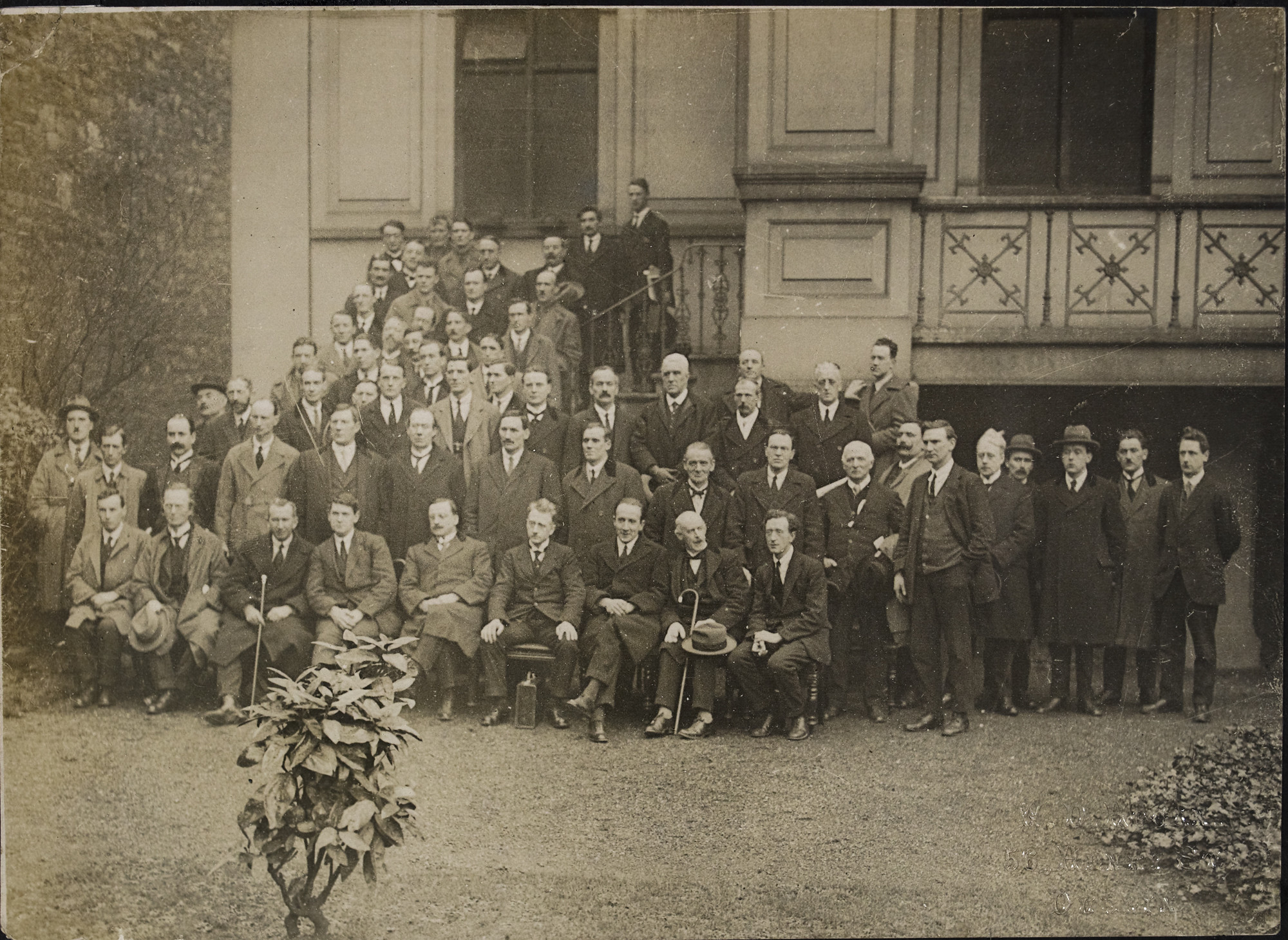
Ireland · Leitrim · 1919–1926
A family makes a home.
A country remakes its government.
What changed around ordinary lives—and what can their records actually tell us?
About 12 minutes · No family-tree knowledge needed
Pro-Treaty Dáil members, Dublin, 1922 · W. D. Hogan / National Library of Ireland, HOGW 135 · No known copyright restrictions · Cropped and shaded. Photograph notes ↗
In March 1920, a birth registration places Thomas McPadden and Alice Hendry’s family at Tullynascreen, near Dromahair. In April 1926, their household appears in the first census of the Irish Free State.
Between those records lie independence, partition, a contested settlement and civil war. This reading follows the revolutionary period and its aftermath, then returns to the family’s own records.
The dates 1919–1926 frame the history. They do not establish a 1919 family crossing. The family chronology
01 · Context is not a cause
Choose a date. The country’s history and one family’s records sit side by side, without turning coincidence into explanation.
The country
The First Dáil met in Dublin on 21 January and declared independence. British rule continued; authority was contested.
Sources for this political timeline ↓One family’s records
Thomas’s service records support release on 5 March. A June school entry is a possible lead for their son, with a conflicting birth date. Neither fixes the family’s crossing.
Service record →Shared dates establish context. They do not, by themselves, establish a cause.
The country: The First Dáil met in Dublin on 21 January and declared independence. British rule continued; authority was contested.
The family: Thomas’s service records support release on 5 March. A June school entry is a possible lead for their son, with a conflicting birth date. Neither fixes the family’s crossing.
The country: On 17 June, Leitrim County Council resolved to recognise Dáil Éireann as the constituted government.
The family: Patrick was born at Tullynascreen on 3 March to Thomas and Alice. Thomas’s occupation was farm labourer. This establishes family presence by that date.
The country: Northern Ireland’s parliament opened in June. A truce began on 11 July; the Anglo-Irish Treaty was signed on 6 December.
The family: Michael Stephen was born at Tullynascreen on 25 December. This birth record calls Thomas a quarry man; it does not identify the quarry.
The country: Civil War began in June 1922. The Free State came into being that December, while the conflict continued into 1923.
The family: The births and later census do not provide an account of this family’s experience of the fighting. We cannot fill that gap with a story of either danger or safety.
The country: The first Irish Free State census was taken on 18 April, covering 26 counties.
The family: Thomas, Alice and four children were recorded at Tullynascreen. Thomas was farming on his own account; the household occupied two rooms.
Why begin in 1919? The assembly’s claim to independence and the developing War of Independence made this a turning point. A family returning from Scotland was entering a country whose government and borders were still being contested. Follow the dated sequence from 1919 to statehood (opens in a new tab)
A service record is not a ballot. Thomas’s British Army service and release are part of his documented life. They do not tell us his position on Irish independence, the Treaty or the Civil War—or how neighbours treated him. Alice’s views are no more recoverable from his military record. What the personal records establish
03 · A settlement with limits
Partition and the Treaty are connected, but they are not the same event. The British Government of Ireland Act of 1920 provided for Northern and Southern Ireland. Northern Ireland’s parliament opened in 1921. The six northern counties included Fermanagh, beside Leitrim. See the dates of partition legislation and the northern parliament’s opening (opens in a new tab)
Explore the map to see why “Ireland” needs a date and a political meaning. Northern Ireland was not the whole province of Ulster: Donegal, Cavan and Monaghan were outside its six-county jurisdiction. How this reference map was made ↓
6 December 1921 · Three terms to understand
The Treaty gave the Free State a parliament and an executive responsible to it, with constitutional status modelled on Canada. It did not establish the sovereign republic demanded by its opponents.
Supporters of the Treaty saw substantial powers of self-government and an alternative to renewed war. Opponents rejected a settlement that fell short of the republic they had fought for. The disagreement divided the independence movement. Explore the Defence Forces’ account of the Treaty split and fighting (opens in a new tab)
The IRA fought British forces to end British rule. The truce led to negotiations and the Treaty—a settlement that offered self-government but fell short of the republic sought.
Former allies divided over the Treaty. Pro-Treaty forces fought to uphold the Treaty settlement and the new Free State. Anti-Treaty republicans fought for the republic declared in 1919, which they believed the Treaty abandoned. The government side won, leaving the Treaty settlement in place.
Fighting began in Dublin with the bombardment of the Four Courts on 28 June 1922. The political split became a war among former comrades. We have not established this household’s direct experience of it.
Read the short overview of the settlement and Civil War outcome (opens in a new tab)The Free State formally began on 6 December 1922, during that war. The 1925 agreement kept the existing boundary unchanged. That agreement did not mean everyone accepted partition. Leitrim belonged to the Free State; nearby Fermanagh remained in Northern Ireland. Find the December 1922 and December 1925 milestones (opens in a new tab)
04 · More than a change of flag
For women, the new constitutional order changed the terms of parliamentary participation. In 1918, women’s voting rights began at thirty and depended on qualifications. The Free State Constitution gave citizens aged twenty-one and over the Dáil vote without distinction of sex, subject to electoral law. Source note: what Article 14 covers ↓
That is part of Alice’s wider historical world. It does not establish her citizenship, registration, turnout or choice. Nor did equal voting terms make all aspects of women’s lives equal.
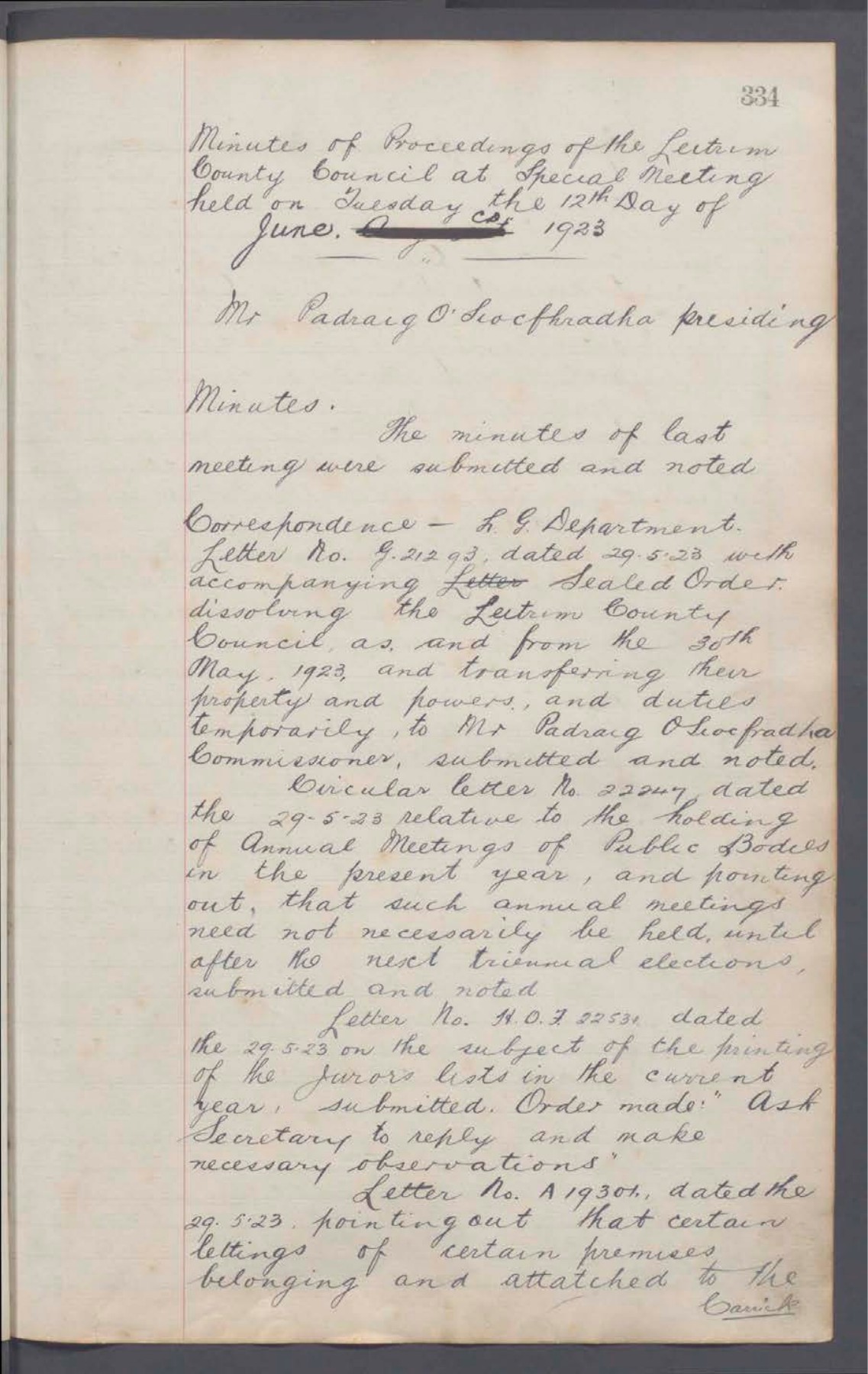
A local change of administration · 1923
A minute of 12 June records the council’s dissolution effective 30 May 1923. A commissioner temporarily took over its powers and duties. In practical terms, elected councillors no longer directed the county’s administration.
On manuscript page 334 (PDF page 393), the meeting is described as a special meeting. The entry records a government letter enclosing a sealed dissolution order. Look for the effective date, 30 May, and the transfer of the council’s responsibilities to a commissioner.
This is a reading guide, not a transcription. The minute records the change; it does not explain all the reasons behind it.
Road grants · 6 July 1925
A recorded allocation for road improvements puts a concrete figure beside state-building. Roads were public work, not just lines on a map. This is an allocation—not proof of completed works or an improvement to the McPaddens’ own road.
See the 1925 grant entry reproduced in the council history (PDF page 27) (opens in a new tab)The council’s published history records elected administration resuming on 2 June 1926. A constitutional milestone and the ordinary machinery of local government ran on different schedules. Source note for the grant and elected council’s return ↓
Care was being reorganised too. The separate parish reading explains the Leitrim County Scheme and its distinction between hospital care and the county home. Explore care and relief →
05 · Return to an ordinary record
The census of 18 April 1926 was the first taken by the Irish Free State. Its twenty-six-county coverage matters: it was not another all-Ireland count on precisely the same territorial basis as 1901 or 1911. National Archives’ introduction to the 1926 census (opens in a new tab)
At Tullynascreen, Thomas and Alice appear with four children. The return gives us rooms, acreage and recorded work. These details bring the household into focus without telling us which political cause, if any, its members supported. Explore this household’s return in the Research Library
The earlier birth records name Alice as the mother of the children born here. They also describe Thomas first as a farm labourer, then as a quarry man; the census later records farming on his own account. Those entries show work recorded at particular dates. They do not explain the reasons for every change, or measure all the work that sustained the home. Follow the birth records in the return-to-Leitrim chapter
Political history explains the changing institutions around these lives. Family evidence anchors a household within that world. Neither has to pretend to answer every question the other leaves open.
Thomas McPadden and Alice Hendry married in Scotland in 1900. Thomas was a son of Michael McPadden and Mary Conlon of Tullynascreen. Their Scottish years and later Leitrim household form the story Thomas and Alice: Between Two Homes.
Follow a life through these years
Follow the evidence
Personal records and county history answer different questions. Open a note for its precise location and scope.
Source links marked ↗ open in a new tab. Stories, readings and sections open here; your story chapter stays available through the return link.
P80/213, 20 October 1921; catalogue printed page 50.
What it supports. Catalogue entry for an Irish Bulletin draft using “the Troubles in Ireland” in its title.
How to read it. Evidence of contemporary usage, not a measure of how commonly it was used or a formal period name for 1919–1926. The catalogue describes the original document.
Reuse. Original explanation and selected facts; linked source retains its own terms. No source page reproduced.
Open source (new tab) ↗Source MCP-POL-TROUBLES-EARLY · Checked 2026-11-09Exhibition large-print guide, introductory text.
What it supports. The later Northern Ireland conflict and the 1998 Good Friday Agreement; differing experiences and unresolved legacies.
How to read it. A museum introduction to the later conflict, not evidence about the earlier wars or this family.
Reuse. Original explanation and selected facts; linked source retains its own terms. No source page reproduced.
Open source (new tab) ↗Source MCP-POL-TROUBLES-LATER · Checked 2026-11-09Andy Bielenberg, Civilian Fatalities: source material, chronology and geography.
What it supports. Civilian deaths, geographical variation and the research use of death certificates, newspapers and compensation claims.
How to read it. National research with acknowledged gaps. No casualty estimate or particular household experience is inferred here.
Reuse. Original explanation and selected facts; linked source retains its own terms. No source page reproduced.
Open source (new tab) ↗Source MCP-POL-CIVILIANS · Checked 2026-11-09“hearts ne’er waver”: exhibition account, imprisonment November 1922–December 1923.
What it supports. Women’s imprisonment extending into December 1923 and surviving letters, diaries, autograph books and handmade objects.
How to read it. An account of a past exhibition, not a current visitor listing. These experiences are not attributed to Alice or to Leitrim families without evidence.
Reuse. Original explanation and selected facts; linked source retains its own terms. No source page reproduced.
Open source (new tab) ↗Source MCP-POL-WOMEN-PRISONERS · Checked 2026-11-09Document 1: Declaration of independence, Dublin, 21 January 1919.
What it supports. The assembly’s claim to an independent republic and exclusive Irish law-making authority.
How to read it. A declaration of political authority, not evidence that the British government accepted the claim.
Reuse. Original explanation and selected facts; linked source retains its own terms. No source page reproduced.
Open source (new tab) ↗Source MCP-POL-DECLARATION · Checked 2026-11-09Provisional constitution approved 21 January 1919, First and Second Sections.
What it supports. An elected legislative assembly and a ministry accountable to it.
How to read it. A contemporary constitutional text. The powers it claims must be distinguished from effective control throughout Ireland.
Reuse. Original explanation and selected facts; linked source retains its own terms. No source page reproduced.
Open source (new tab) ↗Source MCP-POL-DAIL-CONSTITUTION · Checked 2026-11-09Home rule: the campaign for an Irish parliament, from Isaac Butt to Parnell.
What it supports. Home Rule as a movement for Irish self-government within a continuing parliamentary union.
How to read it. A short retrospective introduction, not a statement of every nationalist’s views in 1919–1926.
Reuse. Original explanation and selected facts; linked source retains its own terms. No source page reproduced.
Open source (new tab) ↗Source MCP-POL-HOME-RULE · Checked 2026-11-09Major events, 1919–1926.
What it supports. First Dáil, partition legislation, July 1921 truce, Treaty, Civil War, Free State and 1925 border agreement.
How to read it. An institutional chronology; local experiences varied. Dates do not establish what a family saw or supported.
Reuse. Original explanation and selected facts; linked source retains its own terms. No source page reproduced.
Open source (new tab) ↗Source MCP-POL-TIMELINE · Checked 2026-11-09Conflict: sections on 1919–1922.
What it supports. The Dáil’s claim to independence, opposition to British rule and the constitutional settlement.
How to read it. A brief retrospective account; not a source for a named household’s politics.
Reuse. Original explanation and selected facts; linked source retains its own terms. No source page reproduced.
Open source (new tab) ↗Source MCP-POL-PARLIAMENT · Checked 2026-11-09Document 214, DE 2/304/1; Articles 1–4 and 11–12.
What it supports. Dominion status, Crown representative, parliamentary oath and Northern Ireland provisions.
How to read it. Treaty terms and the later implementation are distinct. Its existence does not establish agreement among all residents.
Reuse. Original explanation and selected facts; linked source retains its own terms. No source page reproduced.
Open source (new tab) ↗Source MCP-POL-TREATY · Checked 2026-11-09Sections “The War of Independence 1919–1921” and “The Civil War 1922–1923”.
What it supports. Guerrilla conflict and the pro-/anti-Treaty split; bombardment of the Four Courts on 28 June 1922.
How to read it. Institutional retrospective. This reading uses no disputed casualty estimate; truce date is taken from DIFP, not this page’s inconsistent date.
Reuse. Original explanation and selected facts; linked source retains its own terms. No source page reproduced.
Open source (new tab) ↗Source MCP-POL-WAR · Checked 2026-11-09Meeting 17 June 1920: manuscript pp. 9–10, PDF pp. 66–67; meeting heading manuscript p. 1/PDF p. 58.
What it supports. Recognition of Dáil authority, council business, instructions to send minutes to its minister, and separate resolutions on Irish in official business and schools.
How to read it. The council’s recorded corporate decision, not a poll of residents or evidence of the McPaddens’ views.
Reuse. Minute-book page images reproduced with permission; credit Leitrim County Council. See image notes for source pages and scope.
Open source (new tab) ↗Source MCP-POL-COUNCIL-1920 · Checked 2026-11-09Special meeting 12 June 1923, manuscript p. 334/PDF p. 393.
What it supports. Council dissolution effective 30 May 1923 and temporary transfer of its powers and duties to a commissioner.
How to read it. Records an administrative decision, not every cause of it or a household’s response.
Reuse. Minute-book page images reproduced with permission; credit Leitrim County Council. See image notes for source pages and scope.
Open source (new tab) ↗Source MCP-POL-COUNCIL-1923 · Checked 2026-11-09Official centenary publication, printed p. 25/PDF p. 27: minute extracts 6 July 1925 and 2 June 1926.
What it supports. £8,640 road-improvement allocation to Leitrim; elected council resumes 2 June 1926.
How to read it. Later official publication reproducing earlier minutes. Allocation is not completed work; no particular household’s road or benefit is identified.
Reuse. Original explanation and selected facts; linked source retains its own terms. No source page reproduced.
Open source (new tab) ↗Source MCP-POL-ROADS · Checked 2026-11-09Life in 1916 Ireland: Introduction to Women of the Rising, paragraph on 1918 and 1922 franchise.
What it supports. The restricted 1918 women’s franchise and equal voting rights in the Free State.
How to read it. Eligibility does not prove registration, turnout or a political preference. General constitutional rights are not a claim about Alice’s individual eligibility.
Reuse. Original explanation and selected facts; linked source retains its own terms. No source page reproduced.
Open source (new tab) ↗Source MCP-POL-VOTE · Checked 2026-11-09First Schedule, Article 14.
What it supports. Dáil voting rights for citizens aged 21 and over, without distinction of sex, subject to electoral law.
How to read it. A constitutional provision, not a voting register or evidence of complete social equality.
Reuse. Original explanation and selected facts; linked source retains its own terms. No source page reproduced.
Open source (new tab) ↗Source MCP-POL-CONSTITUTION · Checked 2026-11-09Census 1926 introduction.
What it supports. 18 April 1926 as the first census of the Irish Free State; returns cover its 26 counties.
How to read it. A different territorial frame from the all-Ireland 1901/1911 censuses. Participation is not a declaration of political allegiance.
Reuse. Original explanation and selected facts; linked source retains its own terms. No source page reproduced.
Open source (new tab) ↗Source MCP-POL-CENSUS · Checked 2026-11-09SRC-560/531/540; SRC-058/059; SRC-062/063; SRC-060/061.
What it supports. Release from service, a qualified school lead and the 1920/1921 births at Tullynascreen.
How to read it. No crossing date, reason for moving or personal political allegiance established. School pupil’s identity remains qualified.
Reuse. Original explanation and selected facts; linked source retains its own terms. No source page reproduced.
Open source →Source MCP-POL-FAMILY-RETURN · Checked 2026-11-09Form A, schedule 153, Tullynascreen; 18 April 1926.
What it supports. Thomas, Alice and four resident children; two rooms; two statute acres; own-account farming.
How to read it. A census-night household, not all children or proof of ownership. Original-image access remains governed by the source-specific public record.
Reuse. Original explanation and selected facts; linked source retains its own terms. No source page reproduced.
Open source →Source MCP-IRL-1926-CENSUS-THOMAS-ALICE · Checked 2026-11-092022 reference geometry, simplified and projected for this reading; political grouping based on cited historical sources.
What it supports. The 32 traditional counties, six-county Northern Ireland and Leitrim’s position beside Fermanagh.
How to read it. Modern reference outlines, not a surveyed 1921 boundary or a family travel route. Map data © OSM contributors, ODbL 1.0; project narrative has separate terms.
Reuse. Original explanation and selected facts; linked source retains its own terms. No source page reproduced.
Open source (new tab) ↗Source MCP-POL-MAP · Checked 2026-11-09Reviewed · Adds permitted Leitrim County Council minute-book page images with source links and credits. Suggest a correction or share local knowledge.