
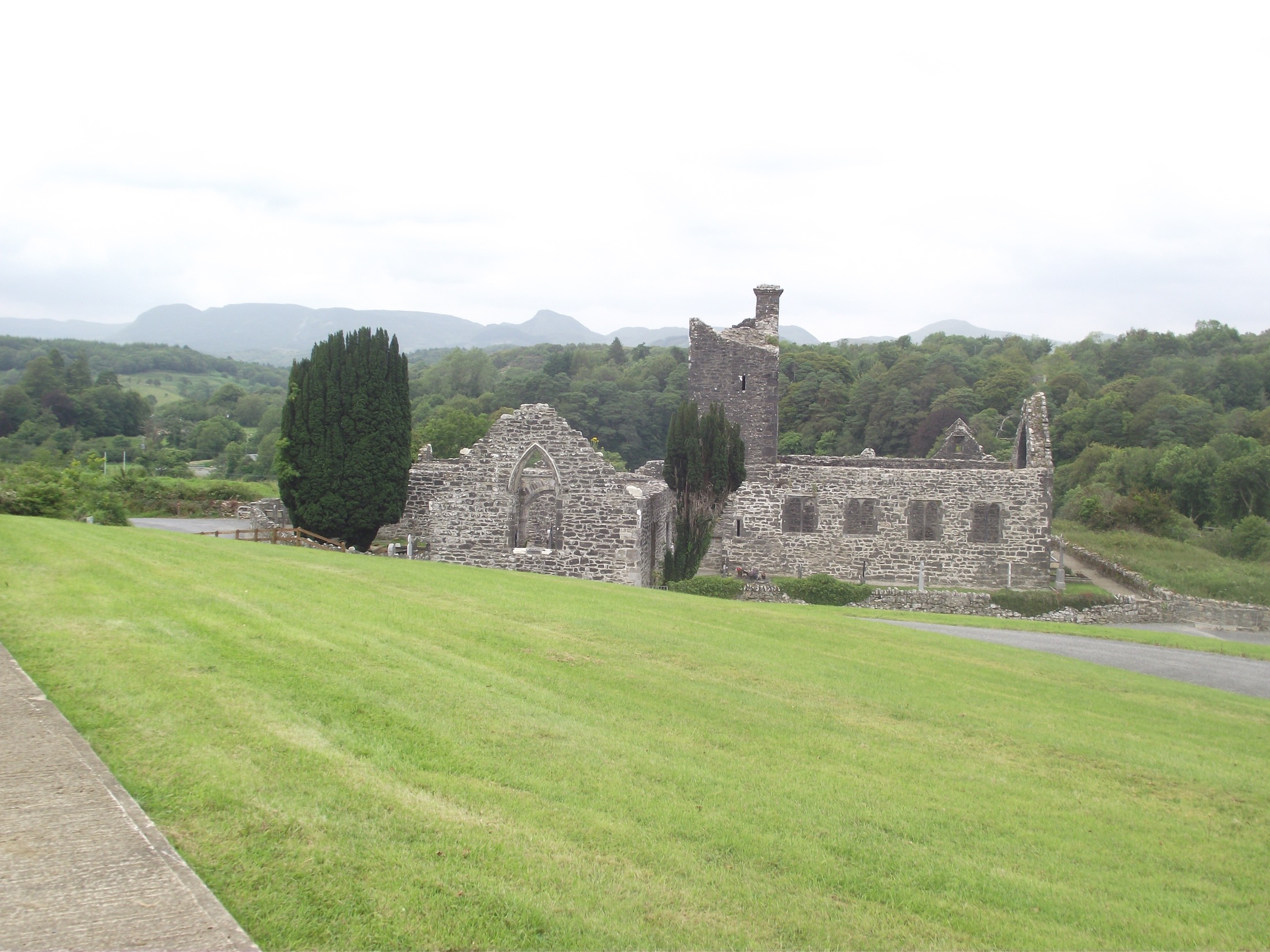
Leitrim & nearby Sligo · 1823–1923 · Memory recorded in 1938
Parish life
around Dromahair.
What did a parish mean in everyday life? Follow a place through its churches, schools, records and remembered traditions.
A place could belong to several different worlds at once. A household appeared in a civil census, a child in a Catholic register, and a school in an account of the locality. Each record draws a different outline around community life.
This reading follows Tullynascreen and the Dromahair area. You can explore the history on its own, or open a family example along the way.
01 · Place & belonging
One place.
More than one parish.
“Parish” needs a second question: which kind? Follow Tullynascreen from its townland outline into civil and religious geography. Change the layers to see why a county line did not contain every community.
01 / 04
Begin with Tullynascreen.
A townland is a named area of land, not necessarily a village. This one lies in County Leitrim. Its outline stays visible as you explore the larger areas.
Reading the map: townland, civil and county outlines are modern reference data for traditional divisions. The Catholic layer represents the mid-19th century approximately. Differences at its edges cannot establish which parish served a particular house.
Geography: © OpenStreetMap contributors / Townlands.ie · ODbL. Representative Catholic extent: National Library of Ireland · CC BY 4.0. Sources and downloads below.
Map sources, dates & a text alternative
Tullynascreen is within the mapped civil parish and County Leitrim. Boleymount is within that civil parish and County Sligo. The Catholic parish is separately catalogued in both counties. These are overlapping systems, not one hierarchy. No school catchment is drawn.
Townlands.ie / © OpenStreetMap contributors, ODbL 1.0 (2022 source snapshot; county outlines simplified for display). National Library of Ireland, Catholic Parish Registers geodata, CC BY 4.0, transformed from its original projection. This map is an orientation aid, not a historical boundary survey or a definition of the census populations below.
© OpenStreetMap contributors / Townlands.ie · ODbL. Catholic layer: NLI · CC BY 4.0. Links open new tabs.
Download layers: Townland ↗ · Civil parish ↗ · Catholic extent ↗ · Counties ↗ (new tabs).
Sources, licences and downloadable layers (new tab) ↗The civil parish helps locate land and census records. The Catholic parish leads to baptisms and marriages. For schools, another question matters: where was the school, and which children reached it?
How the historical records locate Tullynascreen
The 1901 Leitrim census places Tullynascreen in Killanummery civil parish and an electoral division also called Killanummery. These are different units. The NLI catalogue describes the Killenummery Catholic register, 1827–1883, in the Diocese of Ardagh, Counties Leitrim and Sligo.
Census place table (opens in a new tab) · Parish catalogue (opens in a new tab)
The map’s modern reference boundaries and the dated census units have not been reconciled at every edge. The population figures below retain their own census geography.
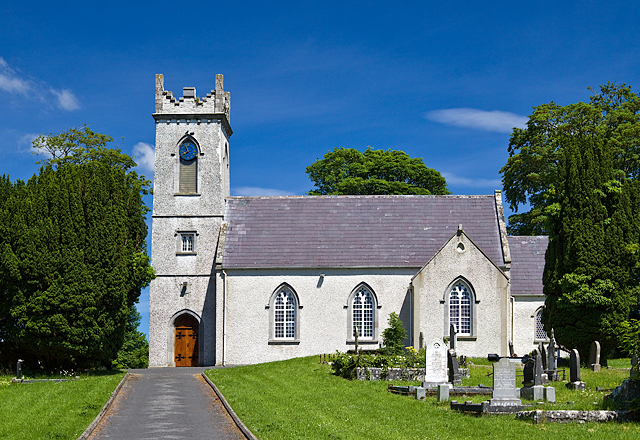 Drumlease · Church of Ireland · 2014
Worship & public authority
A changing
religious landscape.
- 1823–1837Tithe assessments record agricultural holdings supporting the established Church of Ireland.
- 1837A local account describes a Catholic union of Killenumery and Killery, with a chapel at Ballinagar.
- 1871Disestablishment takes effect. The Church of Ireland continues as a religious body.
- 1901The Leitrim census records two religious communities in its Killanummery row.
02 · Faith & authority
A religious community.
A public presence.
In his 1837 description, the writer Samuel Lewis placed Killenumery and Killery together in a Catholic union and named a chapel at Ballinagar. He described the established church’s organisation separately. Nearby Drumlease Church at Dromahair adds another visible part of this landscape: its rebuilding in 1816 was supported by a Board of First Fruits loan.
“Established” meant a formal relationship with the state. Tithe assessments supported the Church of Ireland through agricultural land. An occupier’s appearance in a tithe book therefore does not identify their denomination: church finance reached beyond the congregation.
Explore churches, tithes and the change in 1871
Lewis’s account describes a Catholic chapel and a separate established-church living. The architectural history of Drumlease concerns a different building; neither account establishes where a particular family ceremony took place.
The Irish Church Act was passed in 1869. Disestablishment took effect on 1 January 1871, ending the Church of Ireland’s established position while its congregations continued.
Lewis’s local account (opens in a new tab) · Drumlease’s building history (opens in a new tab) · Tithe records (opens in a new tab) · Disestablishment (opens in a new tab)
A charge on the land
What did a tithe mean?
One part in ten: the historic principle was a tenth of agricultural produce. The highlighted share makes that fraction visible.
From 1823, tithe composition converted the charge into a money assessment. A tithe-book entry is therefore not a bill for 10% of a family’s wages or total income.
Illustration of a fraction, not a reconstruction of one farm’s harvest or payment.
The obligation followed agricultural land, not church membership. A Catholic occupier could be assessed to support the established Church of Ireland.
Sources: National Archives guide ↗ · Lewis, 1837 ↗ (new tabs)
The charge could sit alongside the cost of supporting a household’s own clergy. Resistance to tithes became a national conflict in the early 1830s, especially in Leinster and Munster. That wider tension helps explain why a land assessment was also a question of power; it does not establish a local family’s part in resistance.
Two communities.
One census table.
Killanummery in the Leitrim report · 2,759 people
- Roman Catholic
- 2,516people recorded
- Protestant Episcopalian
- 243people recorded
Historical census categories for religious profession. These describe Killanummery in the 1901 Leitrim census, not the Catholic parish or attendance at worship.
Read the census row and its meaning
| Area / category | People |
|---|---|
| Killanummery · total | 2,759 |
| Roman Catholics | 2,516 |
| Protestant Episcopalians | 243 |
The table is headed parishes in County Leitrim. Its exact geography has not been reconciled with the modern cross-county reference outline on our map. The two returned totals account for the population in this row. They do not measure private belief or tell us how neighbours treated one another. Percentages above are calculated from these counts.
Open the census report at this table (new tab) ↗Meet a family in the parish book
An optional family example
The people around an entry
A register records roles as well as names. Choose an example to see how.
Reported marriage · 25 November 1861
- The couple
- Mary Conlon & Michael McPadden
- The witnesses
- John & Bridget Conlan
The witnesses took a recorded part in the marriage. Their relationship to the bride is unknown. The surviving entry is faint; its complete reading remains unconfirmed.
Reading notes & contributor credit
The reading was contributed by Anne Burgess, a family-history researcher who has helped the project. Credit belongs with the interpretation: the project has not independently recovered the complete entry.
Open the marriage register (new tab) ↗Schools at different scales
Killanummery electoral division · Census
194pupils attending during one week
Three mixed national-school establishments recorded 111 boys and 83 girls during the week ending 11 May 1901.
A weekly total across three establishments—not enrolment, daily attendance or class size. This electoral division differs from Lewis’s parish geography.
Read this source (new tab) ↗Different places, dates and measures: these snapshots cannot be joined into a single attendance trend.
03 · Learning & the school journey
A school nearby.
A place in the day.
School was part of the local landscape, but no single school served everyone. Lewis described seven places of learning in 1837. By 1901, the census recorded 194 pupils attending three mixed national schools in Killanummery electoral division during one May week.
Those figures put children into the picture without inventing their classrooms. Small schools were common nationally: in 1908, about 22% of Irish national schools had fewer than 30 children on their rolls. The local room sizes, teachers and pupils’ journeys still need their own records.
What was taught?
From the basics to a broader programme.
The national system began in 1831. Between 1872 and 1900, payments to teachers were linked to pupils’ examination results. The revised programme of 1900 sought more practical learning: drawing, singing, physical drill, and lessons using objects and elementary science.
English and arithmetic were compulsory; much of the wider programme depended on teachers’ preparation and available resources. A list of subjects in a rulebook was not every child’s timetable.
Explore the changing curriculum (opens in a new tab)Who went—and for how long?
The 1892 Education Act set an attendance obligation for ages six through fourteen where it operated, with exceptions that included proficiency certificates for children over eleven. It initially applied to specified urban places, with provision for county extension. It does not establish that every rural Leitrim child started at six or stayed until fourteen.
The Act recognised the absence of an acceptable school within this road distance as an excuse for non-attendance. For a child under seven, even a shorter journey could count as too far.
Illness, domestic necessity and necessary seasonal work were other recognised excuses. These provisions reveal competing demands on a child’s day; they do not tell us why a particular child missed school.
Between school and home: explore children’s work and responsibilities →
Was there a school district?
There were several kinds of school geography. The 1892 Act allowed districts for attendance committees. Inspectors also organised schools for supervision. Neither establishes a modern catchment assigning every house to one school. To reconstruct a school’s actual community, we need pupils’ home addresses and dated attendance records.
School hours, rooms and the evidence still to find
No local start-and-finish timetable, room dimensions or individual school route has yet been verified for this reading. We should not fill those gaps with an imagined “typical day.” National Archives school applications and registers can record premises and room dimensions; pupil registers, roll books and daily reports can reveal who came and how regularly.
The 1892 Act’s attendance provisions are evidence of national legislation, not proof of when they took effect locally. Its distance test followed roads, so the map does not draw a two-mile circle or invent a school catchment.
Read the attendance law (opens in a new tab) · How school records work (opens in a new tab)
No school here is identified as Mary Conlon’s. Continue with language and literacy →
Different kinds of help
Beyond the
religious parish.
- Dispensary medicine
- A medical officer, consultations and home visits. Free attendance required a ticket under the reorganised system.
- Residential poor relief
- The workhouse offered institutional support for people in need. This was a civil system, governed beyond the church parish.
- Infirmary treatment
- Sick patients received care. From 1862, workhouse hospitals could formally admit people who were not destitute.
04 · Illness, support & public responsibility
When a household
needed help.
Illness could bring a family into contact with a doctor, an institution and an authority whose area was wider than its religious parish. The dispensary system reorganised in 1851 provided medical attendance and home visits. Entering a residential workhouse or its infirmary was a different encounter.
Manorhamilton’s workhouse opened in December 1842. The surviving stone building stands above the town. Its long life crossed the Famine, changing medical services and a later hospital system: “the workhouse” did not mean an unchanging experience across those decades.
Read the history of these services (opens in a new tab) · Explore the surviving building (opens in a new tab)
A local decision · January 1914
Would a patient’s pension pay for his care?
A letter to the Manorhamilton Board of Guardians raised that question about infirmary maintenance. The Board directed that the patient should not be charged. Here, a small surviving decision makes the administration of care tangible.
The patient and what the record can tell us
The patient is named Thomas McPadden. His identification with the older Thomas of Tullynascreen remains probable; he should not be confused with Mary’s younger son Thomas, born in 1876, whose story follows Scotland and a return to Leitrim.
The letter is dated 7 January 1914; the meeting date is unconfirmed. It records an appeal and decision, not a payment account or a description of the patient’s ward, illness, meals or treatment.
What did better care look like?
A later Leitrim scheme, printed in the 1923 Act, makes the ambitions concrete. It distinguished a medical and surgical hospital, a fever hospital and a home for older and chronically ill residents. Proposed improvements included:
- Extending electric lighting
- New baths and lavatories
- Brighter, airier wards
- An operating theatre
These were recommendations, not proof that every improvement happened. They show what reformers wanted to change, rather than what the patient experienced at his bedside in 1914. Read the dated proposals (opens in a new tab)
Explore the household work and exchange behind making a living →
Dromahair · Schools’ Collection
1938Recorded on 10 December
A place.
A family’s hope.
A remembered practice.
05 · Belief & local memory
A place could hold
more than a record.
Religious history also survives in stories about places. An account collected at Dromahair in 1938 describes a tradition at Creevalea Abbey: a relative took clay from a priest’s grave to a sick person’s home, and later returned it.
Here, the connection between a sacred place and a household appears through an act of care and hope. The account adds something a census cannot: a recorded belief about illness, kinship and a place’s meaning.
Meet the account and its collector
“Old Graveyards” was recorded by Maurice Gillmor for the Schools’ Collection at Drom Dhá Eithear. He signed the manuscript on 10 December 1938. No informant is identified.
The account is evidence of a tradition recorded at that date. It does not establish medical efficacy, how common the practice was in the nineteenth century, or any McPadden’s participation.
Credit: Maurice Gillmor, National Folklore Collection, UCD, Schools’ Collection, volume 0199, page 009, via Dúchas. This is an original summary; the manuscript is not reproduced.
Explore the dated account (opens in a new tab)Read alongside the churches, schools and registers, this later memory gives the locality another dimension. Each source offers a different encounter with community life—and each belongs to its own time.
Try a historical question
Could this account tell us what a family believed in 1861?
Consider the evidence
It can suggest a question worth investigating. It cannot supply the answer by itself: it was recorded in 1938, its informant is unnamed, and no connection to that family is established. A later tradition enriches the history when its date and source stay visible.
Keep exploring
Follow a question.
Or follow a life.
Follow the evidence
The sources behind
this reading.
Personal records and county history answer different questions. Open a note for its precise location and scope.
Source links marked ↗ open in a new tab. Stories, readings and sections open here; your story chapter stays available through the return link.
Tullynascreen’s civil-parish geography, 1901Census of Ireland · Central Statistics Office historical archive
County of Leitrim report, Table VII, printed page 21 (PDF page 29); Manorhamilton Union, Drumahaire district, Killanummery DED, heading Drumahaire barony and Killanummery parish; Tullynascreen row.
What it supports. Tullynascreen is listed within Killanummery civil parish and Killanummery electoral division in 1901.
How to read it. Civil parish and electoral division are distinct units even where they share a name. The table is not a Catholic parish boundary map. The interactive map uses separately credited modern reference geography and representative Catholic-parish data; these are not exact 1901 boundaries.
Reuse. Source: Census of Ireland, 1901, County of Leitrim, Table VII, digitised by the Central Statistics Office. Place classifications selected by the McPadden Project; no scan or geographic boundary data reproduced. CSO statistical information: CC BY 4.0.
Open source (new tab) ↗Source MCP-CONTEXT-TULLYNASCREEN-PARISH-GEOGRAPHY · Checked 2026-10-29The Catholic parish and its surviving registerNational Library of Ireland
Catholic parish of Killenummery, Diocese of Ardagh, Counties Leitrim and Sligo; parish register 1827–1883, microfilm 04241/01.
What it supports. The Catholic parish’s name, diocese, two-county description and surviving record series.
How to read it. A catalogue describes the surviving register. It is not a parish boundary survey, a complete list of residents or proof of the building used for a particular ceremony.
Reuse. Catalogue link and original paraphrase only. No new NLI image is reproduced; the register images retain their own terms.
Open source (new tab) ↗Source MCP-CONTEXT-KILLENUMMERY-REGISTER · Checked 2026-10-29Mary and Michael’s reported marriage, 1861National Library of Ireland · Reading attributed to Anne Burgess
Killenummery Catholic parish, Diocese of Ardagh, microfilm 04241/01, digital image 226; reported marriage of 25 November 1861.
What it supports. Anne Burgess’s reading names Michael McPadden and Mary Conlon, with John and Bridget Conlan as witnesses.
How to read it. The correct surviving page is very faint. The project has not independently recovered the complete entry. Witnesses’ kinship to Mary and the ceremony’s exact building are unestablished.
Reuse. Attributed findings and a link to the NLI original. No new scan, crop or facsimile is reproduced here; the existing story image has its separate scoped permission.
Open source (new tab) ↗Source MCP-IRL-1861-MARRIAGE · Checked 2026-10-29Bridget’s baptism and sponsors, 1838National Library of Ireland
Killenummery Catholic parish, Diocese of Ardagh, microfilm 04241/01, digital image 59; baptism of Bridget, 13 January 1838.
What it supports. Parents James McPadden and Betty Murphy; sponsor names James McPadden and Mary Clerkin in the project’s checked reading.
How to read it. The identity of the sponsor named James remains unresolved. Sponsor names establish recorded roles, not kinship or co-residence. Ancestry linking this family to Mary Conlon’s household remains probable, not proved.
Reuse. Original summary and archive link only. This image is not included in the current public edition and is not reproduced here.
Open source (new tab) ↗Source MCP-CROSSINGS-VTLS000632439_059 · Checked 2026-10-29Tithes and the established churchNational Archives of Ireland
Sources for Family History, sections 4.1 and 4.1.2, PDF page 10; assessments compiled in 1823–1837.
What it supports. The historic tenth of agricultural produce, monetary composition after 1823, denomination-independent assessments and national resistance in the early 1830s.
How to read it. The books are not a list of church members; a person’s assessment does not establish their religious affiliation. A general explanation does not prove an individual payment or response to tithes.
Reuse. Link and original paraphrase. No tithe-book image is reproduced.
Open source (new tab) ↗Source MCP-CONTEXT-TITHES-AND-CHURCH · Checked 2026-10-29The end of the Church of Ireland’s establishmentChurch of Ireland
Church teaching: Disestablishment; Irish Church Act 1869 and its commencement on 1 January 1871.
What it supports. Disestablishment took effect on 1 January 1871 under the 1869 Act.
How to read it. An institutional account of a national change; it does not establish any McPadden’s religious or political views.
Reuse. Link and original paraphrase of the institutional history. No extended quotation or image reproduced.
Open source (new tab) ↗Source MCP-CONTEXT-DISESTABLISHMENT · Checked 2026-10-29Drumlease Church of Ireland at DromahairNational Inventory of Architectural Heritage
Record 30806013, Dromahair Church, Drumlease, survey 2003; dates 1806 and rebuilding in 1816.
What it supports. A nearby Church of Ireland building, with rebuilding supported by a Board of First Fruits loan.
How to read it. A modern architectural inventory, not a contemporary attendance record. The building is not identified as a McPadden place of worship or a family ceremony location.
Reuse. Original paraphrase and inventory link; no building photograph or survey image reproduced.
Open source (new tab) ↗Source MCP-CONTEXT-DRUMLEASE-CHURCH · Checked 2026-10-29Religious professions in the civil parish, 1901Census of Ireland · Central Statistics Office historical archive
County of Leitrim report, Table XXIX, printed page 66 (PDF page 74), Killanummery civil-parish row.
What it supports. A total of 2,759 people: 2,516 returned as Roman Catholic and 243 as Protestant Episcopalian.
How to read it. Civil-parish totals are not Catholic-parish or townland totals. The table is headed parishes in County Leitrim; its precise geography has not been reconciled with the modern cross-county reference outline. These census categories record religious profession, not attendance, private belief, political opinion or the quality of relations between neighbours.
Reuse. Source: Census of Ireland, 1901, County of Leitrim, Table XXIX, digitised by the Central Statistics Office. Figures selected by the McPadden Project; no scan reproduced. CSO statistical information: CC BY 4.0.
Open source (new tab) ↗Source MCP-CONTEXT-KILLANUMMERY-RELIGION-1901 · Checked 2026-10-29Killenumery and Killery in 1837Samuel Lewis, A Topographical Dictionary of Ireland · Digitisation hosted by Logainm
1837 dictionary, entries Killenumery and Killery, printed pages 141–142 (PDF pages 816–817).
What it supports. Killenumery’s Catholic union with Killery and chapel at Ballinagar; separate established-church organisation; a description of one public and six private schools in Killenumery; £220 in tithes divided £150 to the vicar and £70 to the impropriator.
How to read it. A dated descriptive account, not an individual attendance record or proof of the building used for Mary’s marriage. Its public/private school labels must not be assumed to describe modern sectors, fees, denomination or management.
Reuse. Original paraphrase of the historical text with a link to the digitisation. No scan or modern transcription reproduced.
Open source (new tab) ↗Source MCP-CONTEXT-KILLENUMERY-LEWIS-1837 · Checked 2026-10-29Townland, civil-parish and representative Catholic boundariesTownlands.ie / OpenStreetMap contributors; National Library of Ireland
Selected OSM reference polygons (2022 snapshot); NLI parish 171, pinned repository source.
What it supports. Overlapping townland, civil parish and county geography; representative Catholic extent across Leitrim and Sligo.
How to read it. Not a synchronised historical survey. NLI warns its outlines are not geographically accurate. No school catchment or individual ceremony location is established.
Reuse. OSM derived layers offered under ODbL 1.0; NLI geometry under CC BY 4.0. Separate download files and full attribution in the map notes.
Open source (new tab) ↗Source MCP-CONTEXT-BOUNDARY-DATA · Checked 2026-11-05Schools and weekly attendance in Killanummery electoral divisionCensus of Ireland · Central Statistics Office historical archive
Leitrim, Table XXXVIII, printed page 91 / PDF page 99; week ending 11 May 1901.
What it supports. Three mixed national-school establishments; 111 male and 83 female pupils, total 194, attending during the specified week.
How to read it. Electoral division, not parish; weekly attendance, not enrolment, daily attendance, class size or the whole school-age population. Different geography and measures from Lewis.
Reuse. Selected statistical figures, original presentation; no scan reproduced. CSO statistical information: CC BY 4.0.
Open source (new tab) ↗Source MCP-CONTEXT-LOCAL-SCHOOLS-1901 · Checked 2026-11-05The scale of small national schools in 1908Cloudesley Brereton · US Commissioner of Education report for 1910
Education in Ireland, printed page 559 / extract PDF page 13.
What it supports. 1,830 of 8,336 national schools, about 22%, had fewer than 30 pupils on the rolls in 1908.
How to read it. All-Ireland enrolment comparison, not local attendance or room size. The report’s causal opinions about school organisation are not adopted.
Reuse. Original paraphrase of the historical report; no scan reproduced.
Open source (new tab) ↗Source MCP-CONTEXT-SMALL-SCHOOLS-1908 · Checked 2026-11-05A changing national-school curriculumTom Walsh · Maynooth University research repository
The National System of Education, 1831–2000 (2016), printed pages 19–20 and 30–31.
What it supports. The 1872–1900 payment-by-results period, revised 1900 curriculum and uneven implementation dependent on teachers and resources.
How to read it. Historical scholarship about the national system; it does not reconstruct a named local classroom or an individual pupil’s day.
Reuse. Brief original paraphrase and repository link; no reproduced table or extended quotation.
Open source (new tab) ↗Source MCP-CONTEXT-SCHOOL-CURRICULUM · Checked 2026-11-05School attendance, ages, distance and administrative districtsIrish Education Act 1892 · official legislation digitisation
55 & 56 Vict. c.42, sections 1, 3 and 15; schedules.
What it supports. Qualified attendance obligations, age range, road-distance and other excuses, attendance committees, initial territorial application and extension mechanism.
How to read it. National legislation, not evidence of rural Leitrim implementation date or a family’s actual schooling. Districts for administration are not demonstrated school catchments.
Reuse. Original explanation and link to historical legislation; no scan reproduced.
Open source (new tab) ↗Source MCP-CONTEXT-SCHOOL-ATTENDANCE-1892 · Checked 2026-11-05Dispensaries, workhouse hospitals and ManorhamiltonNational Archives of Ireland
Survey of Hospital Archives in Ireland (2014–15), pages 6–7 and 46–47.
What it supports. Distinct relief and medical functions; dispensary reorganisation in 1851; non-destitute hospital admission from 1862; Manorhamilton workhouse opening in December 1842 and later reorganisation.
How to read it. A later archival survey, not evidence of Thomas’s diagnosis, ward, daily routine or treatment in 1914.
Reuse. Original summary and institutional source link. No photographs or pages reproduced.
Open source (new tab) ↗Source MCP-CONTEXT-CARE-ARCHIVES · Checked 2026-11-05The surviving Manorhamilton workhouseNational Inventory of Architectural Heritage
Record 30805030, surveyed 14 July 2003.
What it supports. The 1842 stone former workhouse and its position above the town.
How to read it. A modern building inventory, not a complete historical hospital plan or evidence of one patient’s experience.
Reuse. Brief original paraphrase and source link; no photograph reproduced.
Open source (new tab) ↗Source MCP-CONTEXT-MANORHAMILTON-BUILDING · Checked 2026-11-05Proposed facilities in the Leitrim County SchemeIrish Statute Book · Local Government (Temporary Provisions) Act 1923
First Schedule, Leitrim County Scheme, Details for bringing scheme into operation, paragraphs 1–2.
What it supports. Distinct hospital, fever hospital and county-home functions; proposed electric lighting, baths, lavatories, improved wards and operating theatre.
How to read it. Recommendations in the later scheme; not proof of completion and not a reconstruction of conditions in 1914.
Reuse. Original paraphrase and link to enacted historical legislation.
Open source (new tab) ↗Source MCP-CONTEXT-LEITRIM-CARE-1923 · Checked 2026-11-05How school records workNational Archives of Ireland
Education records research guide; National Education Board and school registers, roll books and daily report books.
What it supports. The National Education Board dates to 1831; different school records document enrolment and attendance.
How to read it. A national institutional history does not establish Mary’s childhood, school attendance or the reason for her recorded literacy.
Reuse. Link and original paraphrase only; no archive images or extended extracts reproduced.
Open source (new tab) ↗Source MCP-CONTEXT-NATIONAL-SCHOOL-RECORDS · Checked 2026-10-29An appeal to the Manorhamilton Guardians, 1914Leitrim County Library · Manorhamilton Board of Guardians
BG117/A/109, December 1913–May 1914, page 7; letter headed Dromahair, 7 January 1914. The meeting date is unconfirmed.
What it supports. An appeal concerning a patient named Thomas McPadden and use of his pension for infirmary maintenance; the Board’s recorded direction not to charge the patient.
How to read it. Identification with the older Thomas of Tullynascreen remains probable. The letter reports what its writer had heard; it is not a payment account. A clerical role for the writer is not established. It does not demonstrate parish-funded care or Mary’s involvement.
Reuse. Original summary and link to the existing public source record. The library-approved image has its own scoped display permission; no new reproduction is made here.
Open source →Source MCP-IRL-1914-THOMAS-PENSION · Checked 2026-10-29Old Graveyards, recorded in 1938National Folklore Collection, UCD · Dúchas
Schools’ Collection, volume 0199, page 009; Drom Dhá Eithear school, roll 10825. Item signed Maurice Gillmor, 10 December 1938. School metadata names teacher Emily Nic Adhairt; no informant is identified for this item.
What it supports. Gillmor’s dated account of a tradition involving clay from a priest’s grave at Creevalea Abbey, taken to a sick person’s home and later returned.
How to read it. Evidence of a tradition recorded in 1938, not of medical efficacy, its prevalence in 1861, Mary’s participation or her burial. The unnamed informant must not be identified as the teacher, a parent or another person without evidence.
Reuse. Original paraphrase and item link only. Manuscript images and item data are credited to the National Folklore Collection, UCD; no scan or extended transcription is reproduced. Item-specific terms remain separate from the project’s writing and other source licences.
Open source (new tab) ↗Source MCP-CONTEXT-DROMAHAIR-GRAVEYARDS-1938 · Checked 2026-10-29
Reviewed · Interactive boundary comparison, expanded schooling and care, tangible tithe explanation and credited parish imagery. Suggest a correction or share local knowledge.