
The people who remained
1901–1914 · A household, a pension and a request for care
AI-generated imagined workhouse courtyard · Not the actual Manorhamilton Workhouse or a reconstruction of its buildings.
Three generations on one return
By 1901, we can look inside one household through the census. Its head is Thomas McPadden, husband of Hannah—called Honora Cosgrave in their marriage entry—and the strongest candidate for Michael McPadden’s brother. Michael and his wife, Mary Conlon, raised their family in Tullynascreen. Their son James later emigrated to Connecticut; his journey is told in A Ticket to Bridgeport. If this identification is correct, the older Thomas was James’s uncle. Michael’s 1883 death return explicitly names a brother Thomas as informant, present at death; matching that brother to this household remains probable. He is not the younger Thomas, Michael’s son, whose life with Alice Hendry is told elsewhere.
Thomas is recorded as sixty-six, a farmer. Hannah, his wife, is seventy. With them are their married son Thomas, his wife Mary, and a grandson also named Thomas—just three months old.
Three Thomases on one census return: grandfather, son and infant grandson.
The repetition can make research difficult. The relationships written beside the names make this household intelligible. These are people living together on census night, rather than names we have assembled merely because they match.
The census cannot tell us who held the baby, divided the work or made the decisions. It does show a family life continuing in the place from which other stories would depart.
Hannah’s last record
Hannah dies at Tullynascreen on 8 November 1910. The death return describes her as the wife of Thomas McPadden, farmer, and names their son James as present at death.
Her reported age is eighty-three, older than the age implied by the 1901 census. We keep both readings rather than manufacture a precise birthday.
By the 1911 census, Thomas is a widower. He is still in the household with his married son Thomas, daughter-in-law Mary and, now, five grandchildren.
The record of a continuing household does not mean that its circumstances stood still.

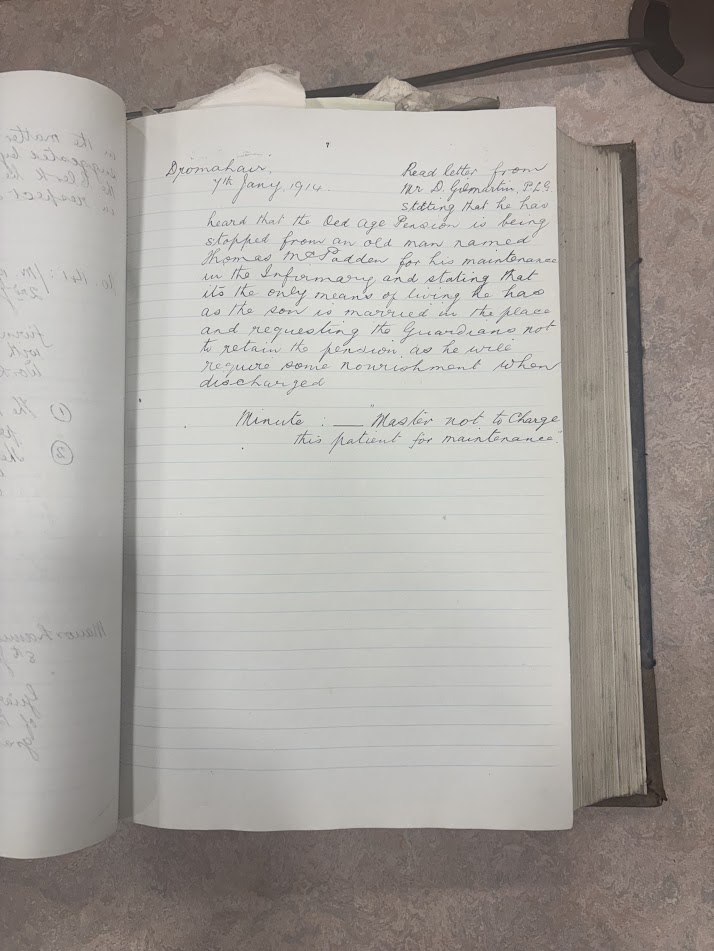
Master not to charge this patient for maintenance.
Enough to live on
January 1914 · Manorhamilton infirmary
A Board of Guardians minute preserves a request concerning an elderly patient named Thomas McPadden.
The letter is headed Dromahair, 7 January 1914. Its writer says he has heard that Thomas’s old-age pension is being stopped to pay for his maintenance in the infirmary. He describes it as Thomas’s only means of living and asks that it not be retained: Thomas will need nourishment when discharged. An unnamed son is said to be married locally.
This was support for old age. The state pension scheme began in January 1909 under the 1908 Act, providing means-tested payments to eligible people aged seventy and over. It came from taxation and required no earlier contributions. The maximum at this time was five shillings a week. We do not know Thomas’s actual rate or when his payments began.
For the man described in the letter, this money was what he would depend on outside the infirmary. If it paid for his time in the institution, what would he have to live on when he came out?
The Guardians’ recorded decision is brief:
Master not to charge this patient for maintenance.
The minute strongly fits the older Thomas from Tullynascreen. It does not give his townland, age, wife’s name or the son’s name, so the identification remains qualified.
It also preserves different kinds of evidence. The pension being stopped is something the letter writer reports hearing. The direction not to charge the patient is the Board’s recorded decision. We have no payment account showing what was actually withheld or refunded.
A return contemplated
The request looks ahead to discharge. It does not prove that discharge happened.
The death return for the older Thomas from Tullynascreen records his death at Manorhamilton Workhouse on 19 January 1914, a widower and farmer, aged seventy-nine. If the letter concerns the same man, it was written twelve days before he died.
We should not turn those days into a scene we cannot know. Nor should we mistake infirmary care for evidence that his family abandoned him. The record supports illness and financial vulnerability; it does not describe a family quarrel or a refusal to help.
What survives is an appeal on his behalf, and a decision that his maintenance should not be charged.