
Harvesting · A handful at a time
Cut and gather.
A sickle cut a handful at a time; a scythe swept a wider swathe. Women as well as men took part in harvesting. Cutting and gathering brought in stalks with the grain still attached.
Dromahair & its surroundings · County Leitrim
Behind a fire, a meal and clean clothes lay a world of work.
Centred on the early twentieth century,
with a look back at the lives and practices it inherited.
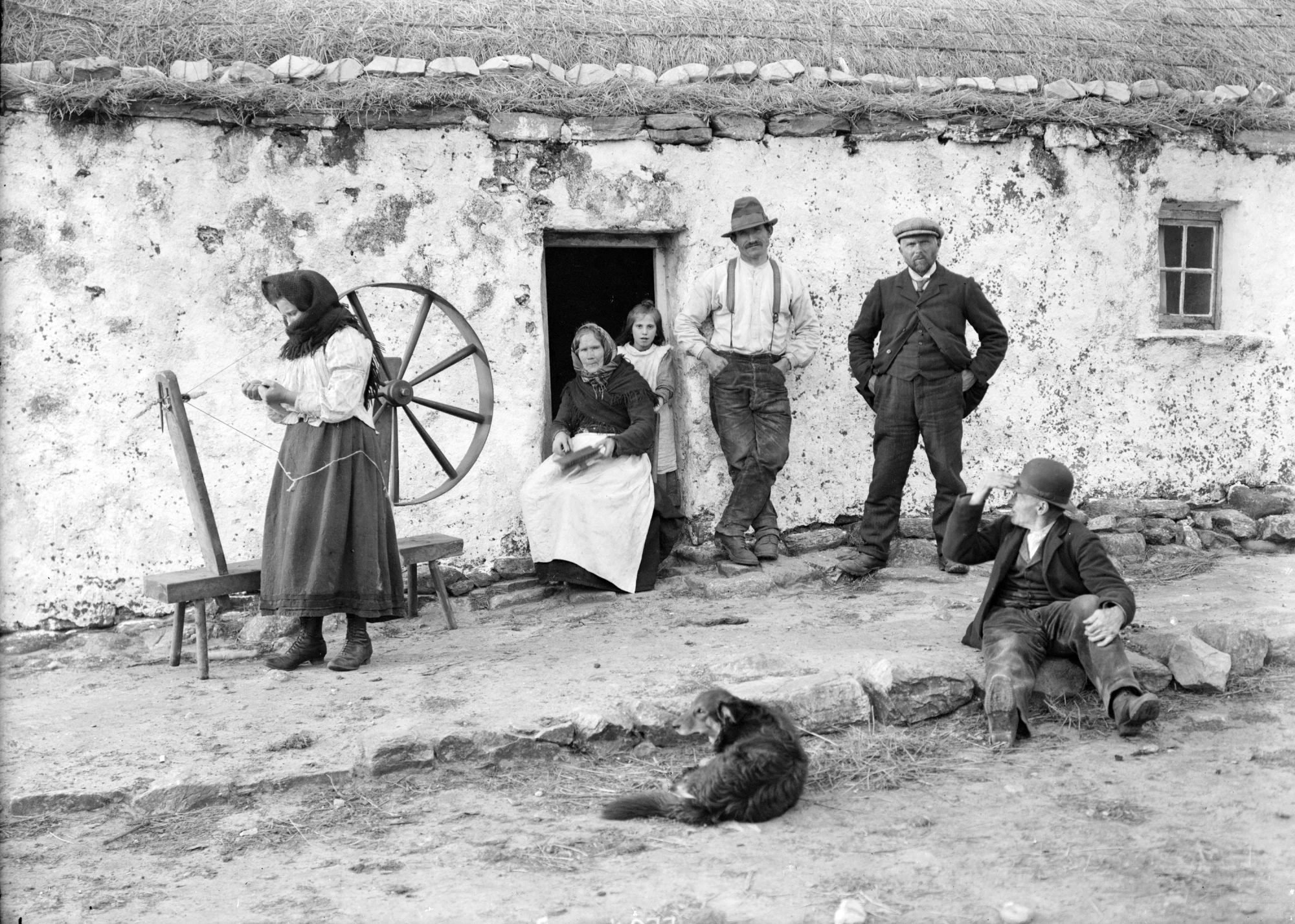
Before our starting point
A household around 1900 carried a nineteenth-century history with it. The Great Famine of the 1840s, deaths and emigration had changed Leitrim’s communities. For a tenant, working the land did not mean owning it: rent was a claim on household resources. Later struggles over tenants’ rights and land purchase changed that relationship. The familiar tasks of making a meal or tending a fire continued within that changing world.
Our window opens around the turn of the century because household records and later local memories let us look closely. 1900 is a focus, not a dividing line. An older practice might persist beside a new purchase. Nor did a farm household, a labourer’s home and a village shopkeeper’s family necessarily have the same resources.
Six subjects lead us through the work of keeping a home. Local memories anchor the reading; labelled comparisons help explain tools and practices. A recollection recorded in 1938 may describe an earlier time, so we distinguish the date of a record from the life it remembers.
Explore at your own pace. Read straight through, or choose a subject and return for the others. Each section can be read on its own. Choose a section ↓
 Enlarge photograph ↗
Robert French / Lawrence Collection, National Library of Ireland. No known copyright restrictions · Source ↗. Resized and encoded for the web; no retouching. Full credits and licence links ↗
Irish practice · A Mayo comparison for drying
A slane cut the wet peat into sods. Its form varied: some were driven down with the foot, others cut horizontally into the exposed bank. Cutting was only the first handling of the fuel.
01 · Hearth & fuel
The fire was the end of a journey. Before turf could burn in a kitchen, wet peat had to be cut, dried, handled again and brought home. The fuel for an evening depended on work done much earlier in the year.
A slane was a specialised turf spade. Different forms cut downwards or into the face of a bank. The sods were spread on the ground away from the cutting face before being stacked. Every change of position meant handling the fuel again. See the tools and regional differences (opens in a new tab)
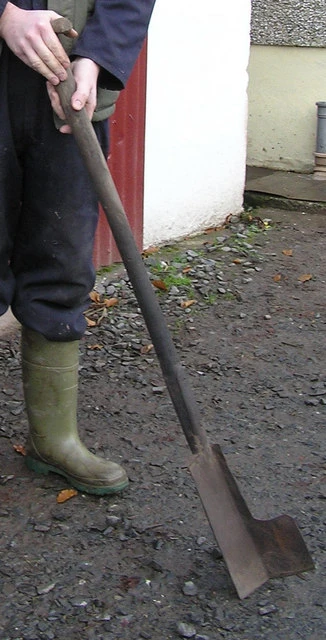
Look at the tool
A slane, or turf spade.Follow the long shaft down to the narrow blade. The projecting side wing gives this example a second cutting edge for shaping a sod.
The hands and boot give a sense of scale. Slanes came in different forms; this is a family tool photographed at Errigle, County Tyrone, in 2008.
Inspect the blade at full size ↗
Kenneth Allen / Geograph · CC BY-SA 2.0 ↗ · Photograph record ↗. WebP encoding; no retouching.
From wet peat to drying sods · Schematic
In a later account of family turf work at Carracastle, County Mayo, Jim Regan describes bending to turn sods, arranging small drying heaps and moving light cartloads to a bog road before taking the fuel home. He gives six weeks in ideal weather as one estimate of the saving period. It is a useful sense of scale, not a drying time established for Leitrim.
Drying outdoors meant working around the weather. Access mattered too: a cart could save carrying, yet soft bog ground limited how heavily it could be loaded. Read the Carracastle account and its setting (opens in a new tab)
Back inside · Heat, smoke and shared space
The hearth brought cooking and warmth into the same place. A pot at the fire and a seat beside it put everyday work close to the heat. But an open hearth could also mean living with smoke.
Jim Cunningham’s Newtownmanor account, recorded in 1938, remembers older kitchens with a fire in the gable and no chimney flue: smoke spread through the house. He is describing an earlier world, not surveying every home in 1938. Read the local description of smoky kitchens (opens in a new tab)
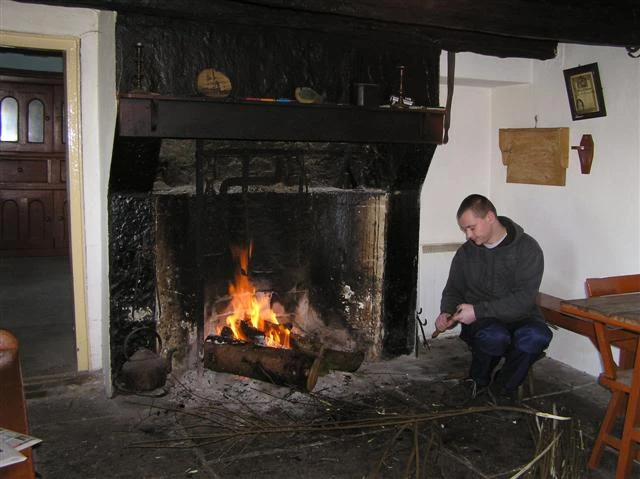
Kenneth Allen / Geograph · CC BY-SA 2.0 ↗ · Photograph record ↗. WebP encoding; no retouching.
Where there was a functioning chimney, rising hot gases helped draw smoke up the flue and air towards the fire. Older houses without that provision could lose smoke through the thatch, doorway or a small opening. A smoky room and a chimney drawing smoke outside belong to different arrangements; we should not picture every cottage as the same.
“I thought it was just the smell of the country”
She later recognised that smell as turf smoke. Her recollection gives the fire a presence beyond the hearth: it reached a child arriving at the gate. Published in 2023–2024, this later Sligo memory conveys the distinctive scent of turf smoke. Read “Country Kitchens”, page 67 (opens in a new tab)
The Newtownmanor account places a settlebed in a corner: seating that became a bed. The photographs below let us see that change in an example displayed at Seán Mac Diarmada’s house in Kiltyclogher, County Leitrim.
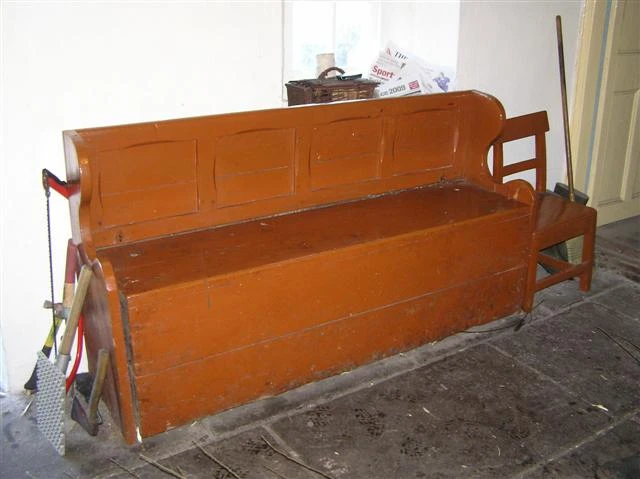
The closed front supports a broad seat beneath the high back. Compare the next photograph to see where the sleeping space appears.
Seán Mac Diarmada’s house, near Kiltyclogher, County Leitrim · Both views photographed 12 January 2009. The furniture’s manufacture date and original provenance are not established by these photographs.
Kenneth Allen / Geograph · CC BY-SA 2.0 ↗ · Photograph record ↗. WebP encoding; no retouching.
This heritage-house example shows how a settlebed worked; it does not establish how common this design was or how other cottages were furnished.
Making room for a household
A settlebed was one part of the sleeping arrangements. The National Museum describes it as a common rural bed, alongside ordinary bedsteads and an outshot bed built into a small recess beside the hearth. “Common” does not tell us how many Dromahair households owned one. Explore the museum’s different bed types (opens in a new tab)
More than one person could share. Furniture historian Claudia Kinmonth describes settle beds opening into double sleeping spaces. Different kinds of beds and rooms used for more than one purpose could make space for a household. We have no local count of beds or record of who shared them. Read how beds made room for a family (opens in a new tab)
A later Galway account recalls parents and the youngest baby in a small bedroom, with other children sharing beds in a larger room—sometimes four or more children, some at each end. It also describes a kitchen settlebed with a straw-filled mattress.
A regional recollection reproduced from Abbeyknockmoy — A Time to Remember, page 128. Its phrase “pre war” gives no precise year; this is not a room plan or sleeping arrangement established for Leitrim. Read the remembered household arrangement (opens in a new tab)
One room, two uses · Illustrative plan
The kitchen has a bench and more room for moving about. The adjoining room already contains a bed.
Behind the hearth · The land supplying the fuel
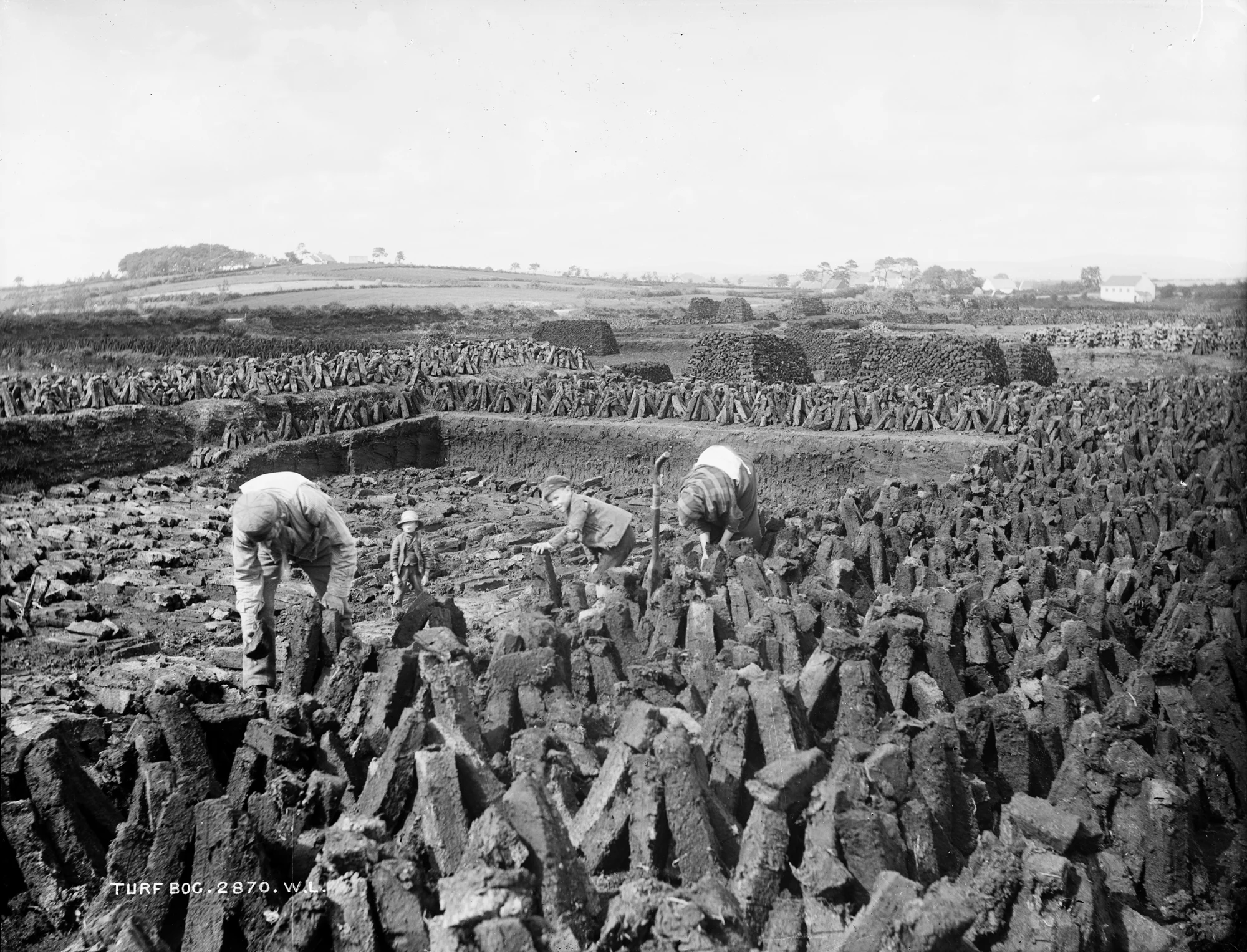
Drying turf took weeks. Making the peat beneath it took centuries and millennia. Those two timescales shaped what a bog could supply.
Background: turf drying near Ballymena, County Antrim, 1880s? · Robert French / Lawrence Collection, National Library of Ireland. A comparative scene. Photograph & reuse notes ↗
Not necessarily. Fuel could come from a separate parcel or a larger bog shared by several users. The journey home was part of the work, and access depended on the land and the right to cut there.
A report published in 1905 records a farmer cutting turf at Drumconnor bog, a few miles from Creevelea, when he found a vessel of butter buried in the peat. This is a contemporary glimpse of cutting in the wider Dromahair area; it does not identify the bog supplying a Tullynascreen household. Read the 1905 report (opens in a new tab)
Both individual and shared arrangements existed. Turbary means a right to cut turf for fuel. Having that right was different from owning the whole bog. A 1906 parliamentary reply, for example, records the purchase of a one-fifteenth share in a 73-acre turf bank in County Galway.
Another reply, concerning an estate in Longford and Leitrim in 1905, distinguishes rights attached to a holding from the trustees managing a bog. “Shared” therefore did not necessarily mean that anyone in the village could cut wherever they wished.
Cutters worked into peat that was already there. A Milltown, County Galway, heritage account describes opening the next bank beside the previous year’s cut, leaving a lower, worked-out area behind. Several groups could be working their own plots within the same bog.
That helps explain the changing face of a hand-worked bog: cutting advanced into the remaining supply. It was not a yearly crop growing back in the hole. Methods and the size of each cut varied. Follow the bank-cutting explanation, pages 1–2 (opens in a new tab)
Yes—exhaustion was a real experience. An 1837 description of County Derry reports that people turned to mountain bogs after supplies in fertile, densely inhabited districts were exhausted. This is an earlier comparison, not a record of Dromahair. Read the 1837 account’s final paragraph (opens in a new tab)
A household’s usable bank could run out while peat remained elsewhere. How long a supply lasted depended on the bank, the amount taken and access to other ground. These examples establish that exhaustion happened; they do not tell us whether it was common or rare around Dromahair.
Explore the timescale · Illustrative calculation
Waterlogged conditions slow the decay of dead plants, allowing peat to accumulate. The Irish Peatland Conservation Council gives about 1 millimetre a year for active peat growth.
A scale comparison, not a recovery forecast. Growth varies, and a drained or cut bog does not automatically resume peat formation. Returning vegetation is not the same as a replaced fuel bank.
How peat accumulates in a living bog (opens in a new tab) · Why a drained bog does not simply refill (opens in a new tab)
02 · Food
Between the two lay a chain of hands, tools, water and fire.
Cutting the crop was only the beginning. Grain had to be freed from the stalk, cleaned and processed before it reached a cooking pot or griddle. Follow that work into the mill, then back to the household waiting for its meal.
Holding · From standing crop to loose grain
A cut stalk was still a long way from food. Harvesting brought the crop down; threshing released the grain it carried.
A sickle cut a handful at a time; a scythe swept a wider swathe. Women as well as men took part in harvesting. Cutting and gathering brought in stalks with the grain still attached.
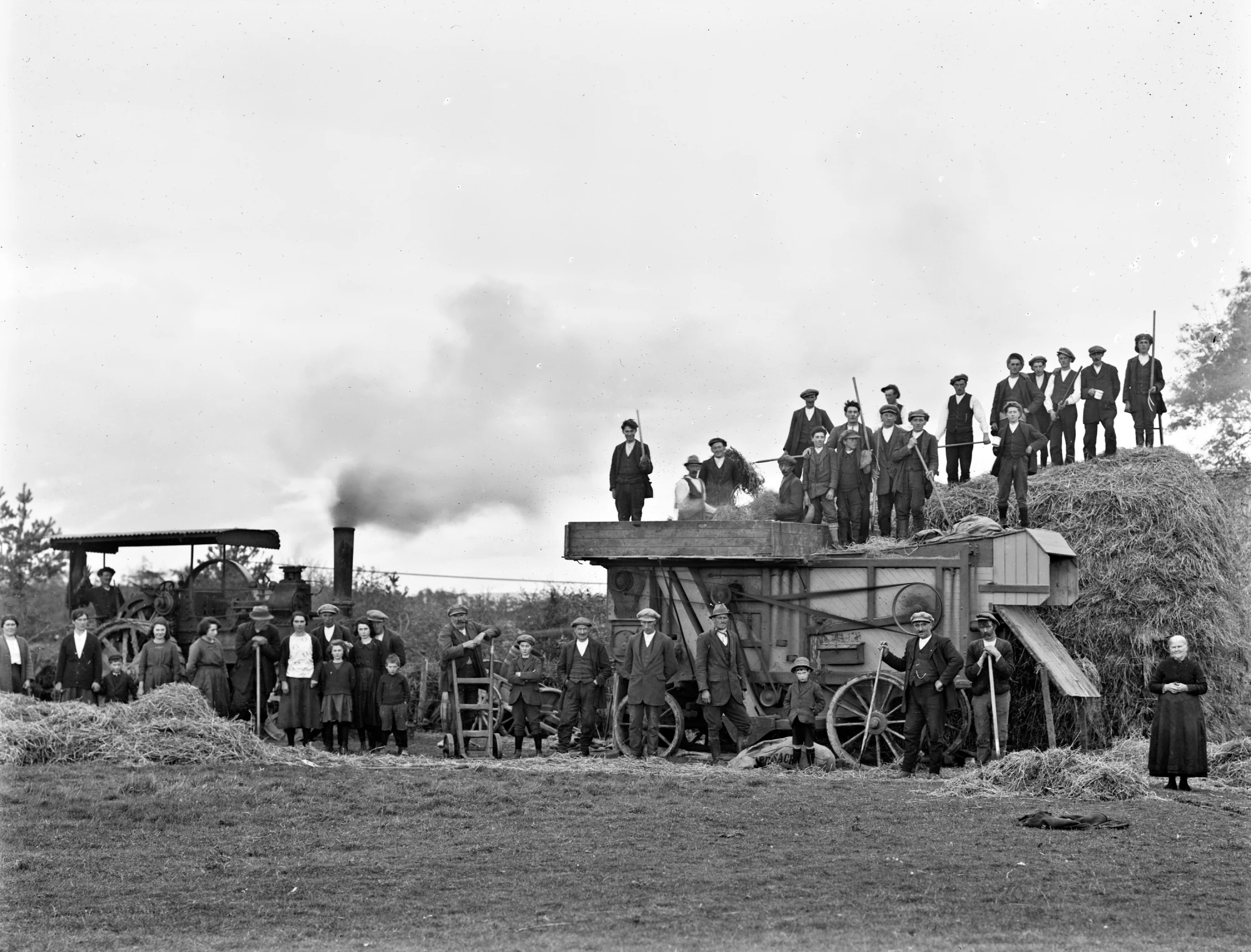
The long handle and shorter wooden beater were joined by a flexible link. Repeated blows released grain from the crop. This was threshing: the grain still needed cleaning and grinding.
Explore the museum’s harvesting tools, workers and changing methods (opens in a new tab)
 Enlarge photograph ↗
A. H. Poole / National Library of Ireland · POOLEWP 3130. Original photograph ↗ · No known copyright restrictions ↗. Resized where needed and converted to WebP; display may be cropped. No retouching. Full credits ↗.
The local memory describes flails. This 1923 photograph shows a steam-powered threshing machine and a large gathering around it. Access to machinery varied; neither image represents every farm.
Follow the wider change from hand tools to machinery (opens in a new tab)Cleaning the harvest
Threshing left grain mixed with chaff and other debris. Winnowing separated lighter material using air; sieves helped remove what remained.
Working with a breeze
The National Museum describes Irish grain being cleaned in a breeze or a strong draught. Lighter chaff blew aside while heavier grain fell onto a sheet. Further sieving could remove remaining weed seeds and debris.
In this basket method, the mixture goes over the rim into the air. Sieving works through openings in a mesh instead, separating material by size. Both actions could help clean a harvest.
The Museum of English Rural Life traces their appearance in Europe to the eighteenth century. That is a broad history, not a date when they became common in Leitrim.
Yes: the museum records one bought for an English farm in the 1920s. Commercial makers also supplied them; a Tasker example dates to 1871. These are comparisons, not local purchase records.
We have not established who made the photographed machine, or whether Dromahair households bought, built, borrowed or shared one. We should not assume universal ownership—or routine home construction.
The museum’s purchased farm machine and historical overview (opens in a new tab) · A named manufacturer’s 1871 machine (opens in a new tab)
The local account takes the oats to Dromahair. The next work belonged to a milling business serving the surrounding countryside. Read the remembered journey to the mill (opens in a new tab)
Mill · A household’s harvest enters a village workplace
The mill supplied space, power, equipment and skilled work that an individual household did not have to provide for itself.
 Enlarge photograph ↗
Iamagnat. Original photograph ↗ · CC BY-SA 4.0 ↗. Resized where needed and converted to WebP; display may be cropped. No retouching. Full credits ↗.
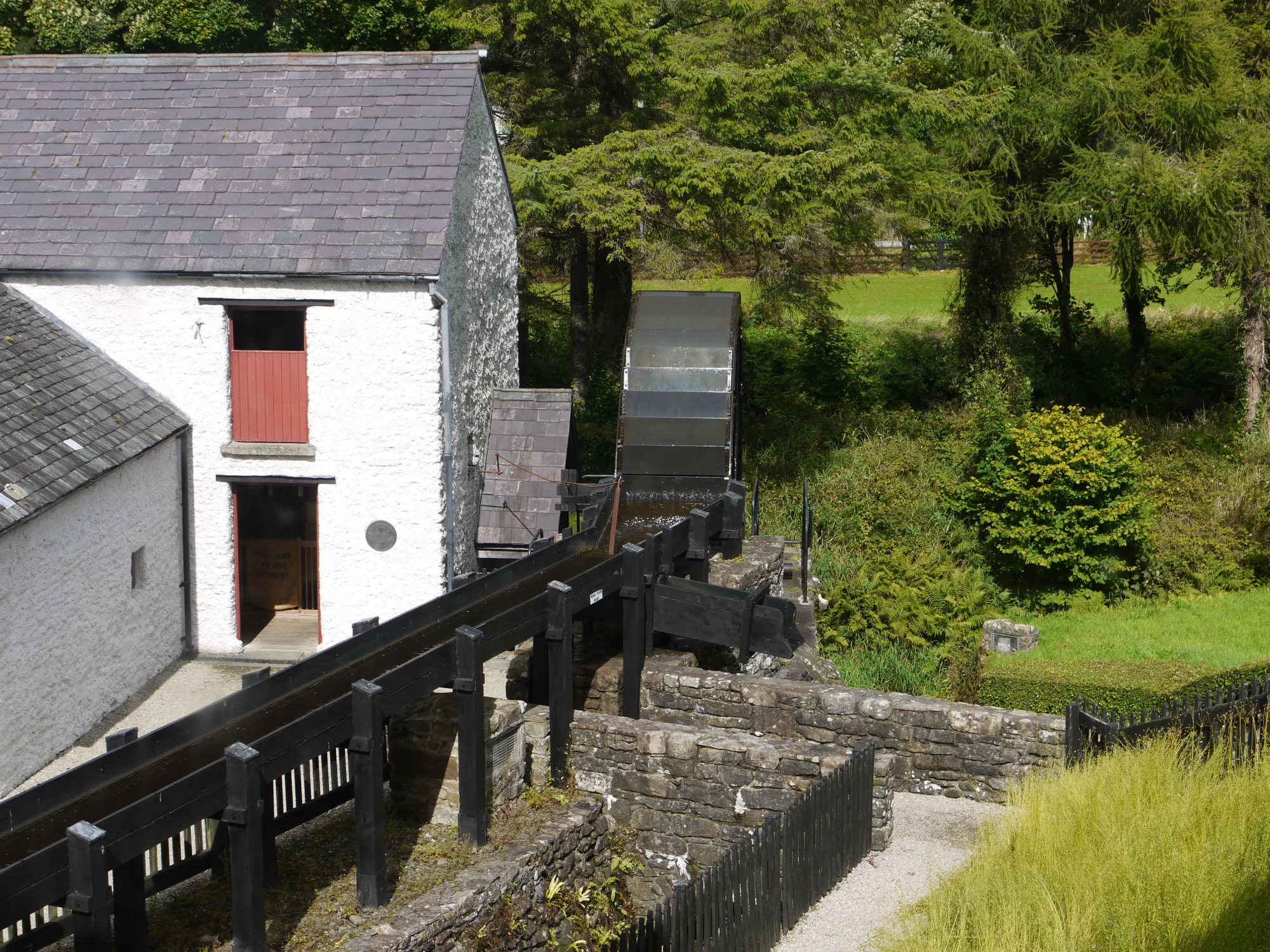
Dromahair’s surviving corn mill beside the Bonet dates from around 1800. Its architectural record describes two storeys, seven bays across and a tower—“bays” being the repeated divisions across its face.
The Newtownmanor recollection names a Dromahair mill associated with the Hosie name. Using the same milling business did not mean families collectively owned it.
See Dromahair’s recorded building and its photograph (opens in a new tab)A local history identifies a separate coal-fired Hosie mill completed in 1910 near the railway station. We cannot attach every remembered operation to the older riverside building. The photographs here show Newmills in Donegal, a documented comparison.
Read about the later Hosie mill and its setting (opens in a new tab)Prepare the grain
At Newmills, grain was dried on a heated, perforated floor. Cleaning and shelling removed unwanted material; fans, sieves and elevators helped separate and move it. These were distinct operations around the grinding machinery.
See the OPW’s illustrated account, pages 16–17 (opens in a new tab)The account gives no bag weights or grain-transport details; the cart it names carries turf. It describes grinding, then drying “meal”. The Newmills technical account describes drying grain earlier. We preserve that distinction: the local recollection conveys the burden of fuel and night work, while the comparison explains operations. This is not a reconstruction of one Dromahair production line.
 Enlarge photograph ↗
Kenneth Allen / Geograph. Original photograph ↗ · CC BY-SA 2.0 ↗. Resized where needed and converted to WebP; display may be cropped. No retouching. Full credits ↗.
Grind
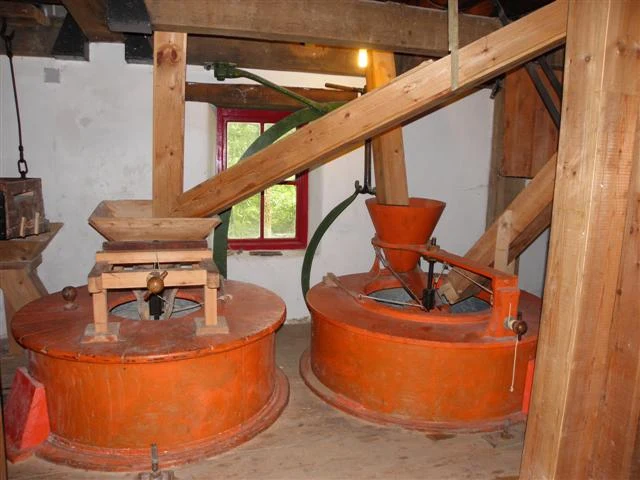
In the traditional mechanism explained at Martry Mill in County Meath, grain feeds between a rotating upper stone and a fixed lower one. The stones do not touch. This operation reduces grain to meal or flour.
Water power could turn the machinery through shafts and gears. The miller’s work included managing the equipment; moving water alone did not turn a harvest into food.
Explore the millstones and the machinery driving them (opens in a new tab)Follow the power · Simplified explanation
At Newmills, water from the River Swilly drove a large wheel. The building needed a managed water supply, not simply a location near a river.
A functional diagram, not a floor plan or gearing reconstruction. Newmills and its waterwheel (opens in a new tab) · Martry’s gears and millstones (opens in a new tab)
Collect and take home
The local account remembers bags of oatmeal stored at home—a supply ready to draw on for meals.
The prepared food named in the local recollection.
Martry demonstrates wheat ground into wholemeal flour. “Corn mill” could refer to cereals generally, not just maize.
The remembered bags of oatmeal (opens in a new tab) · Grain and flour at Martry (opens in a new tab)
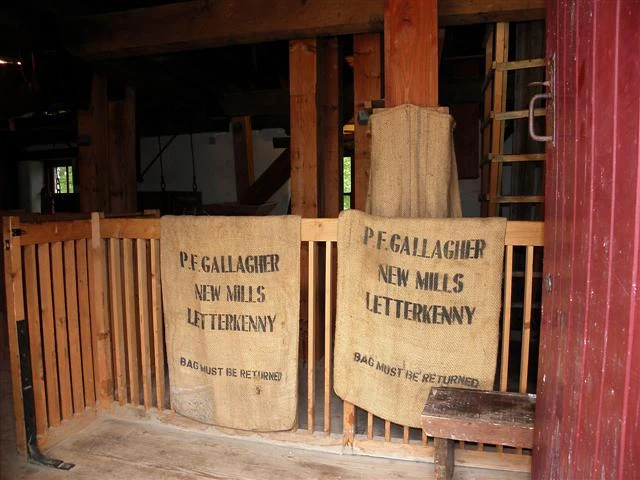 Enlarge photograph ↗
Kenneth Allen / Geograph. Original photograph ↗ · CC BY-SA 2.0 ↗. Resized where needed and converted to WebP; display may be cropped. No retouching. Full credits ↗.
Home · Stored food becomes a meal
A bag of oatmeal was a supply to draw on, not a finished meal. One Newtownmanor recollection describes roughly three meals a day, built around oats, potatoes and dairy.
One household pattern remembered in the 1930s, looking back to an unspecified earlier time. Portion sizes and grain’s share of the diet are unrecorded. Read the meal pattern on manuscript page 244 (opens in a new tab)
The National Museum’s wider rural picture includes vegetables, eggs, meat and fish as well as grains, potatoes and milk. What a household grew, kept, could buy or could spare for its own table shaped its meals. Tea, sugar and salt increasingly connected the kitchen to the shop.
Explore the museum’s account of growing, buying and cooking (opens in a new tab)A Newtownmanor pupil writing in March 1938 contrasts earlier home baking with bread sold from vehicles along the road. Home production and bought food could coexist; a cottage kitchen was not sealed off from changing trade.
Read the comparison between home baking and bread deliveries (opens in a new tab)From ingredients to food
Historical methods to explore, rather than measured modern recipes.
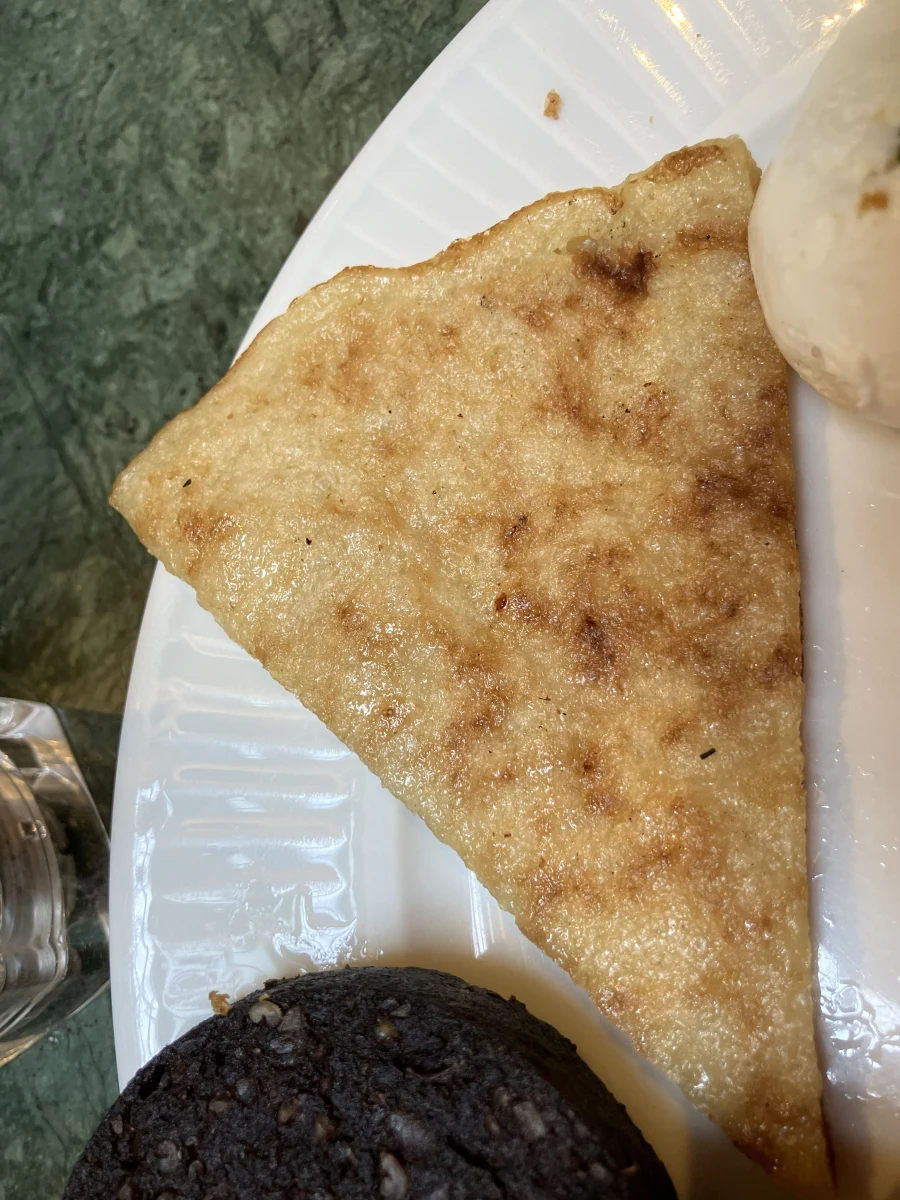 Enlarge photograph ↗
さえぼー / Wikimedia Commons. Original photograph ↗ · CC0 ↗. Resized where needed and converted to WebP; display may be cropped. No retouching. Full credits ↗.
Newtownmanor · Remembered oat bread
The local account describes oatmeal mixed with water and baked on a griddle before the fire.
South Leitrim · A 1930s boxty method
A Drumloughan account describes a grater made by piercing tin with a nail. The rough surface reduced peeled raw potatoes into a basin.
These sources give no measured quantities, reliable cooking minutes or temperatures. Boxty also had other forms; this example does not establish how a Tullynascreen household made it.
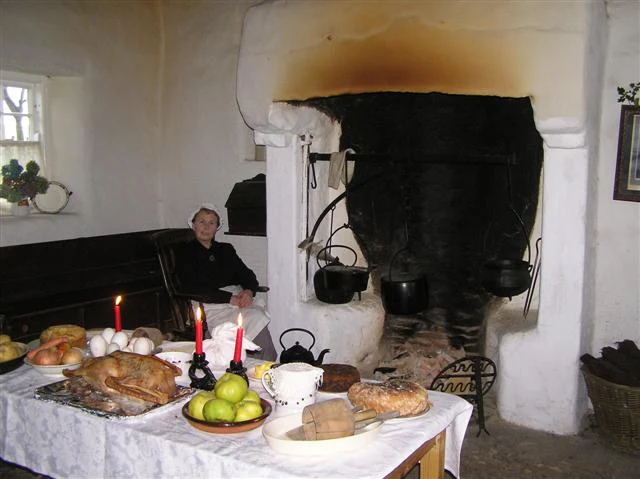 Enlarge photograph ↗
Kenneth Allen / Geograph. Original photograph ↗ · CC BY-SA 2.0 ↗. Resized where needed and converted to WebP; display may be cropped. No retouching. Full credits ↗.
The cook’s work
Heavy pots had to be moved and heat judged. With one vessel directly over the fire, other dishes simmered or baked nearby. Cooking meant coordinating the hearth, rather than turning separate controls for each dish.
Griddles baked flat breads; pot ovens also made bread baking possible. The museum describes food preparation as women’s responsibility in the rural household. That national picture should not be used to assign every task in a particular family.
See the cooking equipment and the work of managing it (opens in a new tab)The local accounts do not supply a trustworthy daily total. Work crossed the boundaries of a “cooking time”: fuel and water, milling, dairy work, the meal itself and clearing away. A Newtownmanor pupil describes her family churning by hand and working butter with wooden boards—another task behind food ready for the table.
Read the local account of hand churning (opens in a new tab)The meal also depended on water. Next, follow the journey from its source to the kitchen and wash tub.
03 · Water & washing
A drink. A pot of potatoes.
A clean shirt. Another journey.
For a home without piped water, each task began somewhere beyond the kitchen. Water had to be reached, lifted and brought back. Warm water needed fuel as well. Follow the supply from its source to the work it made possible.
Source · Water in the landscape
A spring near the surface, a shaft dug into the ground, or a pump raising water: the equipment changed how a person filled a bucket.
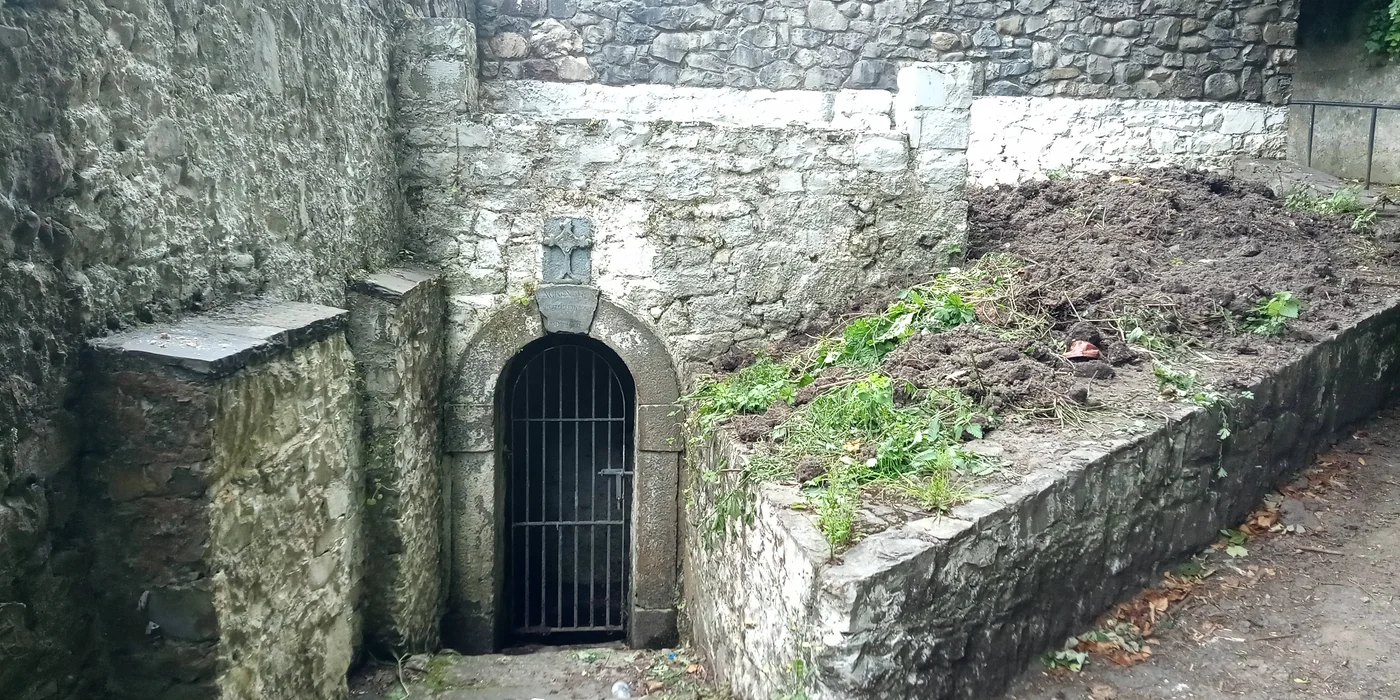 View photograph ↗
A.-K. D. · CC BY-SA 4.0 ↗ · Original photograph ↗. Resized and WebP-encoded; no retouching.
Three ways to reach water · Simplified cross-sections
Water emerging from the ground could collect in a shallow hollow or flow through an outlet. Stonework might protect the collection point.
A shaft reached water below ground. A rope and sometimes winding gear raised the bucket; lining helped hold back surrounding earth.
A hand pump could raise well water through a pipe and spout into a waiting container. Carrying it home still remained.
Functional explanations, not reconstructions of three specific Leitrim wells. Movement is slowed and illustrative.
Explore the Kilkenny examples: springs, a dug well and hand pumps (opens in a new tab)
Access mattered as much as distance
Both arrangements existed. Brian Gabriel’s history of the Blarney district describes council-maintained roadside pumps and private pumps in farmyards. It also recalls people going farther afield when a source dried up. This is a Cork comparison, rather than a map of access around Dromahair.
A water point on somebody’s land and the right of neighbours to use it are separate questions. A dot on an old map cannot settle both.
Read about public pumps, private supplies and dry summers (opens in a new tab)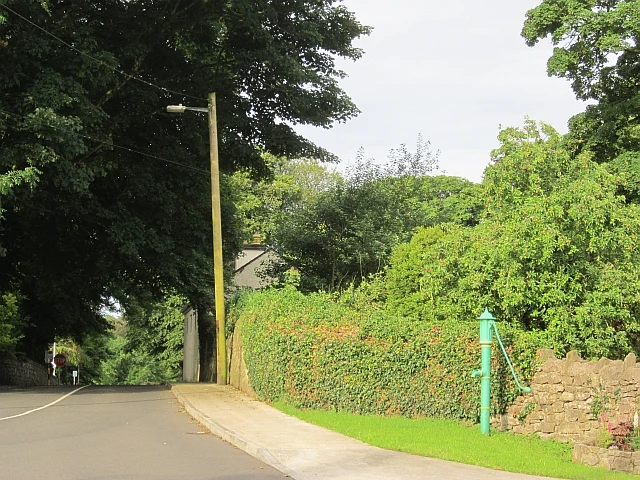 View photograph ↗
Richard Webb / Geograph · CC BY-SA 2.0 ↗ · Original photograph ↗. Resized and WebP-encoded; no retouching.
Carry · The return journey was heavier
A local riddle collected at Ardvarney pictures a person carrying two wooden water buckets. Small as it is, that detail puts the work into someone’s hands. Find the local bucket-carrying riddle (opens in a new tab)
Try a journey · Your choices, not a recorded household
Change the distance, amount carried and number of trips. Every return brings water home; every new collection requires an outward walk too.
A Rathnew recollection records young women and older children walking with two buckets, including trips after dark when supplies ran short. It also remembers the well as a place to meet neighbours. Fetching could interrupt the evening as well as begin the day.
Read the remembered trips to a Wicklow well (opens in a new tab)No. A Wexford account collected in 1938 remembers water in earthenware jugs carried on women’s heads, and crocks used to hold it. Containers and carrying practices differed.
Explore the Wexford memory of jugs and water crocks (opens in a new tab)Use · A supply to draw on
Getting water through the door did not finish the work. It still had to be stored, poured, sometimes heated—and eventually carried away again.
The kitchen
The local food account already puts water into oat bread. A Bohola community history describes a kettle kept hot for washing up: the hearth served cleaning as well as cooking.
The local oat-bread method (opens in a new tab)The kettle in a Mayo kitchen (opens in a new tab)Washing yourself
The Bohola account places a washstand in the kitchen, with a jug replenished each morning for children’s hands and faces and men’s shaving. Personal washing could be a basin task, without filling a bath.
Read about the kitchen washstand (opens in a new tab)Clothes & cleaning
Washing and rinsing were separate demands. Some supplies could serve different purposes: the Blarney account recalls rain caught in a barrel for domestic work, kept distinct from drinking water.
The washday sequence below follows the handling after collection.
Rain barrels and domestic work (opens in a new tab)Around the holding
Animals and farm work added their own demands. The Cork account describes troughs catching pump overflow and farmyard pumps supplying water for animal food and cleaning buildings.
That supply need not have passed through the house.
Water in the farmyard (opens in a new tab)Washday · Follow the work after fetching
Clothes did not emerge clean and dry from one operation. Follow the changing task: heat and soap, friction, rinsing, water squeezed out, drying space, and an iron heated separately.
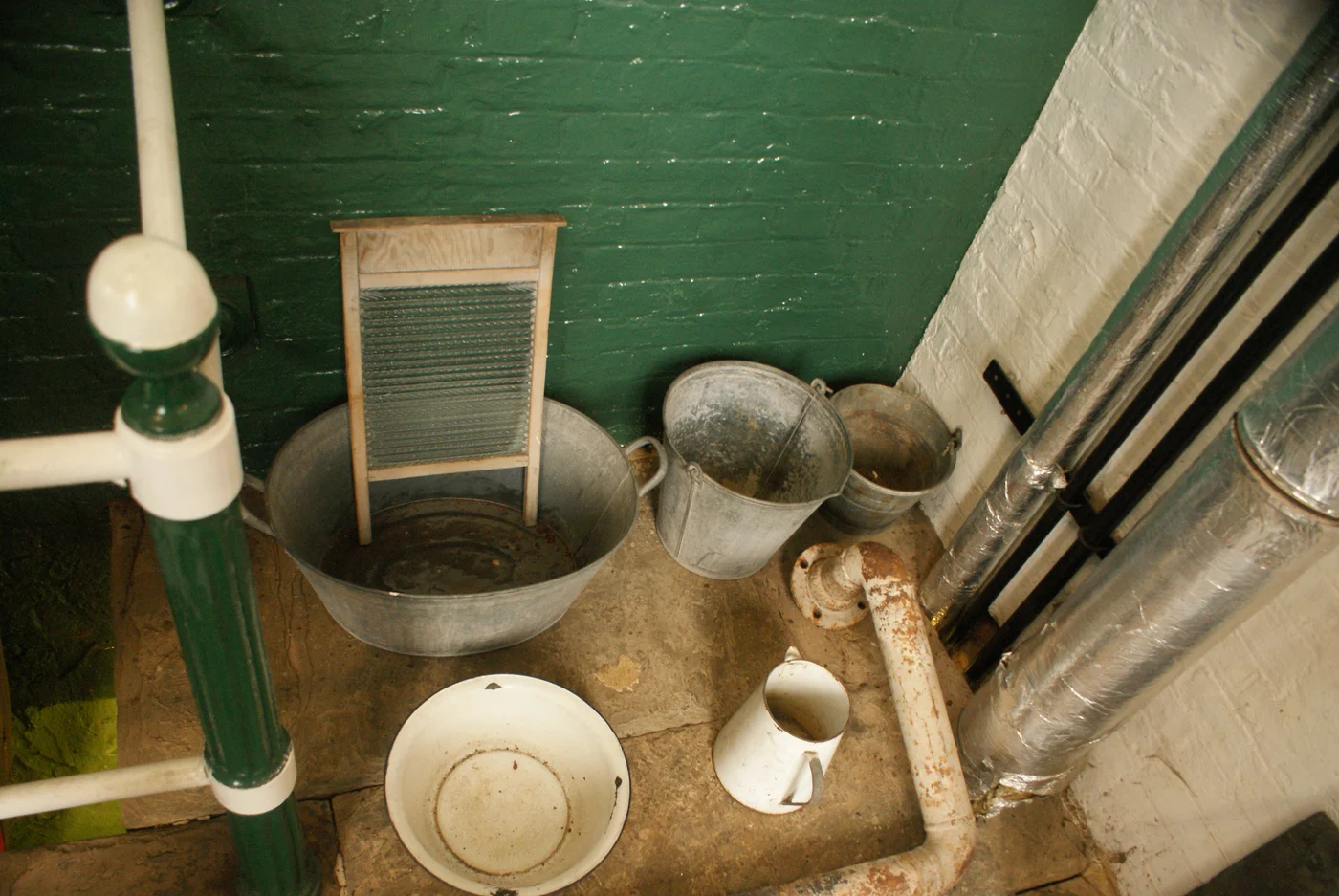 View photograph ↗
Robert Lamb / Geograph · CC BY-SA 2.0 ↗ · Original photograph ↗. Resized and WebP-encoded; no retouching.
Bohola’s local history describes water heated in a pot over the fire, then mixed with cold water in a tub. Monaghan’s museum describes clothes soaking in hot soapy water.
Fabric was rubbed against the washboard’s ridges. A dolly agitated a tubful; laundry tongs helped handle hot cloth. Different tools provided different kinds of effort.
Cloth had to be handled again in water to remove soap and loosened dirt. Rinsing was another demand on the supply, beyond the water used for soaking and scrubbing.
Squeezing and twisting removed water before drying. The Wexford memory specifically describes wringing. A hand-cranked mangle was another tool, where available; Glenview Folk Museum in Leitrim preserves examples.
The Wexford account names hedges and lines. Spreading or hanging the cloth exposed it to air; the account gives no fixed drying time. This was still work in progress.
Monaghan’s museum explains flat irons heated on a range. Heat had to be replenished as the iron cooled. A clean, dry garment could still need this final handling.
Look at the action · 1 of 6
Simplified movements, not a timed demonstration or a reconstruction of one household’s routine. Select a stage to look closer; all six explanations remain alongside.
See Monaghan County Museum’s washing tools and how they worked (opens in a new tab) · Explore Glenview Folk Museum’s household collection in Leitrim (opens in a new tab) · Read a Wexford recollection of washing and drying, recorded in 1938 (opens in a new tab)
The Wexford account remembers white washing left overnight in clear spring water after washing and drying, then wrung out and dried again. It also names hedges and lines as drying places. This was one remembered bleaching practice, not a timetable for every garment.
Without a drain at the basin, emptying it was another job. A Newtownmanor folklore entry records beliefs about throwing dirty or hot water out after nightfall. It gives a local glimpse of disposal as part of household life, while recording belief rather than a sanitary rule.
Read the Newtownmanor account of water after dark (opens in a new tab)Local evidence: the Ardvarney bucket riddle and Newtownmanor account of disposal; the surviving Dromahair pump is photographed, but its historical users are unverified.
Named comparisons: Kilkenny water structures; Rathnew carrying; Cork pumps and rain barrels; Wexford vessels and laundry; a Mayo kitchen; and museum washing tools. These explain possibilities without assigning them to a particular Leitrim home.
Still to establish: a dated source near Tullynascreen, the path used to reach it, shared access, bucket capacity, storage and daily quantities, bathing frequency and livestock provision. We have no evidence here for a regular local horse-and-cart water delivery. Historic maps, sanitary records and local testimony could connect the water points with households. A holy well’s presence alone would not prove domestic use.
The diagrams explain mechanisms, not measured structures. Journey values are illustrative; no walking speed, waiting time, terrain or historical consumption average is assumed.
Washing was one way to keep clothing useful. Next, follow the making and mending that gave it a longer life.
04 · Clothing
Before a shirt could be washed,
someone had to make it.
After it wore thin, someone might mend it.
Clothing held the work of many hands: preparing fibre, making cloth, cutting, sewing and keeping it useful. A household could make one part, buy another and depend on skills beyond its own door.
Material · From fleece, field and shop
A Newtownmanor account collected in 1937–1939 remembers local linen weaving, then describes shirts sewn at home and socks, stockings and jumpers knitted there. Some thread was spun; some was bought. Older skills and purchased materials belonged to the same story.
Read the local account: remembered weaving and then-current making (opens in a new tab)Animal fibre
Fleece had to be sorted and prepared. Carding opened and arranged the fibres; spinning twisted them into yarn. Yarn could then be knitted into a garment or woven into cloth.
The National Museum describes wool left in its natural colour or dyed, using natural or bought dyes. There was work before the needles ever began.
Explore fleece, carding and spinning (opens in a new tab)Plant fibre
The useful fibres lay inside flax stems. The Irish Linen Centre explains pulling the crop, soaking it to loosen the fibres, drying it, beating away woody matter and combing before spinning.
Those operations had names: retting for the soaking, scutching for removing woody material, hackling for combing. Growing flax was only the beginning.
Follow flax preparation in the museum guide, page 8 (opens in a new tab)A bought material, made up at home
The local writer names flannelette for shirts. It belongs among cotton fabrics; the name should not lead us to picture every home-sewn shirt as woollen flannel.
Cotton fibres also needed cleaning and spinning before weaving. The local account identifies the material, but not its mill, manufacturer or country of production.
Compare cotton fabrics and their construction, page 9 (opens in a new tab)The patterns above are graphic cues, not magnified samples or evidence of a particular household’s cloth.
Follow the thread · An enlarged explanation
Spinning makes yarn. Weaving crosses two sets of yarns; knitting forms linked loops. A knitted sock can take shape without first cutting it out of a woven length.
The demonstration below is a plain weave, not a model of a particular local loom.
Rows are packed together to form cloth. This enlarged drawing leaves gaps so the crossings are visible; real cloth is much denser.
See how warp and weft make cloth, page 11 (opens in a new tab) · Explore the different structure of knitting (opens in a new tab)
Making · A wardrobe, many hands
Making clothes involved choices about money, skill and time. A length of bought cloth still needed cutting and sewing. A ball of yarn could become a sock through repeated work with needles.
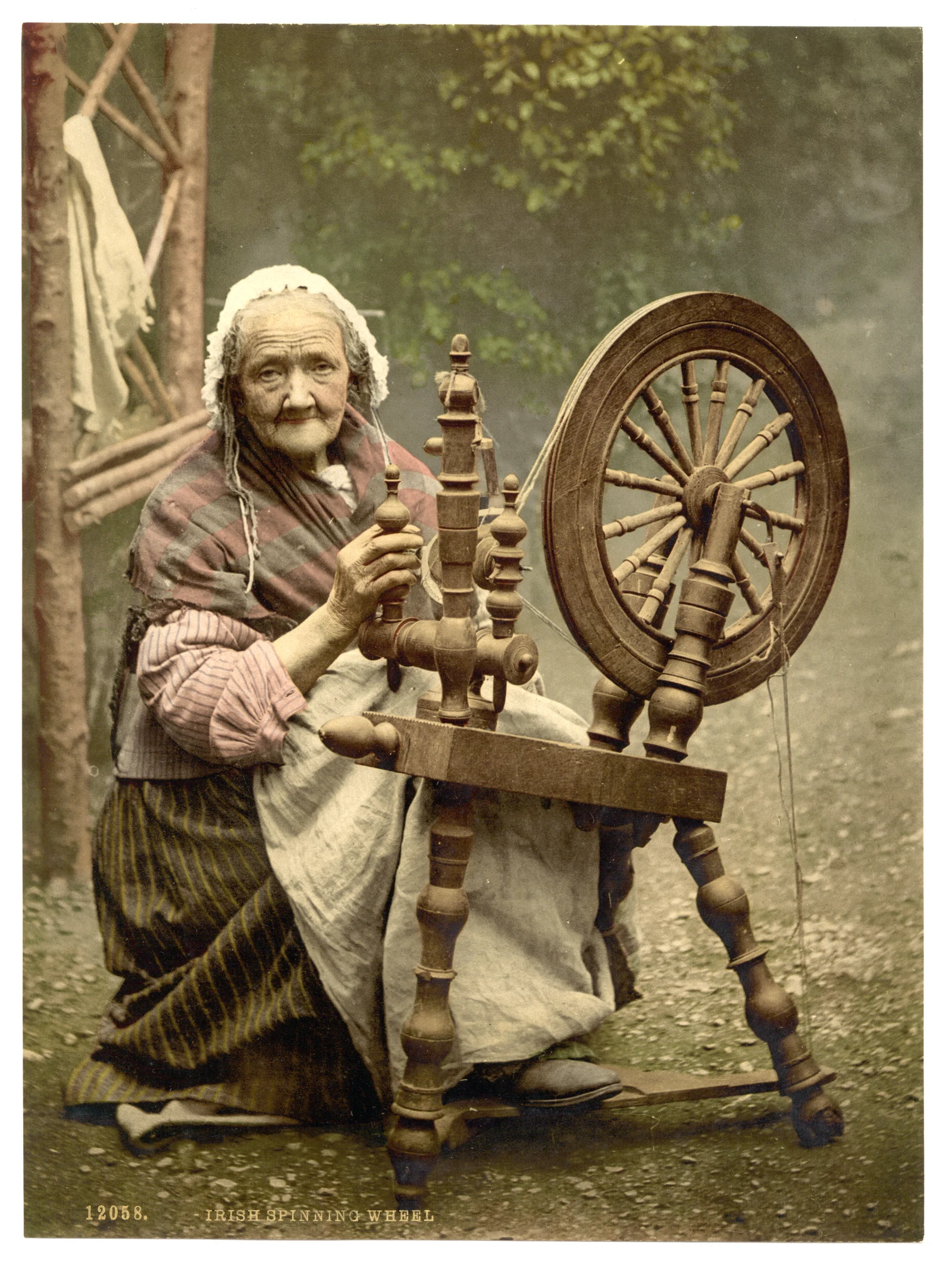
Photochrom Prints Collection, LC-DIG-ppmsc-09892. Library record: no known restrictions on publication ↗. Resized and WebP-encoded from the archival scan; no retouching. Selected details enlarge the same print.
Look closer · Dress and work in one image
Select a detail to enlarge it. The full print remains a click away.
A shawl around the shoulders, sleeves rolled back, an apron over a long skirt, a cap and visible footwear: several pieces make up the outfit. This is one Galway sitter at a spinning wheel, not a wardrobe recorded in Leitrim.
Colour in a photochrom was part of the printing process. It cannot establish the original shades, dyes or fibre content.
Four views of the work: historical photographs and a modern museum display. Each is identified below; none depicts a Dromahair household. Select an image to look closer.
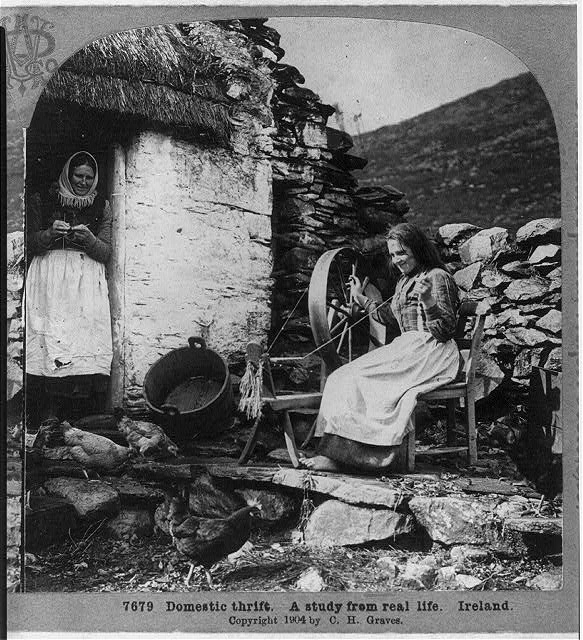 Enlarge ↗
One half of a stereograph. The exact Irish locality is unidentified.
C. H. Graves / Library of Congress · Source ↗ · No known restrictions on publication ↗. Web copy resized where needed; card view cropped, full image available. No retouching.
The Newtownmanor writer places shirts and knitting in the home. The National Museum’s wider account describes women making their own and children’s clothes, as well as shirts and undergarments for men. This was skilled labour alongside other household work.
Read the museum’s account of household makers (opens in a new tab)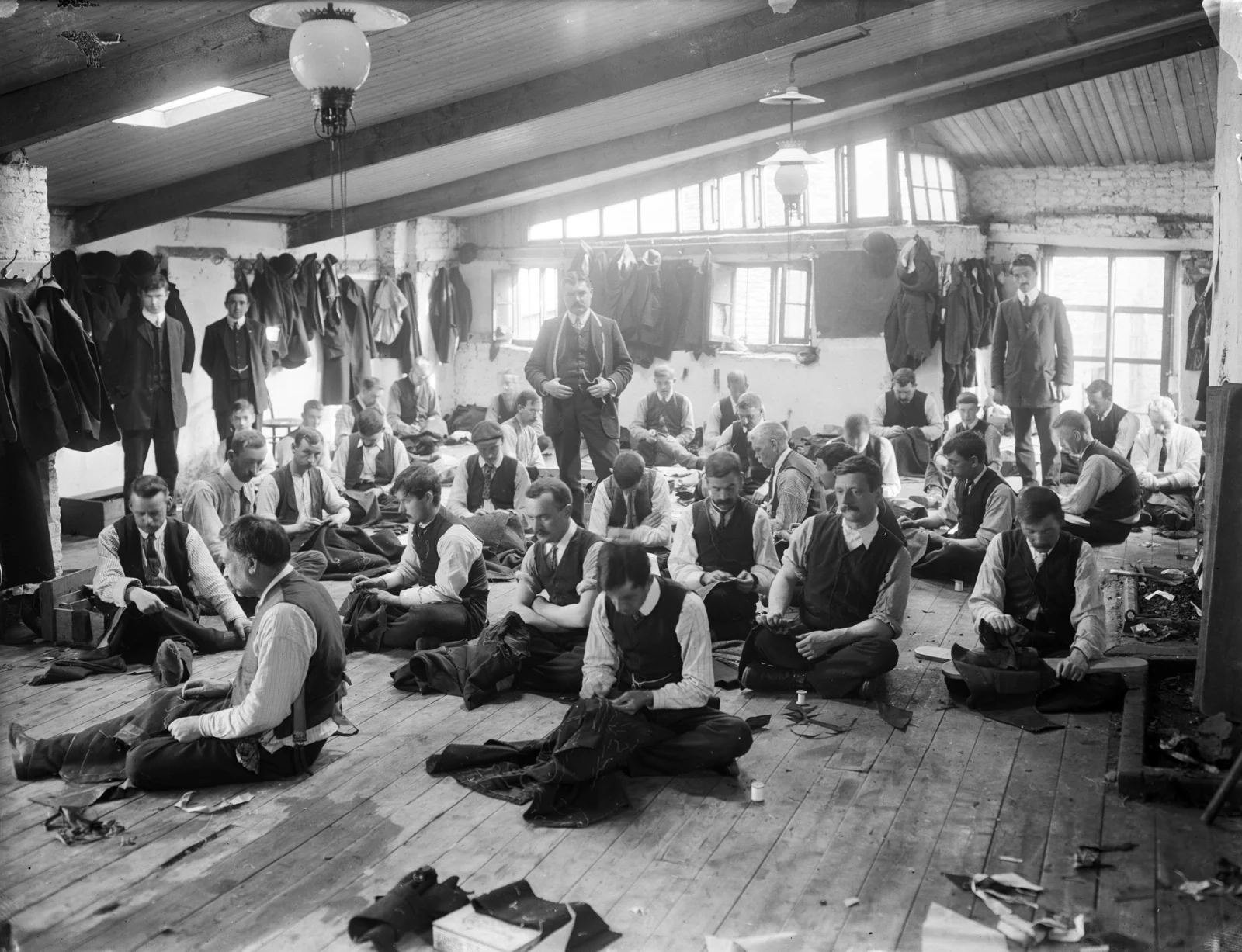 Enlarge ↗
Photographed 25 July 1907. This department-store workroom was larger than a small village tailor’s shop.
A. H. Poole / National Library of Ireland · Source ↗ · No known copyright restrictions ↗. Web copy resized where needed; card view cropped, full image available. No retouching.
The same museum account places much of men’s clothing with the local tailor. Measuring, cutting pieces to fit and assembling them were a different service from selling a roll of material.
No single maker necessarily supplied a person’s whole wardrobe.
 Enlarge ↗
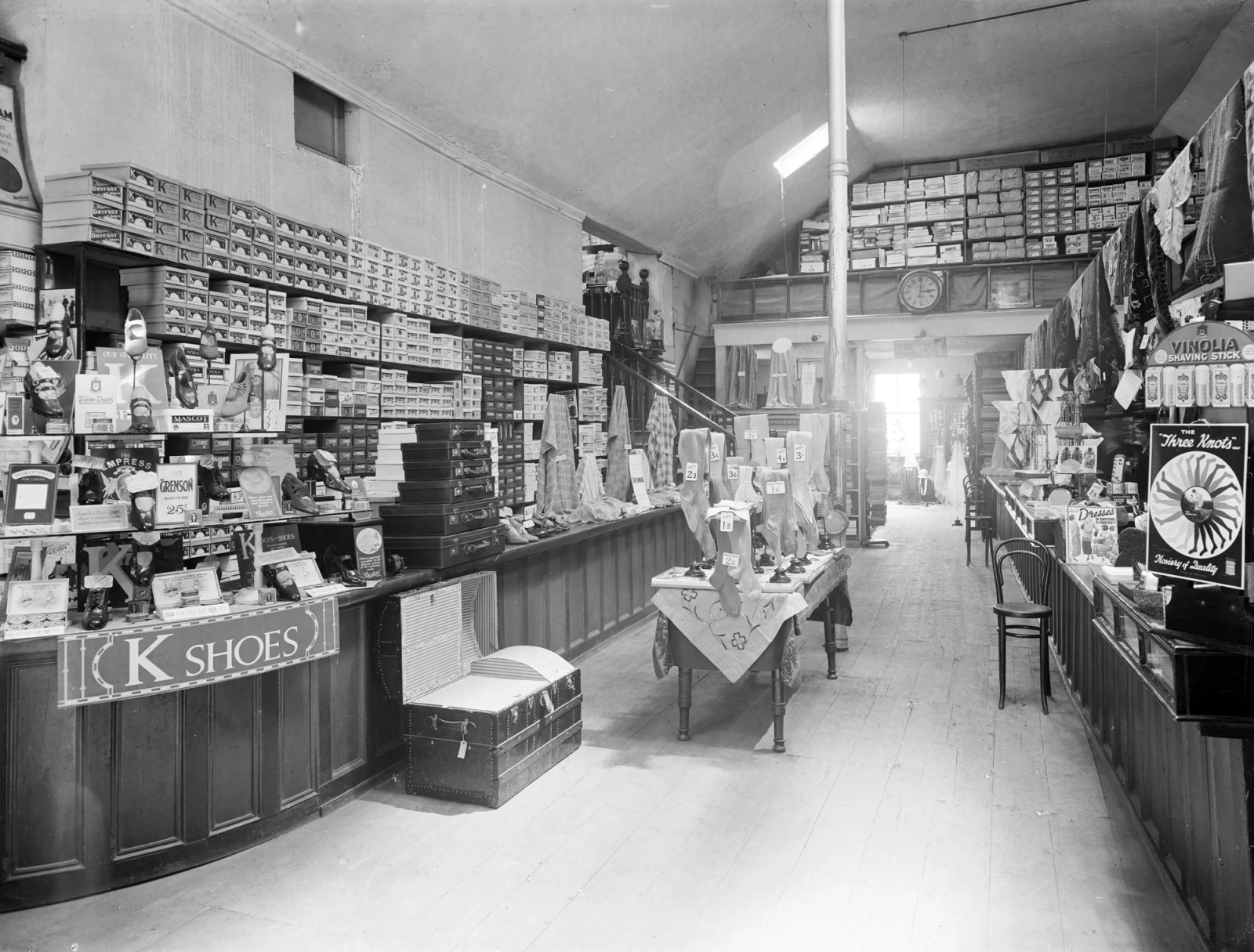
Photographed 4 May 1925; locality uncertain. A later comparison, not Gillmor’s shop or evidence of Dromahair prices.
A. H. Poole / National Library of Ireland · Source ↗ · No known copyright restrictions ↗. Web copy resized where needed; card view cropped, full image available. No retouching.
Shops supplied materials as well as finished things. The museum names bought headgear, cloaks and shawls. A Dromahair directory from 1932 lists drapery businesses: a later local glimpse of this trade, not the identity of everyone’s supplier around 1900.
Find the dated Dromahair drapery entries (opens in a new tab)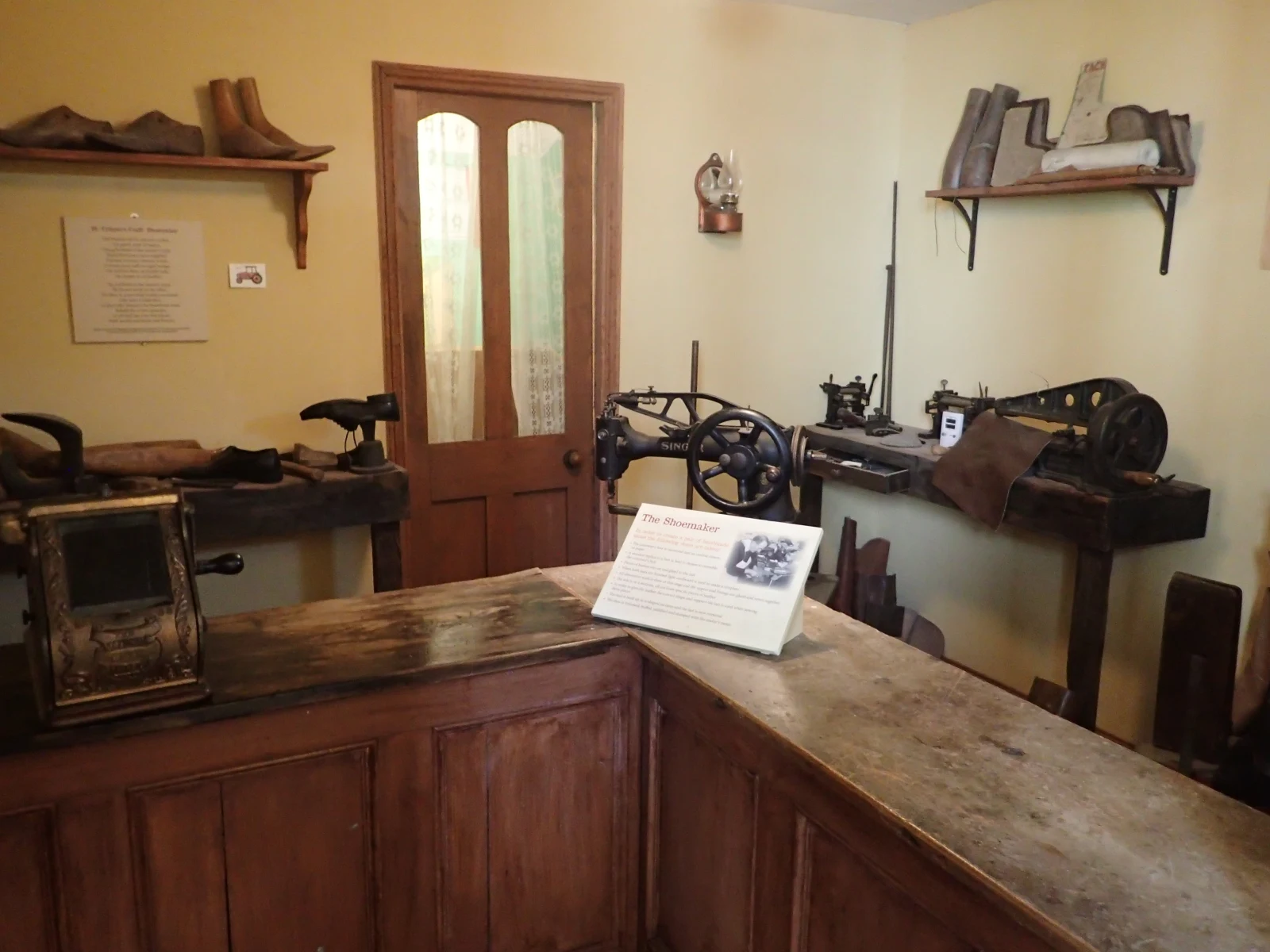 Enlarge ↗
Irish Agricultural Museum, Johnstown Castle, photographed 12 August 2026. A museum display, not a surviving local workshop.
Marathon / Geograph · Source ↗ · CC BY-SA 2.0 ↗. Web copy resized where needed; card view cropped, full image available. No retouching.
A local footwear account recalls shop-bought, machine-made shoes and small repairs at home. Clothes and footwear could each pass between commercial production and household maintenance.
Read the Newtownmanor comparison of buying and repairing shoes (opens in a new tab)The portrait shows one combination of layers; the local text adds shirts, socks, stockings and jumpers.
As the National Museum’s The Way We Wore explains, Irish dress also followed changing European fashions. Resources, age, occupation and occasion shaped what people wore.
Explore why Irish dress was more varied than one familiar image (opens in a new tab)Our local sources give no dependable hours-per-shirt or days-per-jumper. The useful distinction is between the stages: preparing fibre, making yarn, forming cloth and constructing a garment were separate jobs. Buying material saved some of that work; it did not remove the sewing or the later repairs.
Counting only the finished garment would miss the time already invested in it.
Mending · Keep the sound cloth working
A hole need not mean that the rest of the fabric had failed. Repair could add material over a weak spot or rebuild the missing threads. Those are different jobs for the needle.
At the mending table · Two different repairs
Darning fills a thin place or hole with interwoven thread. It can avoid the extra layer of a patch at a heel or toe, where bulk might rub inside a shoe. The surrounding fabric must still be strong enough to hold the stitches.
Which was better? Neither method suited every job. The fabric, size and position of the damage, comfort, available materials and the maker’s skill guided the choice. Darning was not only for knitting, and patching was not simply an inferior repair.
The gap is only one part of the garment. Sound fabric around it provides the place to anchor new stitches.
New thread crosses the missing area and is worked into sound material on either side. A smooth support can help hold the fabric’s shape.
A second set passes over and under the first. The needle makes a small woven repair across the hole. The new threads are shown in contrasting colours so the method is visible.
Showing 1 of 3: Keep the surrounding cloth.
Compare patching, darning and surviving nineteenth-century repairs (opens in a new tab) · Read the Irish library resource’s explanation of darning (opens in a new tab) · Why a patch could rub at a stocking heel (opens in a new tab)
 View full photograph ↗
Wuerzele · Original photograph ↗ · CC BY-SA 4.0 ↗. Resized and WebP-encoded; no retouching.
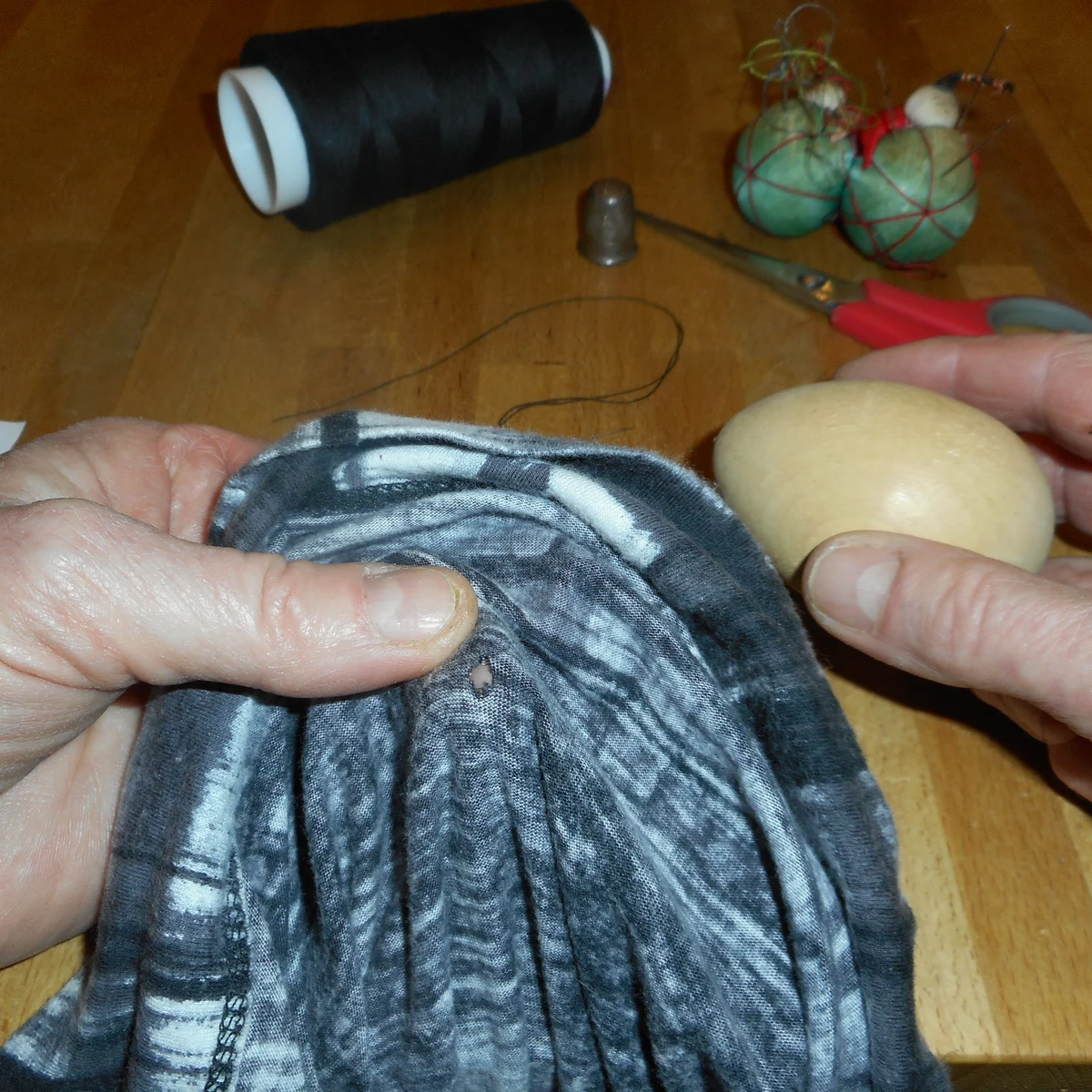
A wooden egg or mushroom-shaped support held the fabric while the needle crossed a worn area. It helped preserve the shape of the work rather than letting stitches pull the edges together. See how the support and thread tension worked (opens in a new tab)
The Illinois State Museum pairs such tools with surviving repaired stockings and other clothing. Those objects are American comparisons. They show the method and the repeated attention a garment could receive, without establishing which tools a Dromahair household owned.
Look at the museum’s darned stockings and supporting tool (opens in a new tab)Thread tension, the strength of the surrounding cloth and the position of a repair all mattered. A bulky patch at a rubbing point was a different problem from a loose seam. The diagrams show the principle, not a complete sewing lesson or a measured reconstruction of local stitchwork.
A changing use · Not a fixed lifespan
The National Museum describes better outfits passing into everyday wear. Clothes could also pass to another wearer: the Irish library resource recalls children receiving garments from older siblings or cousins. Read about clothes made at home and handed down (opens in a new tab)
Eventually another repair might have too little strong fabric to hold it. Yet an intact sleeve or a sound piece of a worn skirt could still be useful. A garment did not have to be equally worn everywhere.
There was no fixed age when clothing became “rags”, and reuse was not a single path followed by every family. The question was practical: what useful material remained?
Different material · Different possibilities
Cloth still strong enough to hold stitches could supply a patch or part of another garment. A repair needed useful fabric, not another piece already wearing through. Remaking, patching and saving scraps could overlap.
Ulster Folk Museum shows old wool skirts and trousers cut into strips for rugs, and lighter garments reused in patchwork. Strips could be pushed or looped through sacking, or sewn to a backing. Surviving rugs dated 1900–1910 and the 1900s–1920s show the result.
Look at the rugs and how their strips were attached (opens in a new tab)Rag collecting belonged to Irish history too. Claudia Kinmonth’s research describes linen rags collected for Ireland’s eighteenth-century paper industry. Cotton and linen rags could be broken down into fibres and made into paper; this was not the destination of every fabric.
Read about Irish rag collecting and recycling (opens in a new tab) · How cotton and linen became paper (opens in a new tab)These are documented possibilities, not a claim that nothing was discarded. We have not identified a rag collector, collection route or payment rate for Dromahair around 1900.
The Newtownmanor clothing and footwear accounts were collected in 1937–1939 and distinguish remembered practices from their own present. Their generalisations are not household surveys. The Dromahair directory is dated 1932.
The Galway portrait is a photochrom print dated about 1890–1900; its applied colours do not identify fibre, dye or the sitter’s finances. Museum explanations supply broader context; American repaired garments illustrate construction. The modern tool photograph is labelled as such. The additional making photographs show Ireland c.1904, a Waterford workroom in 1907, a drapery probably in Dungarvan in 1925, and a Wexford museum display photographed in 2026. The rag bag is an American comparison; the Irish paper-industry example concerns the eighteenth century, not an identified Dromahair ragman. We have no inventory of one local family’s clothing, no established supplier chain or thread brand, and no reliable making-time or garment-lifespan average. Remembered linen weaving does not establish that every home still grew and processed flax around 1900.
Thread, cloth and shoes connected the home to the shop.
Next, we follow that exchange across the counter.
05 · Home & village
Butter leaving the house.
Tea coming home.
An account still to settle.
Keeping a home meant depending on other people’s work as well as your own. A trip to the village joined the kitchen and farm to counters, workshops and markets—and to a much wider trading world.
Look around · A neighbouring town
Select a detail to look closer.
Shopfronts, carts and people occupy the same street. This is Barrack Street in Boyle, County Roscommon, photographed within the catalogue range 1865–1914—not Dromahair.
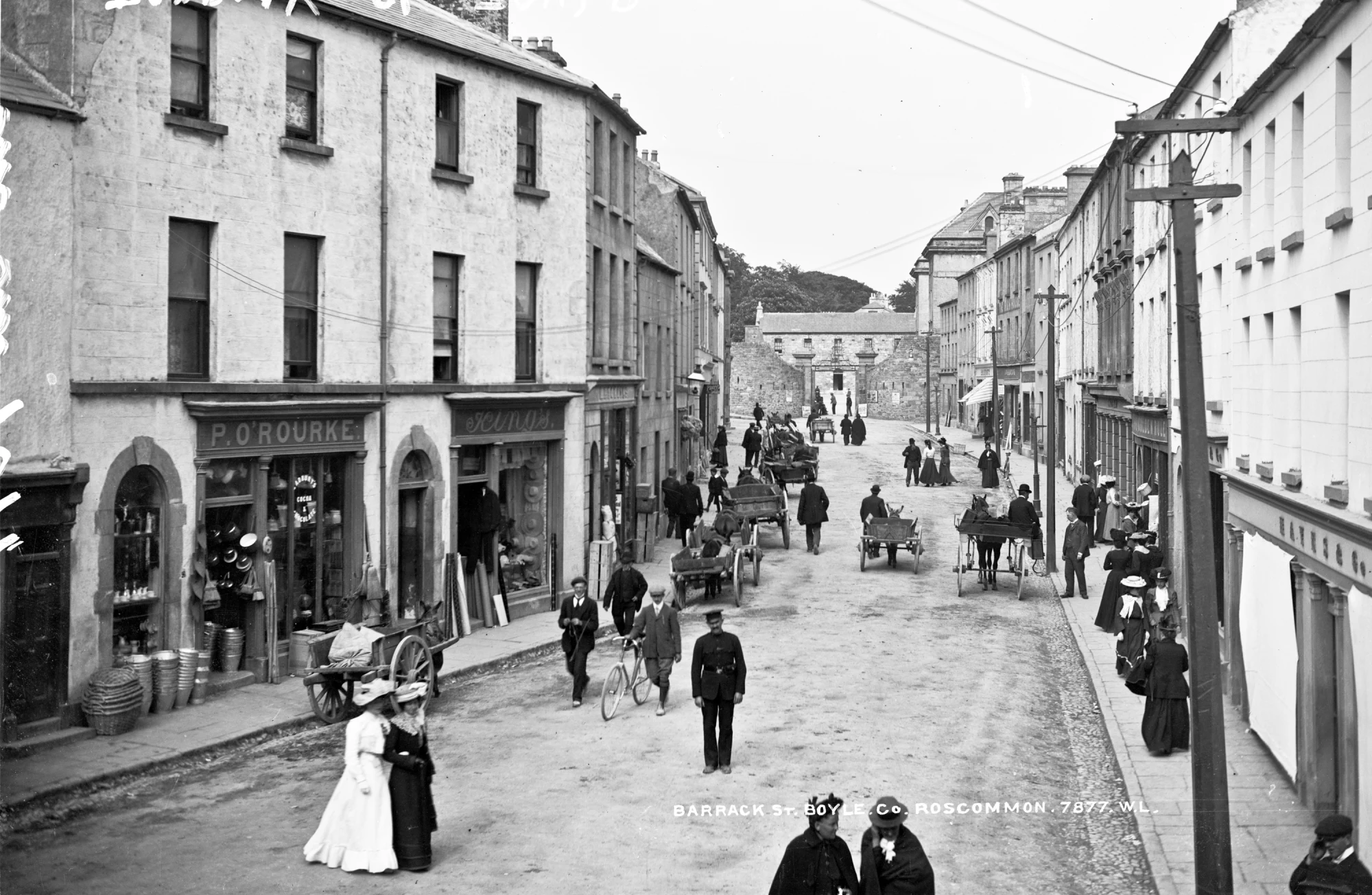
Source and catalogue details ↗ · No known copyright restrictions. Resized and encoded; views crop and enlarge, without retouching. Full credits ↗
Bring · Work became something to sell
A Darkvalley recollection connects Dromahair’s market with butter, eggs and straw. Collected from an older resident in 1937–1939, it describes obtaining goods with money, produce or labour. The household was both a consumer and a possible supplier.
Read the local memory of small purchases and different ways of paying (opens in a new tab)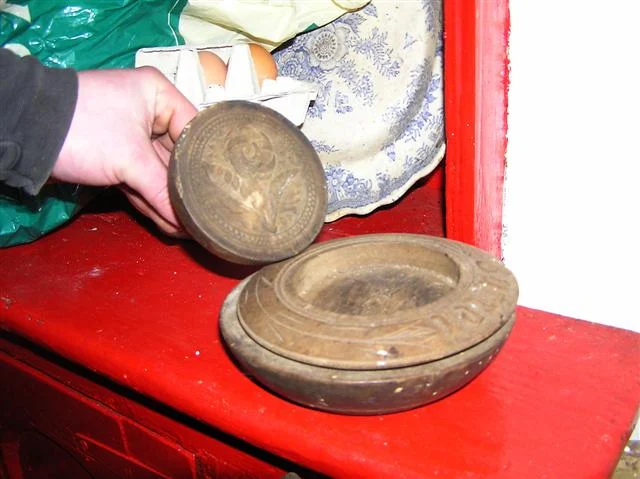
Kenneth Allen / Geograph. CC BY-SA 2.0. A heritage display, not a family possession. Source ↗ · Full reuse details ↗
Milk had to be produced and cream separated. Churning brought butter together; washing, salting and shaping followed. Tipperary Museum describes butter pressed into one-pound blocks, marked with a maker’s stamp and wrapped for sale. Larger quantities could travel in wooden firkins.
That is a museum comparison, not a specification for every Leitrim seller. But it makes the labour inside a small parcel easier to see.
Explore the churns, butter pats and packing described by the museum (opens in a new tab)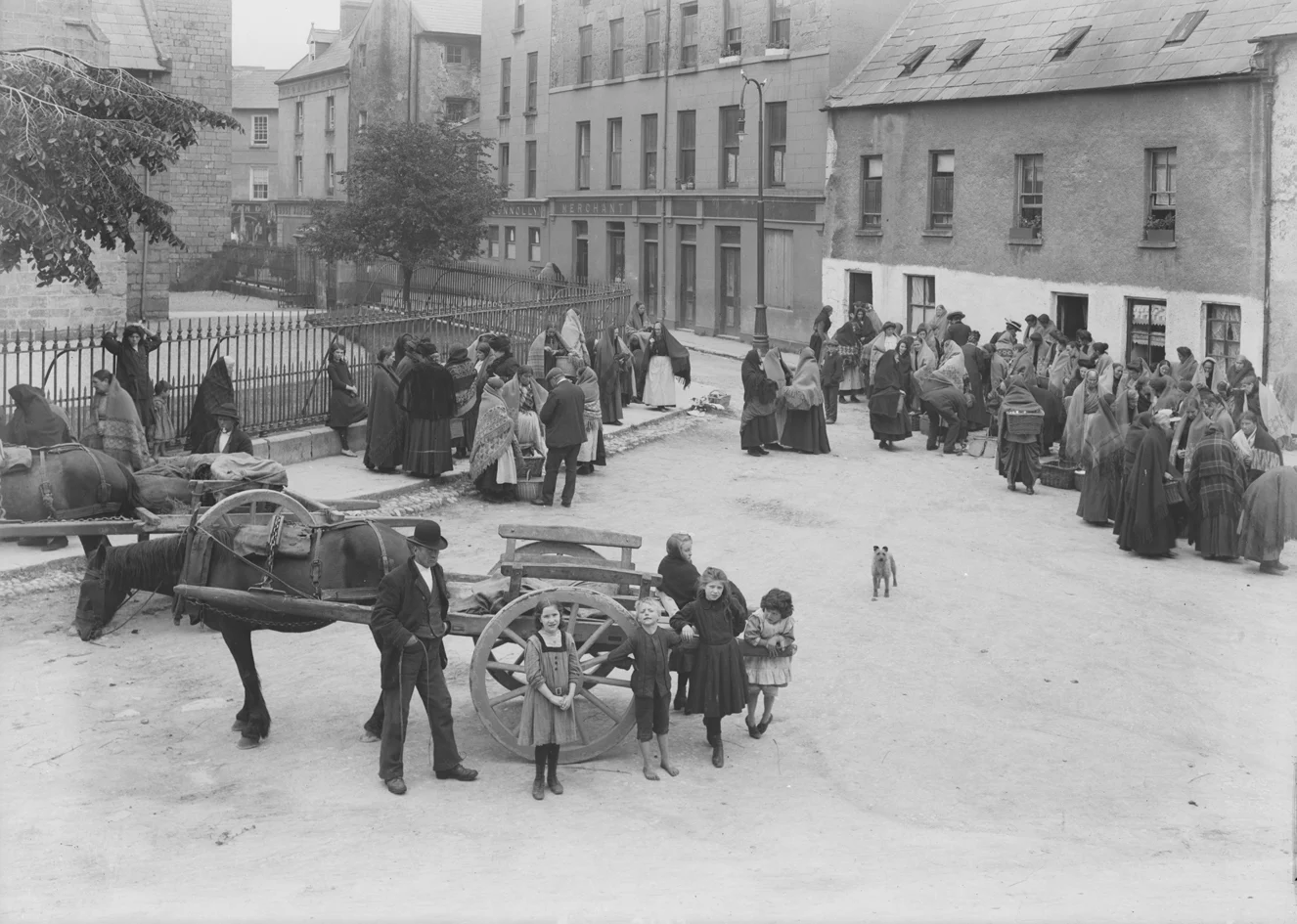
Eason Collection, National Library of Ireland, EAS2173. No known copyright restrictions. A comparison from Galway. Source ↗ · Full reuse details ↗
The National Museum describes women selling surplus butter and eggs. Selling some of what a household produced could help obtain things it did not make. Butter on a market stall was therefore more than food: it represented a possible purchase elsewhere.
Having produce to sell depended on the holding, animals and household’s own needs. A labourer’s family and a dairy-producing farm did not have identical choices.
Read the museum’s account of food production and surplus sales (opens in a new tab)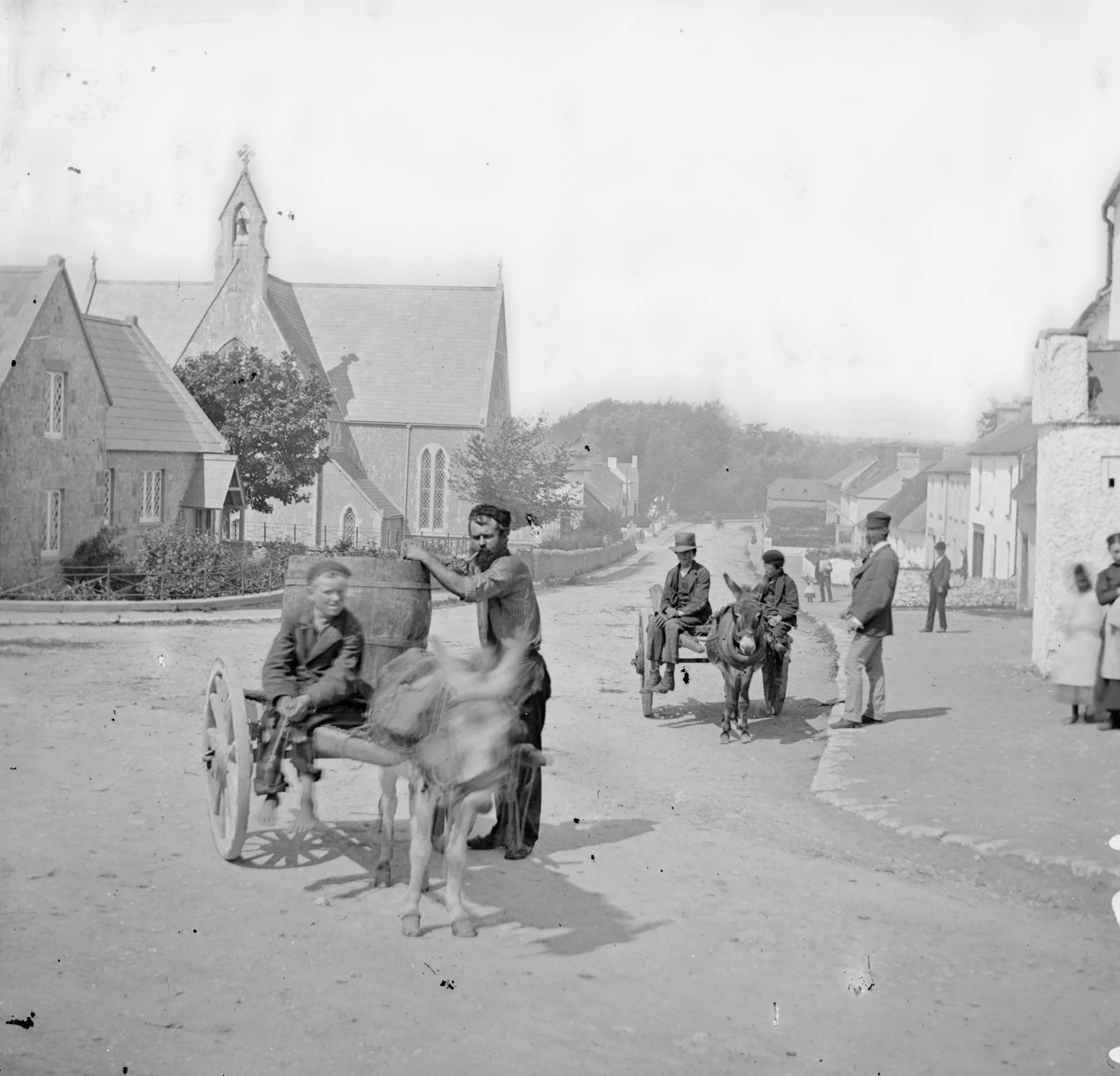
Frederick Holland Mares / James Simonton, Stereo Pairs Collection, National Library of Ireland, STP_1867. No known copyright restrictions. An earlier comparison. Source ↗ · Full reuse details ↗
Someone still had to get the goods to a buyer. In the street photograph, carts share the road with people on foot. A cart could move a load; walking required carrying it. The image cannot give us a particular family’s route or travel time.
Access could shape what was sold. A Newtownmanor school account says its household was too far from the road to send milk to a creamery—a small but telling limit on the idea that every farm had the same market.
Read the local explanation of why milk did not go to the creamery (opens in a new tab)Buy · Across the counter
Three questions help us understand a transaction: what was being bought, what was accepted in return, and when the payment was made. Exchanging produce and buying on credit were different arrangements.
Coins changed hands for goods. The Darkvalley account remembers buying small amounts of groceries, including tea and sugar.
The same account recalls produce and labour as ways of obtaining goods. It gives no universal rate: we cannot turn a basket of eggs into a fixed number of bags of flour.
Goods could be entered in a book and paid for later. Surviving Irish household ledgers let us explain the practice, even though we have not established a particular Dromahair shop’s terms.
Try a small purchase · Irish town averages, 1914
Change the quantities. These are comparisons using published average retail prices, not a Dromahair receipt or a suggested household allowance.
Your comparison
≈ 11.26 old pence in total
“d” means old pence; “s” means shillings. Decimal fractions come from averaging prices, not decimal coins. Totals use unrounded figures.
An approximate price-level comparison
≈ €7.50 or US$8.40
For your selected basket, using the Irish price level in October 2026. Rounded to the nearest ten cents. This is not what these groceries cost in a shop today, or how affordable they were to a household in 1914.
The dollar figure converts the euro estimate at the 11 November 2026 reference rate. It does not measure changes in US purchasing power.
Old pence ÷ 240 gives pounds. We multiply by 126.367, the rise in the CSO’s long-run consumer-price index from July 1914 to October 2026, then divide by 0.787564, the fixed Irish-pound/euro conversion. The dollar conversion is €1 = US$1.1127. The long-run index links changing baskets and geographic coverage; it is a broad comparison, not a precise equivalent for one family or product.
CSO historical price index ↗ · Fixed euro conversions ↗ · Dated ECB exchange rates ↗
Tea is scaled from 18.1d per pound: 2 oz is one-eighth of a pound. These are retail averages across Irish towns. They cannot tell us what a local seller earned, how long someone worked to pay, or what butter and eggs would fetch.
Check the CSO’s 1914 price tables: foods in 4.12, soap in 4.14 (opens in a new tab)
Inside a real account book · Cloughjordan, County Tipperary
A household kept the book; the shop recorded its dealings. Select a detail to follow the writing, from a purchase to evidence of payment.
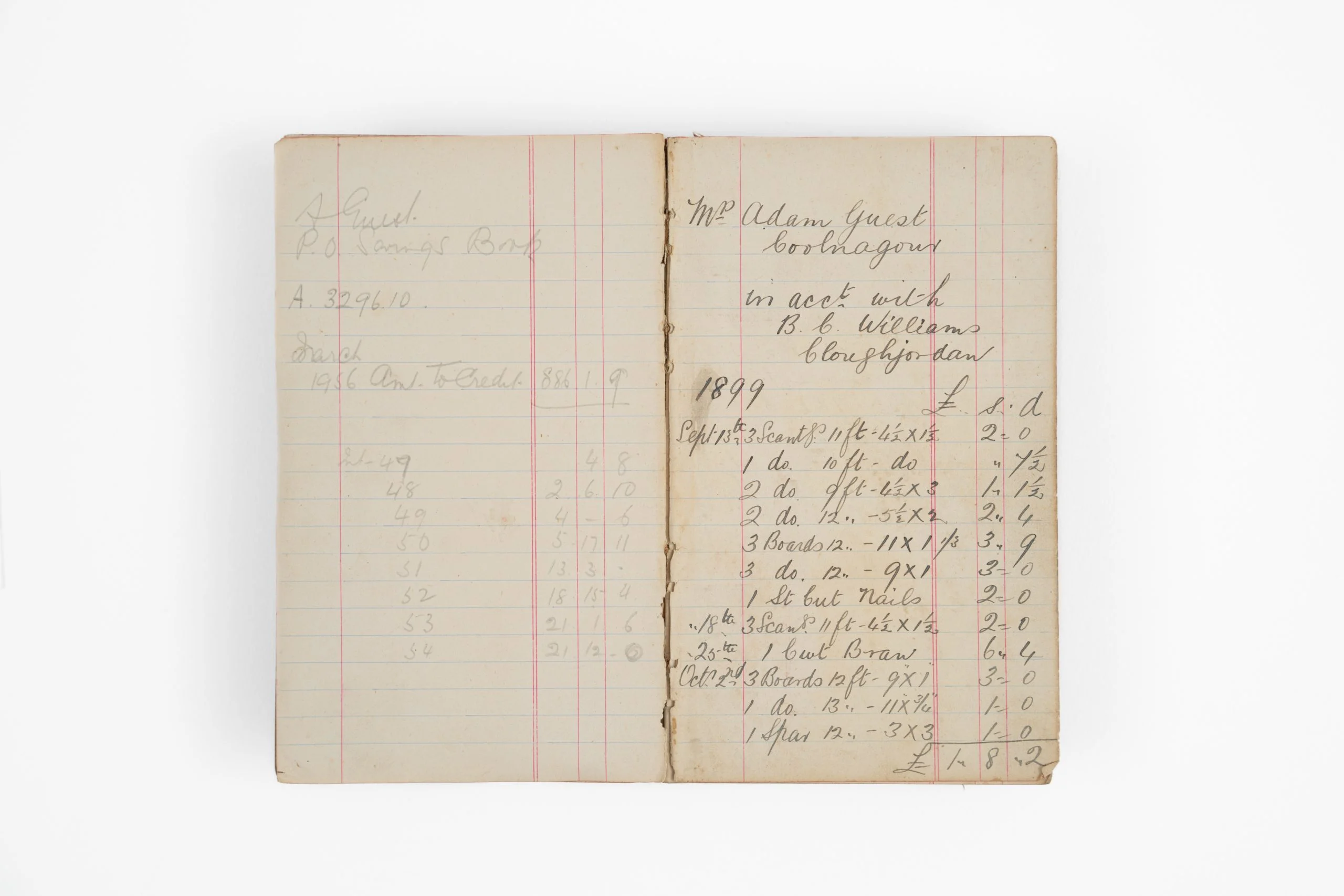
1899 · Look at the outlined area
The right-hand page names Adam Guest and records his account with B. E. Williams, Cloughjordan. The year 1899 appears above the first entries. This is a Tipperary comparison, not a Dromahair household.
Selected readings of the handwriting, not a complete transcription. These are two different dated spreads, not stages in one purchase.
Thomas MacDonagh Museum · Living Heritage 2023 · Material shared by Breda Mounsey. Explore the household collection ↗ · CC BY-SA 2.0. Full credits and image-policy note ↗
When money reached the house
A household could need flour today while waiting for a sale, wages or help from a relative. Different sources of income had different rhythms.
Butter, eggs or other produce could bring money once a buyer was found. What could be sold depended on production and the household’s own needs; there was no identical market basket for every family.
A report dated 1895 describes seasonal workers from Kiltubrid, Leitrim leaving for England and Scotland between April and June and returning in November. They sent or brought savings home. This is a dated example of seasonal income, not a timetable for all Dromahair households.
Read the Kiltubrid evidence, printed pages 40–41 (opens in a new tab)A remittance is money sent home. A relative’s earnings overseas could support people in Ireland as well as the person earning them. Help depended on that person’s circumstances; it was not a guaranteed allowance.
Explore the museum’s “American Letter & Remittances” section (opens in a new tab)Belong · More than a shopping list
A directory gives us another kind of evidence: named businesses at a particular date. These examples come from Dromahair’s 1932 directory, reproduced by Dromahair Heritage. They are a later glimpse, not a street map for 1900.
Groceries and crockery
CanningDrapery
Gillmor; HoneBooks and school supplies
G. E. M’GowenCorn milling
John Hosie, Breffni MillsExplore the directory entries, followed by separately dated memories (opens in a new tab)
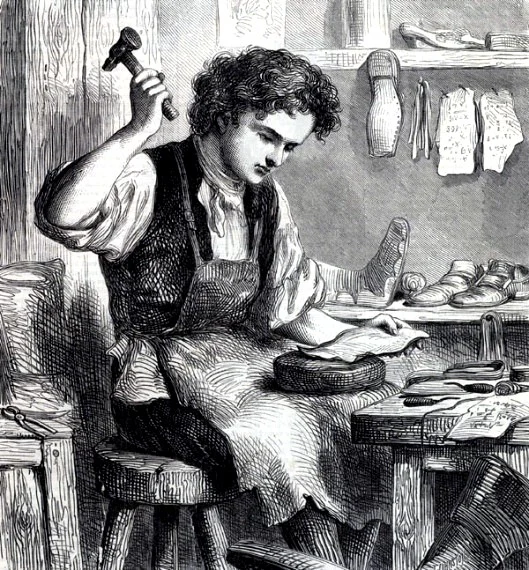
The Band of Hope Review, November 1861, London. Public domain. A comparison of handwork, not Toner’s shop or a photograph of Dromahair. Source ↗ · Full reuse details ↗
A remembered interior
A recollection reproduced by Dromahair Heritage places children playing among leather scraps in Toner’s shoemaking shop while adults chatted. The encounter itself is undated. It gives the workshop a social life alongside its practical one.
A shop visit could be an encounter with neighbours as well as goods.
Find the shoemaker’s-shop recollection near the start of the article (opens in a new tab)Beyond the village · A railway connection
The Sligo, Leitrim and Northern Counties Railway connected Dromahair with places along the route between Collooney and Enniskillen. Dromahair Heritage describes its role in moving people, supplies and produce. A village transaction could belong to a trade stretching far beyond the next townland.
That connection did not remove the work of reaching the station or finding a buyer. Nor does the existence of the line tell us how any particular household’s parcel travelled.
Follow the railway’s local history and its links beyond Dromahair (opens in a new tab)A connection, not a route map
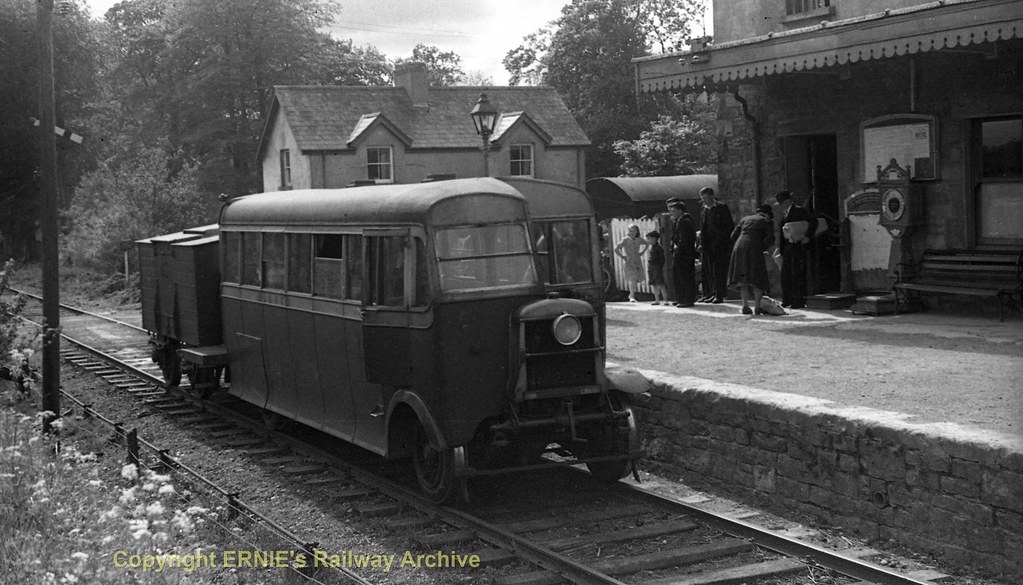
Archive photograph · 18 May 1950
The station connected local journeys with a longer railway. This photograph shows railcar 2A on the 4.20 service from Sligo, beside Dromahair’s platform.
In the archive photograph. Look beyond the railcar: people wait by the station doorway, beneath the canopy, with a bench and weighing machine nearby. A railway journey began in a place like this.
View Dromahair station · 18 May 1950 ↗Opens in a new tab · Ernie’s Railway Archive · HCC73018aThese photographs show the working railway in 1950–1957, several decades after the household period explored here. They are later views of the stations. Selected places only; intermediate stops omitted.
Local: the Darkvalley exchange memory, Newtownmanor’s road-access account, Dromahair’s 1932 directory and later shop recollections, and the railway history.
Elsewhere in Leitrim: Kiltubrid’s seasonal earnings. This is a county example, not a record of a Dromahair household.
Comparisons: Boyle’s street photograph, Tipperary butter-making and account books, Irish town retail averages for 1914. The ledger’s later payment page is from 1950–1951; its prices are not treated as prices around 1900. Retail prices are not the amount a farmer received for produce. We do not use them to calculate an egg-for-tea exchange or a day’s wages.
Still unestablished: a household’s shopping frequency, exact route, budget, shopkeeper, wage or credit terms; any remittance received by the McPadden households discussed on this site. Shop ledgers, receipts and dated local testimony would let us bring the account closer.
What could be sold depended on what could first be produced.
Next, the work—and company—of the changing seasons.
06 · Work & company
A field to return to.
A task to learn.
Someone to work beside.
The household’s work followed more than one clock. Crops changed with the seasons; animals needed daily care. Children grew into responsibilities while still finding ways to play. The work that kept a home going also connected its people to one another.
Around Dromahair, with wider Irish comparisons.
Local school accounts collected in 1937–1939.
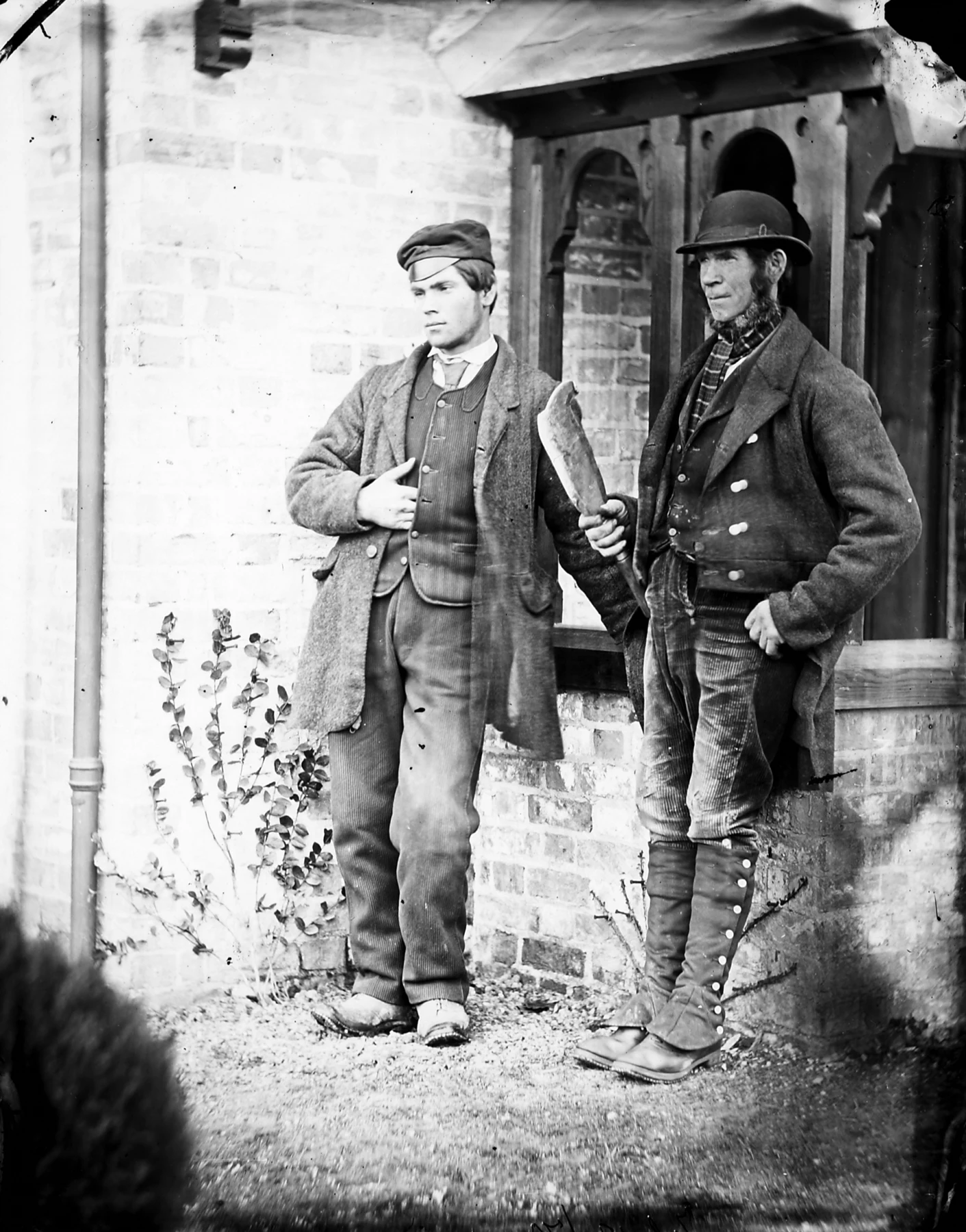
Clonbrock Collection / National Library of Ireland · CLON472. No known copyright restrictions. Resized and WebP-encoded; no retouching. Source and full record ↗
The year · Preparing for what came next
Planting did not finish a crop. Growing plants needed attention, and the harvest still had to be lifted, moved and kept. Meanwhile, the household’s other work continued.
Explore the working year
Select a season. This is a broad Irish pattern described by the National Museum, not a dated diary for one farm.
Spring · March–May
The land warms slowly. A bright afternoon can still be followed by a cold night; spring frost remains possible.
The household needed food and fuel while preparing supplies it could not yet use.
Reading the weather. Temperature and sunshine describe Leitrim in 1931–1960; rainfall describes Dromahair in 1941–1970. These are later climate comparisons. Cloudy hours still count as daylight.
Temperature ranges show differences between parts of the county in the seasonal mean, not daytime highs and night-time lows. Rainfall is the sum of three published monthly averages: March–May, June–August, September–November, and December–February. It does not say how often rain fell or how long a dry spell lasted.
The Dromahair gauge in this table operated from 1944 to 1960. The Meteorological Service estimated averages for the full 1941–1970 period using nearby longer records where needed. These are not measurements from a named household or from 1900.
Sources, monthly values and conversions ↗Through the year Milking, meals, water, cleaning and care continued alongside seasonal work. Which tasks belonged to a household depended on its animals, land and people.
The museum’s farming year (opens in a new tab) · Temperature and sunshine in the Leitrim survey, pp.9–11 (opens in a new tab) · Dromahair rainfall table · PDF p.19 (opens in a new tab) · Met Éireann’s seasonal weather explanation (opens in a new tab) · Daylight calculations for nearby Sligo (opens in a new tab)
One local crop · Newtownmanor
The potatoes we eat are tubers: swollen underground parts of the plant. Leaves grow above the ground while new potatoes develop beneath it. To start another crop, people planted a potato, or a piece with a bud, often called an “eye”. This was the “seed potato”.
A Newtownmanor pupil describes how that worked locally: manure, a plough, planted pieces and long raised rows called ridges.
Manure feeds the soil. The local writer describes cutting seed potatoes into pieces, setting them along the prepared row and covering them with soil. Shoots grow up from the planted pieces.
As the stems grow, draw loose soil around their bases. The local account calls this moulding; it is also called earthing up. It keeps developing potatoes covered and out of the light. The writer also records efforts to protect the crop from blight.
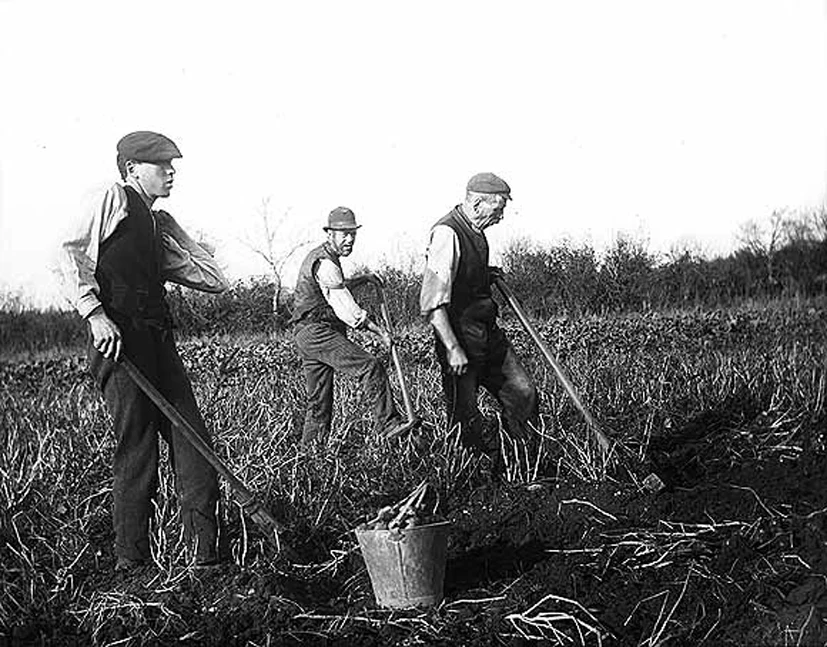
Dig into the row to loosen the earth and expose the potatoes, then gather them by hand. In this account, the larger potatoes are heaped in the field; small ones are boiled as feed for cows and hens.
Follow the local account across manuscript pages 448–449 (opens in a new tab) · How potato plants grow: a modern botanical explanation (opens in a new tab)
 Enlarge photograph ↗
Clonbrock Collection, National Library of Ireland. No known copyright restrictions · Source ↗. Resized and encoded for the web; no retouching. Full credits and licence links ↗
Look at the handling. Notice the long handles, the workers’ stances and the bucket between the rows. This Galway photograph makes the equipment and handling visible.
The National Museum describes small holdings with little machinery, where a spade was a central tool. A plough and harrow changed the work where they were available. The tools available varied with the holding, its soil and its resources.
See the range of spades, ploughing and harvesting tools (opens in a new tab)These local accounts do not give reliable hours per day or days per acre. The physical sequence is clearer: carrying manure, cutting seed, turning soil, returning to tend, then lifting and gathering. Fuel, water and meals still needed attention around it.
Build the cover · A remembered potato store
Harvesting produced more potatoes than a family would eat at once. The next job was to keep that supply cool, dark and protected. This panel shows the harvested crop being stored for later use.
One method, recorded at Leitrim village school in 1937–1939, was a covered heap on the ground. Its writer lived in Dergraw, Roscommon. She called it a pit or heap; it was not a deep underground cellar.
Layer 1 of 4
These potatoes have already been dug up. The writer sorts out sound ones and piles them on level ground into a long, low heap, with a roof-shaped cross-section.
Read the covering and drainage description on manuscript page 449 (opens in a new tab)
This account helps explain what keeping a harvest could involve. It does not establish how the Newtownmanor writer’s heaps were covered, or a guaranteed storage life.
The hands · Growing into responsibility
There was no single birthday when every child stopped playing and began to work. A household could depend on small contributions long before a child took on an adult’s load.
A local memory · After school
One Newtownmanor account remembers boys and girls collecting plants from the fields after school for cattle feed in early summer. The writer looks back about twenty years from the collection period.
The task connected schoolchildren with the household’s dairy work. It was seasonal help, not evidence of a fixed daily schedule for every child.
Read the after-school work in “The Butter Markets”, page 434 (opens in a new tab)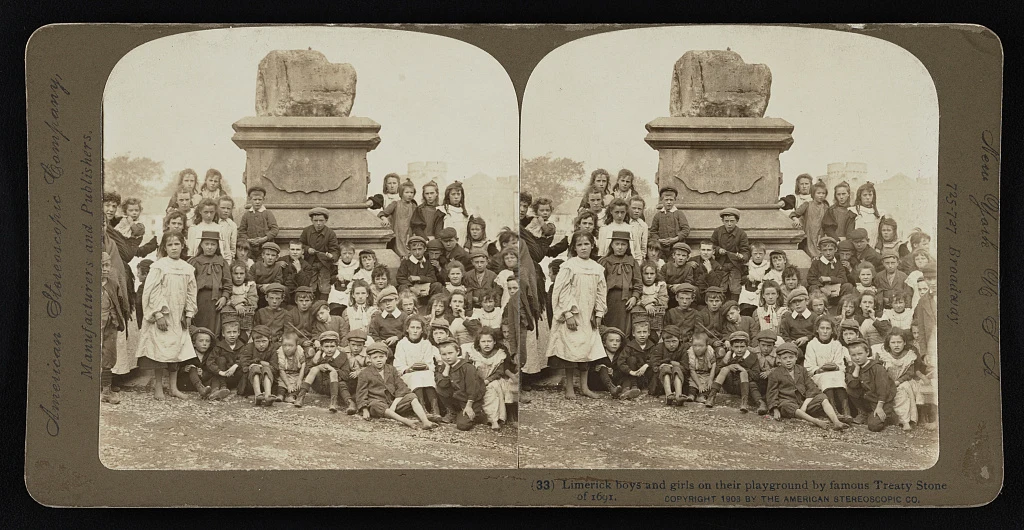
American Stereoscopic Company / Library of Congress · LC-DIG-stereo-1s27938. No known restrictions on publication. WebP conversion; optional enlargement. Archive record ↗ · Whole image ↗
Historian Sarah-Anne Buckley describes older siblings, especially sisters, helping care for younger children. Work within the home was part of the family economy, even when it left no wage record.
Her broader account describes boys taking on errands and small jobs around six or seven, then being called from school for major seasonal tasks around ten or eleven. These are historical patterns, not rules for every child.
Extra hands mattered when work came due. Age, gender, family resources and position among siblings shaped what was expected—and whose schooling could continue.
Read the historian’s “Family life and work” section (opens in a new tab) · Explore schooling in the parish reading →
Together · More than a pair of hands
Some work called for more hands than one household could supply. Company also had a life beyond getting a job done.
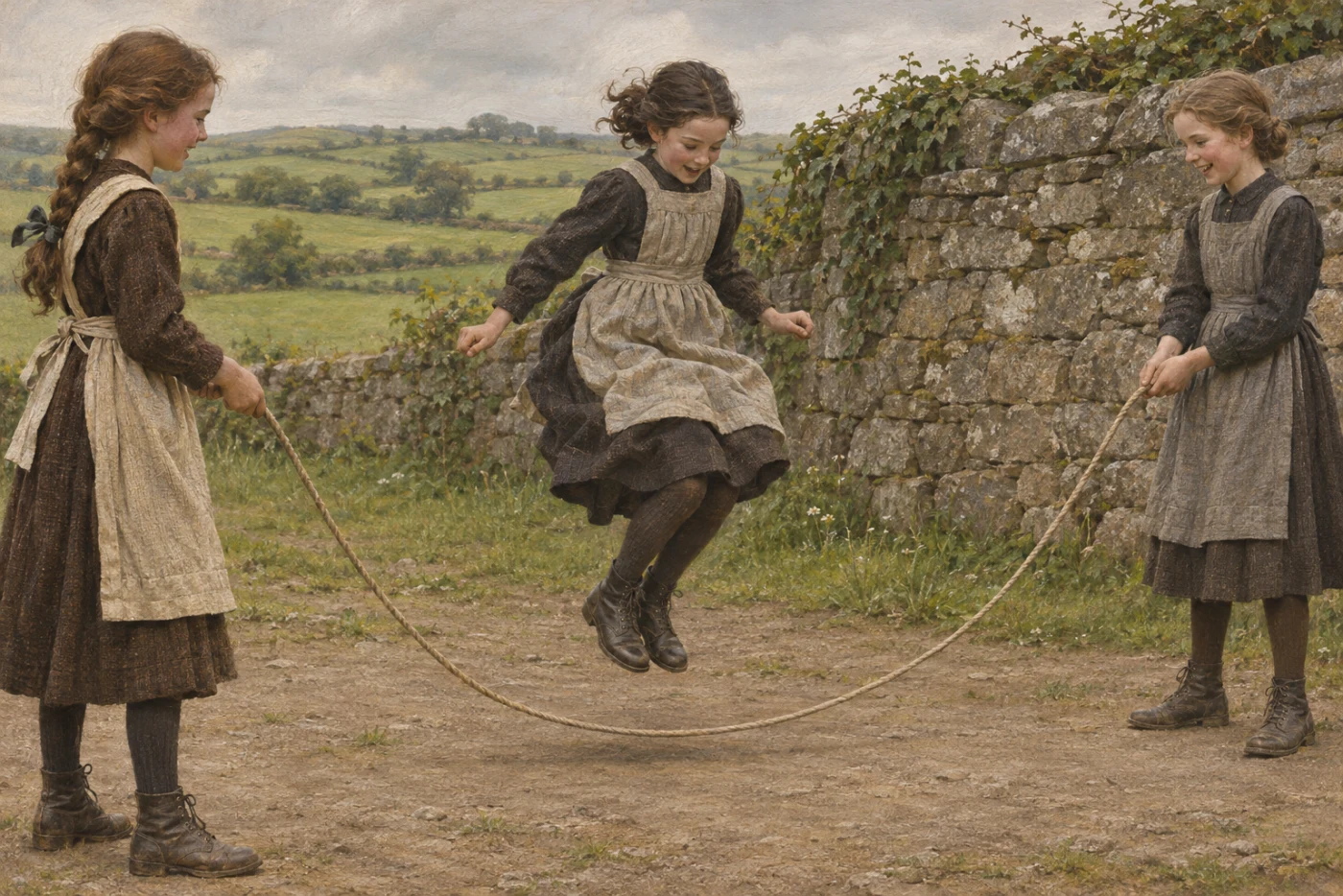
Work was not the whole of childhood. A Newtownmanor pupil also lists skipping, hide-and-seek, draughts, ludo, snakes and ladders, and daisy chains among games at school and home. These are her collection-era experiences, not a list assigned to every earlier generation.
A local game · High Windows
A Newtownmanor pupil describes this chasing game in the Schools’ Collection. Follow her explanation.
The girls count to twelve to choose a catcher. This is the writer’s version of the game.
Read “Games I Play”, including the High Windows description (opens in a new tab)
The chasing game used the players themselves to make its openings. Its equipment was the group and the space they shared.
Draughts and daisy chains sit beside running games in the same child’s list. The record gives us more than labour: concentration, making things and enjoyment.
Around Dromahair: the Newtownmanor potato sequence, after-school cattle-feed memory and first-person game account. Their dates and whether they describe memories or the writer’s own present remain distinct.
Wider comparisons: the museum’s Irish farming year; the historian’s account of childhood; Kiltubrid’s 1894 haymaking; a Mayo account of shared labour; and a potato-store description collected at Leitrim village school from a writer living in Roscommon. Photographs show Galway workers and Limerick children.
Still unknown: a named Dromahair household’s working hours, exact tools, division of chores, ages of starting work, storage capacity and routine arrangements with neighbours. The diagrams explain recorded practices without reconstructing an identified household.
Keeping a home took strength and skill.
It also took learning, help and company.
These were lives being lived, as well as work being done.
An optional family window
Meet Mary Conlon McPadden, a widowed farmer at Tullynascreen, near Dromahair.
In 1911 she appears as Mary McFaddin, the only person recorded in her household that night. The associated returns count one occupied room, one front window and one fowl house.
Those details bring a particular home into view. They do not tell us what she ate, how her room was arranged or who helped her. The local accounts above offer context, not missing pages from her biography.
Carry the questions into another life
Follow the evidence
Personal records and county history answer different questions. Open a note for its precise location and scope.
Source links marked ↗ open in a new tab. Stories, readings and sections open here; your story chapter stays available through the return link.
Doherty, H. B. and Logue, J. J. (1977), Climatological Note No. 5; Dromahair row, County Leitrim, PDF p.19; estimation method PDF p.4.
What it supports. Published monthly rainfall averages for the Dromahair gauge, grid G799317, summed into meteorological seasons: spring 219 mm; summer 293 mm; autumn 367 mm; winter 330 mm. Annual 1209 mm.
How to read it. Gauge opened 1944, closed 1960; shorter records were adjusted using nearby longer records to estimate the 1941–1970 averages. Not the separate Market Street gauge, a county average, a wet-day count or a record of weather in 1900. Seasonal totals and unit conversions calculated by this project.
Reuse. Original explanation and source link; no source photographs or pages reproduced.
Open source (new tab) ↗Source HH-SEASON-RAINFALL · Checked 2026-11-11County Leitrim Resource Survey, Part 1, November 1973; climate pp.9–11 (PDF pp.16–18).
What it supports. Seasonal mean air-temperature ranges across the county and bright-sunshine averages; cool moist climate and year-round rainfall.
How to read it. Later county averages, not weather measurements for 1900 or an identified household. Bright sunshine is distinct from astronomical daylight.
Reuse. Original explanation and source link; no source photographs or pages reproduced.
Open source (new tab) ↗Source HH-SEASON-CLIMATE · Checked 2026-11-11Recurrent Features of the Irish Climate and Meteorological Seasons.
What it supports. Slow spring warming and frost risk; summer humidity and dew; autumn fog and rain; cool windy winters.
How to read it. General climatic mechanisms and patterns, not a dated local weather diary. No modern temperature average applied to 1900.
Reuse. Original explanation and source link; no source photographs or pages reproduced.
Open source (new tab) ↗Source HH-SEASON-WEATHER · Checked 2026-11-11Sligo sunrise/sunset calculations; June and December solstices and March/September equinoxes.
What it supports. Rounded seasonal markers of about 17 hours near June solstice, 7¼ near December solstice, and 12 near equinoxes.
How to read it. Nearby Sligo is a geographic proxy. Day length is not sunshine duration or labour hours; local terrain changes visible sunrise and sunset. Modern astronomical calculations, not historical clock times.
Reuse. Original explanation and source link; no source photographs or pages reproduced.
Open source (new tab) ↗Source HH-DAYLIGHT · Checked 2026-11-11Getting Started, Plant Care, Harvesting and Storing.
What it supports. Seed tubers, shoots, developing underground tubers, earthing up, and the purpose of cool dark storage.
How to read it. Modern botany supplies vocabulary; the local manuscript supplies the historical sequence. Not evidence that historical households followed current RHS advice.
Reuse. Original explanation and source link; no source photographs or pages reproduced.
Open source (new tab) ↗Source HH-POTATO-BASICS · Checked 2026-11-11What activities typically took place on the farm?
What it supports. Seasonal cultivation, hay and turf work, winter maintenance and continuing animal care.
How to read it. National outline, not a calendar or allocation of work for an identified Leitrim holding.
Reuse. Original explanation and source link; no source photographs or pages reproduced.
Open source (new tab) ↗Source HH-WORKING-YEAR · Checked 2026-11-11Kiltubrid, County Leitrim: snapshots of a rural parish in the 1890s; printed pages 26–28, discussion of Leland L. Duncan’s August 1894 photographs.
What it supports. Posed haymaking group and rake in figure 3.1; discussion of long-handled forks and a horse in the wider photographic record.
How to read it. A Kiltubrid example, not a Dromahair agreement. Figure 3.1 is a posed group beside a completed hayrick; the tools and horse discussion draws on more than one photograph. A private development-only scan preview is permission-pending; publication builds retain the source link.
Reuse. Original explanation and source link; no source photographs or pages reproduced.
Open source (new tab) ↗Source HH-LEITRIM-HAY · Checked 2026-11-11The Potato Crop, vol.0207, p.449; Liathdruim school, Leitrim village; collector Margaret Smart, Dergraw, County Roscommon. Schools’ Collection, 1937–1939.
What it supports. Father and boys digging while children pick; sound potatoes heaped on level ground, covered with rushes then earth, with a surrounding trench to drain rain.
How to read it. A county-boundary comparison, not a Dromahair store. Schematic is not to scale. Chemical treatment instructions are not reproduced; no storage lifetime or modern horticultural instruction asserted.
Reuse. Original paraphrase and source link. No manuscript pixels or extended transcription reproduced. The archive’s image and data terms remain separate from this reading.
Open source (new tab) ↗Source HH-POTATO-STORE · Checked 2026-11-11The Potato Crop, vol.0119, p.215; Clochar Lughaidh, Coillte Mághach / Kiltimagh, County Mayo. Schools’ Collection, 1937–1939.
What it supports. Retrospective account of neighbours working on successive farms, described as a meitheal.
How to read it. Mayo recollection, described by its writer as declining; not a claim of universal communal ownership, paid labour or an identified Dromahair arrangement.
Reuse. Original paraphrase and source link. No manuscript pixels or extended transcription reproduced. The archive’s image and data terms remain separate from this reading.
Open source (new tab) ↗Source HH-MEITHEAL · Checked 2026-11-11Printed pages 40–41; Henry Doran’s report to the Congested Districts Board, 31 January 1895.
What it supports. Seasonal workers leaving for England and Scotland April–June and returning in November; savings sent or brought home.
How to read it. A dated Kiltubrid example, not a Dromahair household budget or universal seasonal pattern.
Reuse. Original explanation and source link; no source photographs or pages reproduced.
Open source (new tab) ↗Source HH-MARKET-INCOME · Checked 2026-11-11American Letter & Remittances section.
What it supports. Letters, money transfers, tickets, clothes and photographs; practical connections with relatives abroad.
How to read it. General Irish emigration context. No remittance attributed to a named family here.
Reuse. Original explanation and source link; no source photographs or pages reproduced.
Open source (new tab) ↗Source HH-MARKET-REMIT · Checked 2026-11-11Buttermaking; cream, churning, washing and salting, butter stamps, wrapping and firkins.
What it supports. Work before sale; distinction between wrapped small quantities and larger wooden containers.
How to read it. A museum comparison from Tipperary, not a Leitrim packaging specification or universal timing. Its folklore generalisations are not adopted.
Reuse. Original explanation and source link; no source photographs or pages reproduced.
Open source (new tab) ↗Source HH-MARKET-BUTTER · Checked 2026-11-11Feeding the Family, Country Life interpretation.
What it supports. Women selling surplus butter and eggs within the wider work of provisioning a household.
How to read it. National interpretation, not proof of a particular household’s livestock, surplus, earnings or diet.
Reuse. Original explanation and source link; no source photographs or pages reproduced.
Open source (new tab) ↗Source HH-MARKET-SURPLUS · Checked 2026-11-11Life in 1916 Ireland: Consumer Prices, tables 4.12 and 4.14; source Report on the Cost of Living in Ireland, June 1922.
What it supports. 1914 average retail prices: 2 lb bread 3.2d; cheapest tea 18.1d/lb; white granulated sugar 2.2d/lb; household soap 3.6d/lb. 12d=1s; 20s=£1.
How to read it. Irish town retail averages, not local receipts or producer prices. Tea scaled to 2 oz by dividing by eight. Interactive quantities are user choices; fractional pence are arithmetic averages, not denominations. No wage, barter, household-budget or modern-money conversion.
Reuse. Original explanation and source link; no source photographs or pages reproduced.
Open source (new tab) ↗Source HH-MARKET-PRICES · Checked 2026-11-11Commerce in Cloughjordan; Guest family books, Williams’ shop from 1899 and Harty’s shop. Living Heritage 2023.
What it supports. Customer-held household books, purchases on account and retailer stamps when paid.
How to read it. Tipperary comparison. Facsimiles show an 1899 purchase page and a separate 1950–1951 settlement example. No local credit terms inferred or later prices assigned to 1900.
Reuse. Two photographed spreads reused under museum image policy, CC BY-SA 2.0; credited, WebP-encoded and highlighted with removable overlays. Full provenance in household photograph notes.
Open source (new tab) ↗Source HH-MARKET-LEDGER · Checked 2026-11-11Railway; Sligo, Leitrim and Northern Counties Railway route and local role.
What it supports. Dromahair between Collooney and Enniskillen; movement of people, supplies and products.
How to read it. Selected-stops diagram only; no scale, household itinerary, consignment or travel time inferred.
Reuse. Original explanation and source link; no source photographs or pages reproduced.
Open source (new tab) ↗Source HH-MARKET-RAIL · Checked 2026-11-11Recycling Clothing: rag bag c.1850–1900, remaking and rag sales; also Remaking Clothing.
What it supports. Sound portions of worn garments retained for remaking; scraps saved for reuse or sale; an actual rag bag and examples of reused cloth.
How to read it. American comparison, not evidence of a Dromahair bag, collector or price. No universal claim that nothing was discarded; no source photographs copied.
Reuse. Original explanation and source link; no source photographs or pages reproduced.
Open source (new tab) ↗Source HH-CLOTH-REUSE · Checked 2026-11-11Rags & Recycling; research arising from the Royal Dublin Society Library and Archives Bursary, 2018.
What it supports. Linen rags collected for eighteenth-century Irish papermaking, within a wider economy of material reuse and barter.
How to read it. Earlier national context, not a documented collector or route around Dromahair circa 1900. Indexed author text reviewed; direct retrieval unavailable. No prices, prevalence figures or source images reproduced.
Reuse. Original explanation and source link; no source photographs or pages reproduced.
Open source (new tab) ↗Source HH-CLOTH-RAGTRADE · Checked 2026-11-11Rag paper: material and process definition.
What it supports. Cotton or linen rags broken down into fibres and made into paper.
How to read it. A general material explanation, not evidence of a local mill, buyer or the destination of all textiles.
Reuse. Original explanation and source link; no source photographs or pages reproduced.
Open source (new tab) ↗Source HH-CLOTH-PAPER · Checked 2026-11-11The Darning Mushroom, 26 January 2022; tool handling and hand-darning explanation.
What it supports. Supporting the cloth without over-stretching it, controlling tension, interweaving new thread, and darning where a patch would cause discomfort, such as a sock heel.
How to read it. An Australian collection explanation of a technique, not a local ownership record. Its broad claims about all women’s clothing work are not adopted. No source image reused.
Reuse. Original explanation and source link; no source photographs or pages reproduced.
Open source (new tab) ↗Source HH-CLOTH-TOOL · Checked 2026-11-10Flax to Fabric gallery guide, updated June 2025; pp.7–10, especially flax into yarn (p.8), industrial production (p.7), thread and spinning (p.9).
What it supports. Retting, scutching and hackling; nineteenth-century machine spinning, continuing hand-loom work, northern firms and Barbour thread production at Hilden.
How to read it. Northern industry supplies context, not an identified supplier to Newtownmanor. The earlier domestic-industry description is not transferred wholesale to Leitrim around 1900. No numerical production or task-duration estimates used.
Reuse. Original explanation and source link; no source photographs or pages reproduced.
Open source (new tab) ↗Source HH-CLOTH-LINEN · Checked 2026-11-10Identifying Textile Types and Weaves 1750–1950, workshop pack, 2007; cotton p.9 and weaving pp.11–12 (PDF page numbers).
What it supports. Cotton preparation and flannelette among cotton fabrics; warp held under tension, weft crossing it, and over-one/under-one plain weave.
How to read it. Technical explanation, not a microscopic identification of the portrait clothing or a reconstruction of a Leitrim loom. Original graphic swatches and weave diagrams; no pack images reused.
Reuse. Original explanation and source link; no source photographs or pages reproduced.
Open source (new tab) ↗Source HH-CLOTH-FABRICS · Checked 2026-11-10Introduction to Knitting: knitted fabric formed from a single yarn and interlocking loops.
What it supports. The structural distinction between knitting and weaving; yarn can form a garment without first becoming a cut woven length.
How to read it. Construction comparison; British industry history and dates are not used as Leitrim adoption evidence.
Reuse. Original explanation and source link; no source photographs or pages reproduced.
Open source (new tab) ↗Source HH-CLOTH-KNIT · Checked 2026-11-10Exhibition introduction, clothing chiefly from the 1760s to 1960s.
What it supports. Diversity of Irish dress and the influence of changing European fashion.
How to read it. A national interpretation across two centuries; not a wardrobe inventory for a locality. The Galway portrait remains one posed comparative image.
Reuse. Original explanation and source link; no source photographs or pages reproduced.
Open source (new tab) ↗Source HH-CLOTH-DRESS · Checked 2026-11-10Fashioning Illinois 1820–1900: Mending & Remaking; c.1880s stockings, c.1860 darning egg, repaired garments and definitions.
What it supports. Patching adds cloth; darning replaces missing structure with interwoven stitches; wooden supports help hold a stocking’s shape; surviving garments show repeated repairs.
How to read it. American museum objects are explicitly comparative, not evidence of Leitrim possessions. Diagrams are original simplified explanations, not copies of museum photographs or exact local stitch patterns.
Reuse. Original explanation and source link; no source photographs or pages reproduced.
Open source (new tab) ↗Source HH-CLOTH-REPAIR · Checked 2026-11-10Darning: short educational explanation of worn heels and elbows and threads woven across a hole.
What it supports. A plain-language explanation of replacing missing fabric with wool or thread.
How to read it. General interpretation without a precise date or locality. Indexed text reviewed; direct retrieval unavailable. No claim about prevalence or a particular household’s repairs.
Reuse. Original explanation and source link; no source photographs or pages reproduced.
Open source (new tab) ↗Source HH-CLOTH-DARNING · Checked 2026-11-10Where Did Our Grandparents Get Their Clothes?, with associated teacher notes.
What it supports. Children receiving clothing from older siblings and cousins and clothing made at home.
How to read it. The resource’s grandparents framing has no fixed historical year. Used only for the practice of hand-me-downs, not a measured frequency around 1900, a local chain of ownership or a lifespan estimate. Indexed text reviewed; direct retrieval unavailable.
Reuse. Original explanation and source link; no source photographs or pages reproduced.
Open source (new tab) ↗Source HH-CLOTH-HANDDOWNS · Checked 2026-11-10Water for drinking, PDF pp.1–3: spring collection points, Rothe House well and hand pumps.
What it supports. Different methods of obtaining water; original diagrams explain collection, bucket raising and a hand pump.
How to read it. Kilkenny comparisons, not Leitrim water-source identifications. No depths or source-to-house distances transferred. Photograph independently licensed; diagrams not to scale.
Reuse. Original explanation and source link; no source photographs or pages reproduced.
Open source (new tab) ↗Source HH-WATER-SOURCES · Checked 2026-11-10Water Pumps of Blarney and District: roadside and private pumps, domestic rain barrels, troughs and dry summers.
What it supports. Public and private access; different supplies for household and farm work; extra journeys when a source failed.
How to read it. Retrospective Cork account with dates varying across the article; not a Dromahair inventory. Its claims about water divining and water purity are not adopted.
Reuse. Original explanation and source link; no source photographs or pages reproduced.
Open source (new tab) ↗Source HH-WATER-BLARNEY · Checked 2026-11-10Vol.0577, p.381; New Ross, Wexford; collected 1938 by Máire Ní Dhonnchadha, informant Liam Ó Ceallaigh.
What it supports. Remembered earthenware vessels for holding and carrying water.
How to read it. Retrospective comparison, not Leitrim equipment or storage quantities. No manuscript images reproduced.
Reuse. Original explanation and source link; no source photographs or pages reproduced.
Open source (new tab) ↗Source HH-WATER-VESSELS · Checked 2026-11-10Bohola: Its history and its people (1992), excerpt: The Kitchen and Wash Day.
What it supports. Washstand, jug and basin; washing before school and shaving; washing-up kettle; heating water and adding cold to a wash tub.
How to read it. Mayo community-history comparison; individual practices not precisely dated. No Leitrim bathing frequency inferred. Wider generalisations elsewhere in the excerpt are not adopted.
Reuse. Original explanation and source link; no source photographs or pages reproduced.
Open source (new tab) ↗Source HH-WATER-BOHOLA · Checked 2026-11-10Vol.0577, p.353; How they Washed Blankets etc.; New Ross, Wexford; collected 1938.
What it supports. Wringing, hedges and lines for drying, and an additional overnight soak of white washing.
How to read it. One retrospective Wexford account, not a universal sequence or Leitrim timetable. No cleaning recipes or efficacy claims reproduced.
Reuse. Original explanation and source link; no source photographs or pages reproduced.
Open source (new tab) ↗Source HH-WATER-LAUNDRY · Checked 2026-11-10Newtownmanor, vol.0199, p.402; Winnie Mc Goldrick, Doonkelly; Reasons for Certain Superstitious Customs, continued.
What it supports. Beliefs about throwing dirty and hot water out after sunset provide a local glimpse of household disposal.
How to read it. A record of belief, not an instruction or sanitary regulation. Indexed archive transcription reviewed; direct retrieval returned cache miss.
Reuse. Original paraphrase and source link. No manuscript pixels or extended transcription reproduced. The archive’s image and data terms remain separate from this reading.
Open source (new tab) ↗Source HH-WATER-DISPOSAL · Checked 2026-11-10Household Items collection overview.
What it supports. Mangles, wash tubs, irons and other household equipment in the museum collection.
How to read it. Collection presence does not prove ownership by a particular household around 1900. Indexed museum text reviewed; direct retrieval failed. No museum photographs reused.
Reuse. Original explanation and source link; no source photographs or pages reproduced.
Open source (new tab) ↗Source HH-WATER-GLENVIEW · Checked 2026-11-10Object 55/218: description and label text; machine purchased in the 1920s and used at Lavells Farm, Stratfield Saye.
What it supports. Basket winnowing; hand cranks producing artificial airflow; appearance of machines in Europe in the eighteenth century; one documented English farm purchase.
How to read it. English comparison, not evidence of Leitrim adoption dates, ownership, affordability, borrowing or home manufacture. Does not identify the maker or date of the photographed Blennerville machine. Reducing dependence on natural breeze follows from the described artificial airflow.
Reuse. Original explanation and source link; no source photographs or pages reproduced.
Open source (new tab) ↗Source HH-WINNOWING-MACHINE · Checked 2026-11-10Object 1969-369, Tasker No.6 winnowing machine, made in Andover in 1871.
What it supports. A named manufacturer and dated surviving machine demonstrate commercial manufacture.
How to read it. English comparison. No claim that this model reached Dromahair or was the Blennerville machine. No machine photograph reproduced from this collection.
Reuse. Original explanation and source link; no source photographs or pages reproduced.
Open source (new tab) ↗Source HH-WINNOWER-MAKER · Checked 2026-11-10Traditional Irish farming methods: sickles, scythes, flails and mechanisation; photograph of women harvesting with sickles, c.1910.
What it supports. Hand harvesting, two-part flails and the changing mix of manual and mechanical work.
How to read it. National synthesis. Drawings explain functions, not measurements or recovered Leitrim tools. The 1923 machine-threshing photograph is an independently credited comparison, not proof of access to machinery on a particular farm.
Reuse. Original explanation and source link; no source photographs or pages reproduced.
Open source (new tab) ↗Source HH-HARVEST · Checked 2026-11-10Martry Mill, Mill Floors: waterwheel, axle, pit wheel, wallower, great spur wheel, runner and bedstone.
What it supports. Rotating upper stone, stationary lower stone, stones not touching; wheat ground to wholemeal flour. A functional diagram explains the power chain.
How to read it. County Meath comparison, not Dromahair machinery. Diagram omits exact gearing and floor arrangement, enlarges the space between stones and is not to scale. Indexed exhibit text reviewed; direct retrieval returned 403.
Reuse. Original explanation and source link; no source photographs or pages reproduced.
Open source (new tab) ↗Source HH-MARTRY · Checked 2026-11-10Newmills Corn and Flax Mills, County Donegal: River Swilly waterwheel and crops processed.
What it supports. Water-powered milling and the use of corn for cereals including oats, barley and maize.
How to read it. A surviving Donegal comparison; photographs are separately licensed modern views. No specific Dromahair wheel type or arrangement is inferred.
Reuse. Original explanation and source link; no source photographs or pages reproduced.
Open source (new tab) ↗Source HH-NEWMILLS-VISIT · Checked 2026-11-10Feeding the Family: Growing and Buying; Kitchen Implements.
What it supports. Wider rural foods and purchases; women’s food-processing responsibilities; heavy cooking vessels, griddles, pot ovens and coordinating dishes around one fire.
How to read it. A national overview, not a measured Dromahair diet or a household-specific division of labour. It supplies no daily cooking-hours total or proportions of dietary energy.
Reuse. Original explanation and source link; no source photographs or pages reproduced.
Open source (new tab) ↗Source HH-FEEDING · Checked 2026-11-10Newtownmanor, vol.0199, p.244; Eugene Mc Ternan, Doonkelly; opening of the food account continued on p.245.
What it supports. Approximately three meals: morning oatmeal porridge; potatoes, buttermilk and salt at dinner and night.
How to read it. Retrospective and nostalgic description of an unspecified earlier time, recorded in the 1930s. Claims about exceptional health or complete self-sufficiency are not adopted. This is not an every-household menu or a quantifiable dietary survey.
Reuse. Original paraphrase and source link. No manuscript pixels or extended transcription reproduced. The archive’s image and data terms remain separate from this reading.
Open source (new tab) ↗Source HH-MEALS · Checked 2026-11-10Drumloughan, vol.0221, pp.111–112. Opening page and indexed transcript continuation reviewed; continuation describes pan cooking, turning, butter and tea.
What it supports. Raw peeled potatoes grated on nail-pierced tin, mixed with flour and salt, pan-cooked on both sides and served with butter and tea.
How to read it. South Leitrim comparison recorded in the 1930s, not a Tullynascreen recipe. No measured quantities, times or temperatures supplied; no modern tested recipe is claimed. Continuation read through Dúchas transcription index; direct page retrieval unavailable.
Reuse. Original paraphrase and source link. No manuscript pixels or extended transcription reproduced. The archive’s image and data terms remain separate from this reading.
Open source (new tab) ↗Source HH-BOXTY · Checked 2026-11-10Newtownmanor, vol.0199, p.431; Rose Anne Smith, Kilmore.
What it supports. A household barrel churn operated by hand, wooden dash and boards for working butter.
How to read it. Contemporary 1930s pupil’s account. No duration, output per session or nineteenth-century continuity is inferred.
Reuse. Original paraphrase and source link. No manuscript pixels or extended transcription reproduced. The archive’s image and data terms remain separate from this reading.
Open source (new tab) ↗Source HH-CHURNING · Checked 2026-11-10Irish Country Furniture FAQs, “What kinds of beds were found in the Irish rural house?”
What it supports. Settlebeds as a common form; built-in outshot beds beside the hearth and other bedsteads; furniture adapted to available space.
How to read it. Museum synthesis, not a count of Dromahair households or settle beds. The illustrative room plan is project-authored and does not reconstruct a documented house or assign occupants.
Reuse. Original explanation and source link; no source photographs or pages reproduced.
Open source (new tab) ↗Source HH-BED-TYPES · Checked 2026-11-10“How a big bed was a status symbol in Irish society”, updated 22 February 2022; edited interview passages about settle beds and rooms used for sleeping.
What it supports. Settle beds opening into double sleeping spaces, containing their bedding; combinations of bed types and adaptable room use.
How to read it. Expert interpretation, not the occupancy history or capacity of the photographed Kiltyclogher bed. No typical number of settle beds per house is established. Indexed full article text read; direct retrieval returned 403.
Reuse. Original explanation and source link; no source photographs or pages reproduced.
Open source (new tab) ↗Source HH-SHARED-BEDS · Checked 2026-11-10“Thatched Houses”, extract credited to Abbeyknockmoy — A Time to Remember, p.128; webpage updated 28 January 2026; section “The thatched house”.
What it supports. Parents and latest baby in a small room; other children sharing beds, sometimes four or more at opposite ends; a kitchen settlebed with a straw-filled mattress.
How to read it. Later regional recollection. “Pre war” is not anchored to a precise year or named conflict; no Leitrim universality or exact historical date is inferred. Indexed full text read; direct retrieval was unavailable. The accompanying diagram does not reproduce this three-room layout.
Reuse. Original explanation and source link; no source photographs or pages reproduced.
Open source (new tab) ↗Source HH-GALWAY-SLEEPING · Checked 2026-11-10County Londonderry, Agriculture, final paragraph on fuel.
What it supports. The contemporary description reports exhausted bogs in fertile, densely inhabited districts and recourse to mountain bogs.
How to read it. An earlier County Derry comparison, not a Leitrim survey. Online transcription read directly; original printed page not inspected. No distances or frequency of household shortages are established. A changed journey and access arrangements are possibilities inferred from changing supply, not documented details of this example.
Reuse. Original explanation and source link; no source photographs or pages reproduced.
Open source (new tab) ↗Source HH-EXHAUSTED-BOGS · Checked 2026-11-10House of Commons, 28 May 1908, vol.189, col.1381: John Dillon, MP for East Mayo, in the agriculture and technical instruction estimates debate.
What it supports. Dillon reported hardship where bogs were cut out, described coal at 35 shillings a ton in some country districts as unaffordable for poorer people, and advocated conserving woodland for fuel.
How to read it. A parliamentary argument, not an independent price survey or a measure of Leitrim prevalence. Price applies to unspecified rural districts in his speech, not Dromahair. Woodland conservation was proposed; household delivery of replacement fuel is not established. No present-day price conversion is made.
Reuse. Original explanation and source link; no source photographs or pages reproduced.
Open source (new tab) ↗Source HH-FUEL-SCARCITY · Checked 2026-11-10“Chimneys, flues and hearths”, historical note, especially the explanation of draft.
What it supports. The open hearth as a place of cooking, warmth and gathering; rising gases and airflow through a functioning chimney.
How to read it. General building interpretation. It cannot establish the chimney design or smoke level in a particular family home. This reading gives no repair instructions.
Reuse. Original explanation and source link; no source photographs or pages reproduced.
Open source (new tab) ↗Source HH-CHIMNEY · Checked 2026-11-10Traditional Buildings in Ireland: Home Owners Handbook (2004), printed p.15, PDF page 23, “Chimneys”.
What it supports. Smoke escaping through thatch, doorway or gable window in buildings without chimneys; differing historical arrangements.
How to read it. Earlier vernacular-building context, not a claim that all homes around Dromahair lacked chimneys in 1900.
Reuse. Original explanation and source link; no source photographs or pages reproduced.
Open source (new tab) ↗Source HH-EARLY-SMOKE · Checked 2026-11-10“Country Kitchens”, The Corran Herald, issue 56 (2023–2024), printed p.67, PDF page 68.
What it supports. A childhood memory of arriving at a grandmother’s home in Rossmore near Riverstown, County Sligo, and recognising turf smoke as the scent once associated with the countryside.
How to read it. A later personal recollection; the passage does not give the childhood year. It does not establish the sensory experience of a particular Dromahair household. The reading reproduces one short quotation; the publication’s other material is linked, not reproduced.
Reuse. Original explanation and source link; no source photographs or pages reproduced.
Open source (new tab) ↗Source HH-TURF-SCENT · Checked 2026-11-10“Find of Bog-Butter, Canoe, and Bronze Sword in County Leitrim”, vol.35, no.2, 30 June 1905, p.171. Bibliographic details corroborated by the National Library of Ireland catalogue.
What it supports. A report of a farmer finding a vessel of butter while cutting turf at Drumconnor bog, described as a few miles from Creevelea.
How to read it. A contemporary report accessed through a modern text reproduction, not an inspected original journal scan. It does not identify the fuel source, cutting rights or travel route of a Tullynascreen household.
Reuse. Original explanation and source link; no source photographs or pages reproduced.
Open source (new tab) ↗Source HH-LOCAL-BOG · Checked 2026-11-10“Drumgriffen Turbary Eights” [catalogue title], House of Commons, 2 August 1906, vol.162, cols.1339–1340; reply concerning agreements signed 1 March 1905.
What it supports. An agreement to buy a one-fifteenth share of a 73-acre turf bank in County Galway.
How to read it. A dated example of shared interest, not a typical share size, an account of all Irish bog ownership or current legal advice. Read from Parliament’s indexed full text; direct tool retrieval was unavailable.
Reuse. Original explanation and source link; no source photographs or pages reproduced.
Open source (new tab) ↗Source HH-TURBARY-SHARE · Checked 2026-11-10“Turbary Rights on the Granard Estate”, House of Commons, 30 May 1905, vol.147, cols.225–226; estate described as extending across Longford and Leitrim.
What it supports. The official reply distinguishes turbary rights vested with a holding from a separately constituted bog trust.
How to read it. The reply does not establish that the questioner’s grievance was resolved, or locate this household near Dromahair. Used only for the historical distinction between holding, cutting right and trust. Indexed full text read; direct tool retrieval was unavailable.
Reuse. Original explanation and source link; no source photographs or pages reproduced.
Open source (new tab) ↗Source HH-TURBARY-ESTATE · Checked 2026-11-10“A Day in the Bog – La sa bPortach”, PDF pp.1–2; hosted in the Milltown heritage collection, upload path May 2017; author and composition date not stated in the PDF.
What it supports. Opening a new bank beside the previous cut, a lower worked-out area, and different groups working their own plots.
How to read it. A later Galway heritage explanation, not a measured Leitrim cutting plan. Its modern prices and machinery dimensions are not transferred to this reading.
Reuse. Original explanation and source link; no source photographs or pages reproduced.
Open source (new tab) ↗Source HH-ADVANCING-BANK · Checked 2026-11-10What’s So Special About Peat? (2012), second PDF page: “What is Peat?”, “Destroying Peat” and “Peat Land Restoration”.
What it supports. Waterlogged conditions, slow accumulation at about 1 mm/year in active peat, and damage to peat-forming conditions through cutting and drainage.
How to read it. An explanatory rate, not a site-specific growth measurement. The 20/100/1,000-year comparison is simple arithmetic at that rate, not a prediction of regrowth in a cut bank. No contemporary national statistics are taken from this older leaflet.
Reuse. Original explanation and source link; no source photographs or pages reproduced.
Open source (new tab) ↗Source HH-PEAT-FORMATION · Checked 2026-11-10“Why protecting peatlands matters for our future”, section “If peat forms naturally, is it a renewable resource?”
What it supports. Slow formation over long timescales and the lack of peat accumulation in drained peatlands.
How to read it. Modern ecological explanation, distinguished from historical household choices. It does not promise that a cut bank will refill after a specified waiting period.
Reuse. Original explanation and source link; no source photographs or pages reproduced.
Open source (new tab) ↗Source HH-PEAT-RECOVERY · Checked 2026-11-10Carracastle family account, published 29 May 2015, drawing on Irish Family History Forum articles of 2014–2015.
What it supports. Turning and footing sods, light cartloads on bog ground and six weeks in ideal weather as one estimate of the saving period.
How to read it. A later family reconstruction in County Mayo. Its timings, loads and work arrangements are not transferred to Tullynascreen.
Reuse. Original explanation and source link; no source photographs or pages reproduced.
Open source (new tab) ↗Source HH-TURF-MEMORY · Checked 2026-11-10“Using wooden sieves”, agricultural and domestic uses.
What it supports. Winnowing with air and sieves, grain falling onto a sheet and further cleaning.
How to read it. An explanation of tool use, not evidence of a particular local household’s tools, crop quantity or working day.
Reuse. Original explanation and source link; no source photographs or pages reproduced.
Open source (new tab) ↗Source HH-SIEVES · Checked 2026-11-10Registration 30806001; former water-powered corn mill, built c.1800. Also listed in Leitrim County Development Plan 2023–2029, Record of Protected Structures, item 62.
What it supports. A documented two-storey, seven-bay stone mill complex with a northern tower and a water-power setting in Dromahair.
How to read it. The inventory does not establish each phase of operation or identify the machinery used in the local recollection. No family ownership or exclusive use is inferred.
Reuse. Original explanation and source link; no source photographs or pages reproduced.
Open source (new tab) ↗Source HH-MILL · Checked 2026-11-10Published 22 February 2017; MacDonald’s Irish Directory (1932) entries followed by recollections and later history.
What it supports. Canning’s grocery and crockery business, Gillmor and Hone drapers, and John Hosie’s Breffni Corn Mill. Later commentary identifies a separate coal-fired Hosie mill completed in 1910 beside the railway station.
How to read it. The directory date is kept distinct from later memories. These entries do not establish household spending, account terms or the same proprietors in earlier decades.
Reuse. Original explanation and source link; no source photographs or pages reproduced.
Open source (new tab) ↗Source HH-SHOPS · Checked 2026-11-10Heritage Ireland, issue 2, summer 2015, pp.16–17: Newmills, County Donegal.
What it supports. Water power, kiln drying and processing, bagged output, and retention of 10 lb per hundredweight bag when payment could not be made.
How to read it. A Donegal comparison, not a Dromahair machinery specification or fee. The approximate 9% display is the project’s calculation using an imperial hundredweight of 112 lb.
Reuse. Original explanation and source link; no source photographs or pages reproduced.
Open source (new tab) ↗Source HH-NEWMILLS · Checked 2026-11-10Ardvarney Schools’ Collection entry; Agnes McGovern, Cleen. Collected 1937–1939.
What it supports. The answer describes a person carrying two wooden water buckets.
How to read it. A riddle makes an everyday image visible. It is not a measured container, a water-source map or an account of a named family’s supply.
Reuse. Original paraphrase and source link. No manuscript pixels or extended transcription reproduced. The archive’s image and data terms remain separate from this reading.
Open source (new tab) ↗Source HH-BUCKETS · Checked 2026-11-10“Traditional life in Rathnew Village”; updated 18 March 2020, including Elizabeth Kearney’s recollections.
What it supports. Walking with two buckets, young women and older children fetching water when supplies ran short, and the well as a meeting place.
How to read it. A later recollection from Rathnew, County Wicklow; the passage does not date each remembered journey. It does not establish a Leitrim route, bucket capacity or daily allowance.
Reuse. Original explanation and source link; no source photographs or pages reproduced.
Open source (new tab) ↗Source HH-RATHNEW · Checked 2026-11-10“Clothing the Family”, Country Life interpretation.
What it supports. Wool and flax, spinning and local weaving, tailors and household making, and better clothing passing into everyday wear.
How to read it. National context. It does not identify the supplier, factory, wardrobe or garment lifespan of a Dromahair household.
Reuse. Original explanation and source link; no source photographs or pages reproduced.
Open source (new tab) ↗Source HH-TEXTILES · Checked 2026-11-10Newtownmanor, vol.0199, p.436; Jim Cunningham, Fawnlion. Schools’ Collection, 1937–1939.
What it supports. Shop-bought machine-made shoes and small repairs made at home.
How to read it. A local comparison of practices, not a measured shoe lifespan or a record of a particular family’s footwear.
Reuse. Original paraphrase and source link. No manuscript pixels or extended transcription reproduced. The archive’s image and data terms remain separate from this reading.
Open source (new tab) ↗Source HH-SHOES · Checked 2026-11-10Museum rag-rug examples: HOYFM.253.1993, dated 1900–1910; HOYFM.354.1978, dated 1900s–1920s.
What it supports. Strips of woollen clothing worked through hessian or sewn onto backing; old garments as material for rugs and patchwork.
How to read it. Museum examples from outside the local household record. They do not establish when a particular garment became a rag or how Mary reused clothes.
Reuse. Original explanation and source link; no source photographs or pages reproduced.
Open source (new tab) ↗Source HH-RAGS · Checked 2026-11-10Newtownmanor, vol.0199, p.434; Winnie Dolan, Curraghan. Schools’ Collection, 1937–1939.
What it supports. Boys and girls gathering plants for cattle feed after school; the writer’s household being too far from the road to send milk to a creamery.
How to read it. The account combines earlier memories and its own present. It does not establish a universal starting age for work, a timetable or Mary’s childhood.
Reuse. Original paraphrase and source link. No manuscript pixels or extended transcription reproduced. The archive’s image and data terms remain separate from this reading.
Open source (new tab) ↗Source HH-CHILD-WORK · Checked 2026-11-10“Childhood and Youth in Ireland: 1800–the present”.
What it supports. Household and seasonal responsibilities, sibling care and the overlap between work and schooling.
How to read it. A wider historical interpretation. Household resources, age and gender shaped differing experiences; no universal age of transition is asserted.
Reuse. Original explanation and source link; no source photographs or pages reproduced.
Open source (new tab) ↗Source HH-CHILDHOOD · Checked 2026-11-10Photographs with individual source and rights links.
What it supports. Visible tools, clothes, fuel handling, shopfronts and harvest work; modern photographs of a Dromahair pump, a turf spade, and a Leitrim hearth and settlebed.
How to read it. Comparative photographs do not identify McPadden households. The Dromahair pump’s installation date and users are unverified. The winnower was photographed in Kerry in 2018. The hearth and settlebed were photographed in a Leitrim heritage house in 2009; the fire’s fuel and the furniture’s manufacture date are not established.
Reuse. Individual image terms apply, including CC BY-SA 2.0 and 3.0 for the modern photographs and NLI’s no-known-restrictions statements for its Commons images. Web copies resized and encoded; no retouching.
Open source (new tab) ↗Source HH-PHOTOGRAPHS · Checked 2026-11-10Newtownmanor, vol.0199, pp.270–271; Jim Cunningham, Fawnlion. Opening manuscript dated 9 March 1938.
What it supports. A local description of earlier houses, a settlebed serving as seat and bed, smoky kitchens and peat fuel. The account explicitly contrasts earlier housing with its own present.
How to read it. A retrospective description, not a survey or a dated inventory. It cannot establish Mary’s roof, furnishings, fuel supply or living conditions. The writer’s generalisations and explanations are not adopted as universal facts.
Reuse. Original paraphrase and source link. No manuscript pixels or extended transcription reproduced. The archive’s image and data terms remain separate from this reading.
Open source (new tab) ↗Source HH-HOUSES · Checked 2026-11-10Newtownmanor, vol.0199, pp.244–246, especially p.245. Collected by Eugene Mc Ternan, Doonkelly; p.246 attributes information to his father and neighbours.
What it supports. A remembered connection between oat bread, threshing, a Dromahair mill, turf and overnight attention during drying.
How to read it. The account’s precise remembered period is unspecified. It includes idealisation of earlier food and sweeping claims about households; neither is treated as measured evidence. Mill-owner spelling and identification remain unresolved.
Reuse. Original paraphrase and source link. No manuscript pixels or extended transcription reproduced. The archive’s image and data terms remain separate from this reading.
Open source (new tab) ↗Source HH-FOOD · Checked 2026-11-10Newtownmanor, vol.0199, pp.265–266; Clara Martin, Cartron. Opening manuscript dated 9 March 1938.
What it supports. The writer contrasts earlier home baking with bread vehicles selling different kinds of bread in her own time; names potato cake, boxty and oatmeal bread.
How to read it. No precise date for the commercial change, representative diet, household menu or reliable modern recipe is established.
Reuse. Original paraphrase and source link. No manuscript pixels or extended transcription reproduced. The archive’s image and data terms remain separate from this reading.
Open source (new tab) ↗Source HH-BREAD · Checked 2026-11-10Newtownmanor, vol.0199, pp.442–443; Winnie Mc Goldrick, Doonkelly. Schools’ Collection, 1937–1939.
What it supports. Recalled weaving and the writer’s contemporary home sewing, knitting, spinning and purchased thread.
How to read it. The account’s local totals are not survey statistics. Its cost judgement is not a price comparison, and the clothes of any named family are unknown.
Reuse. Original paraphrase and source link. No manuscript pixels or extended transcription reproduced. The archive’s image and data terms remain separate from this reading.
Open source (new tab) ↗Source HH-CLOTHES · Checked 2026-11-10Cill Fhearga, vol.0202, pp.392–393; collected by Lizzie Ann O’ Rourke from Mrs E. Carty, recorded age 78, Darkvalley. Schools’ Collection, 1937–1939.
What it supports. Small purchases of sugar, tea, flour and bread; goods obtained with money, butter and eggs or labour; Dromahair’s market connection.
How to read it. A recollection mixing earlier and contemporary practice, not a price list or a standard household budget. Market days and belief statements are not extrapolated across decades or all households.
Reuse. Original paraphrase and source link. No manuscript pixels or extended transcription reproduced. The archive’s image and data terms remain separate from this reading.
Open source (new tab) ↗Source HH-MARKET · Checked 2026-11-10Newtownmanor, vol.0199, pp.448–449; Phil Mc Goldrick, Doonkelly. Schools’ Collection, 1937–1939.
What it supports. Ground preparation, planting, tending and an October harvest; p.449 describes the woman of the house boiling small potatoes for cows and hens.
How to read it. This is one local account, not a universal calendar or a description of Mary’s acreage. Its chemical treatment instructions and explanation of blight are not reproduced as modern guidance.
Reuse. Original paraphrase and source link. No manuscript pixels or extended transcription reproduced. The archive’s image and data terms remain separate from this reading.
Open source (new tab) ↗Source HH-CROP · Checked 2026-11-10“Games I Play”, Newtownmanor, vol.0199, p.418; catalogued to Clare I. Martin, Cartron. Schools’ Collection, 1937–1939. Only the opening page is used here.
What it supports. First-person descriptions of games played at home and school, including skipping, hide-and-seek, draughts and daisy chains.
How to read it. Evidence of the writer’s own collection-era experience. It is not evidence of Mary’s childhood or a description of every local child’s leisure.
Reuse. Original paraphrase and source link. No manuscript pixels or extended transcription reproduced. The archive’s image and data terms remain separate from this reading.
Open source (new tab) ↗Source HH-PLAY · Checked 2026-11-10Country Life guide, “Activities in the Home”, printed pp.34–35 (PDF page 19). Exhibition period 1850–1950.
What it supports. The hearth as a focus for domestic work and sociability; women’s work across home, fields, animals and dairy.
How to read it. National interpretation supplies context. It cannot establish a local family’s possessions, division of labour, visitors or daily schedule.
Reuse. Original explanation and source link; no source photographs or pages reproduced.
Open source (new tab) ↗Source HH-HOME · Checked 2026-11-10Handling Collection booklet, printed p.19 (PDF page 21): washboard 1994.131, wash dolly 1986.58, laundry tongs and flat irons 1992.11b–c.
What it supports. The mechanics of washing with a ridged board, moving clothes with a dolly or tongs, and heating flat irons.
How to read it. Comparative museum objects from another county. The booklet does not date their use in Dromahair or prove a particular household owned them.
Reuse. Original explanation and source link; no source photographs or pages reproduced.
Open source (new tab) ↗Source HH-WASH · Checked 2026-11-10“Traditional Irish farming methods”, section “Turf Cutting and Harvesting”.
What it supports. Turf cut with a slane, laid out to dry and stacked before transport; fuel preparation as work beyond the hearth.
How to read it. Wider Irish context. The national description does not establish a household’s bog rights, equipment, fuel quantity or work calendar.
Reuse. Original explanation and source link; no source photographs or pages reproduced.
Open source (new tab) ↗Source HH-FUEL · Checked 2026-11-10“The Times: Rural Ireland, 1850–1950”.
What it supports. Post-Famine history, the Land War and tenant farmers’ struggle for ownership as part of the changing social world around domestic life.
How to read it. National history is not a dated account of one holding. No ownership transfer or personal political affiliation is inferred.
Reuse. Original explanation and source link; no source photographs or pages reproduced.
Open source (new tab) ↗Source HH-LAND · Checked 2026-11-10Before the Crossings, chapter 3, with its census comparison and source notes.
What it supports. The existing explanation of the Famine-era population change and the distinction between net population loss and deaths.
How to read it. The comparison does not establish an individual household’s experience, a death total or a cause for every absence.
Reuse. Original explanation and source link; no source photographs or pages reproduced.
Open source →Source HH-FAMINE · Checked 2026-11-10National Folklore Collection overview, section “The Schools’ Collection”.
What it supports. Collection in 1937–1939 by schoolchildren from parents, grandparents and neighbours.
How to read it. The date of recording is not automatically the date of the remembered practice. Exact dates and informants vary by entry.
Reuse. Original explanation and source link; no source photographs or pages reproduced.
Open source (new tab) ↗Source HH-COLLECTION · Checked 2026-11-10Mary of Tullynascreen, chapter 7; household and building returns, 2 April 1911. Library records MCP-IRL-1911-MARY and MCP-IRL-1911-BUILDING.
What it supports. Mary recorded as a widow and farmer, one person in the household that night; one occupied room, one front window and one fowl house in the associated returns.
How to read it. Existing published analysis, not a new census transcription. The standalone library locators remain incomplete; no new census-image exhibit is made here. The returns do not establish room layout, exact roof material or who visited and helped.
Reuse. Original explanation and source link; no source photographs or pages reproduced.
Open source →Source HH-MARY · Checked 2026-11-10Reviewed · Revises the shop-credit and remittance sections and their supporting references. Suggest a correction or share local knowledge.