
A townland through the Famine years
1841–1851 · Two counts and the lives between them
AI-generated imagined meadow and valley · Not actual Tullynascreen, surveyed boundaries or evidence of Famine conditions.
The years between the names
The last baptism in our sequence is Mary McPadden’s, in June 1840, with parents read as James and Betty Murphy. She belongs to the earlier parish-book family; she is not Mary Conlon, whom we will meet as Michael McPadden’s wife.
Five years later, potato blight reached Ireland. The following year brought a much more destructive crop failure. For people dependent on potatoes, the loss threatened the food that sustained them from one harvest to the next. Hunger was followed by disease, displacement and death. The Great Famine is commonly dated 1845–1852.
The children in the parish book belong to the generation whose lives would have crossed these years, if they survived childhood. But their baptism entries cannot tell us where they were living when the blight came, or what happened inside their homes.
To look for their world, we must widen the view.
Ninety people
1841 · Tullynascreen
The census comparison printed in 1852 gives Tullynascreen a population of 90 in 1841, with 15 inhabited houses.
A townland is a small, named area of land. Here, it gives us a more intimate scale than the county: Tullynascreen measured in dozens of people.
The table does not name them. It cannot place the children from the parish register behind particular doors. Its houses are counted buildings, not a map of the households we have reconstructed.
Still, it gives the place a human scale before the crisis. When we turn to the next count, we are looking for what changed.
A harvest and a decision
When a household lost its potatoes, getting the next meal could mean earning wages on a relief scheme, collecting a ration or asking for a place in a workhouse.
The British government first put people to work for wages. Over the winter of 1846–47 the pay often bought too little food, and those too weak to work could be left out. The temporary soup kitchens that followed fed nearly three million people a day at their height in the summer of 1847. Later that year the government closed the scheme while the crisis continued. Increasingly, relief depended on the Poor Law and on what could be raised locally.
County Leitrim · Relief during the Famine
At the workhouse door
At Carrick-on-Shannon, a mother ate a little of the bread she had been given and kept the rest. Five children were waiting at home. She said there was nothing else for them to eat that night.
Joseph Crosfield, a Quaker visitor, recorded her reason in a report dated 6 December 1846. His companion had asked for bread for the people who had come seeking admission. Forty pounds was all they could find in town at short notice. Some ate their share where they stood.
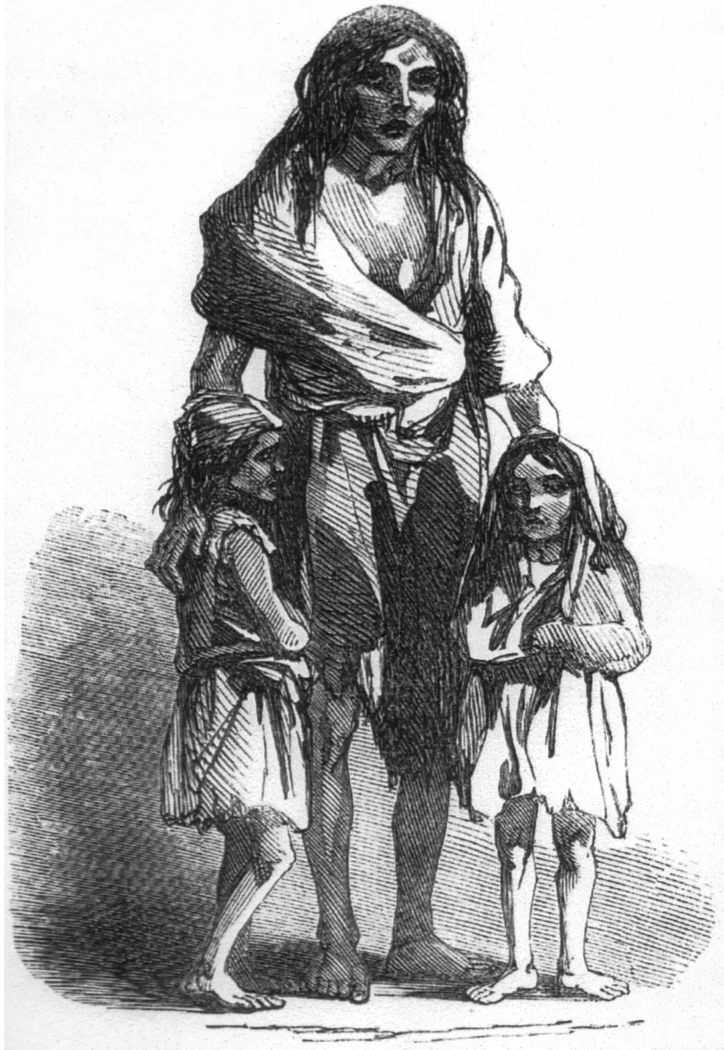
At the admissions meeting · Carrick-on-Shannon
Could they take even two of the children?
Some mothers had six or seven children. Their husbands earned eightpence a day, they said. With food prices so high, they asked the guardians, the board deciding admissions, to take in even two or three.
One widow and her two children had lived for a week on one meal of cabbage a day. All three were admitted. The youngest was so weak that one of the guardians told the master he thought the child had little time left.
Finding the workhouses · County Leitrim
Which door was closest to home?
Dromahair and Killanummery belonged to the Manorhamilton Poor Law Union, the district served by its workhouse. A family admitted there faced another separation inside. Men slept in the east wing, women and children in the west. The meeting Crosfield witnessed took place farther south, in a different union.
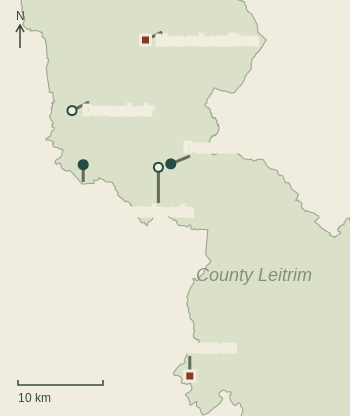
Shading follows the modern county boundary. From central Tullynascreen the workhouse sites lie about 16 km away at Manorhamilton and 28 km away at Carrick, measured in a straight line. Townlands.ie · © OpenStreetMap contributors, ODbL ↗
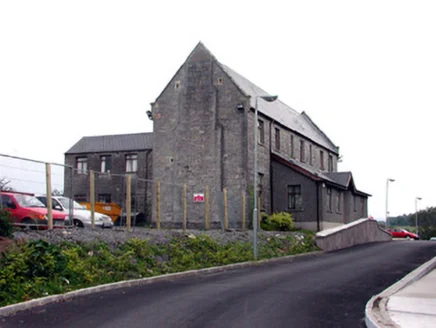
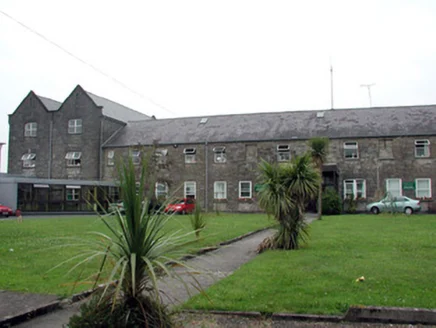
Both photographs are from the 2003 surveys. © Department of Housing, Local Government and Heritage. National Inventory of Architectural Heritage. Educational-use terms ↗
Inside Manorhamilton · Before the blight
Who decided how much to eat?
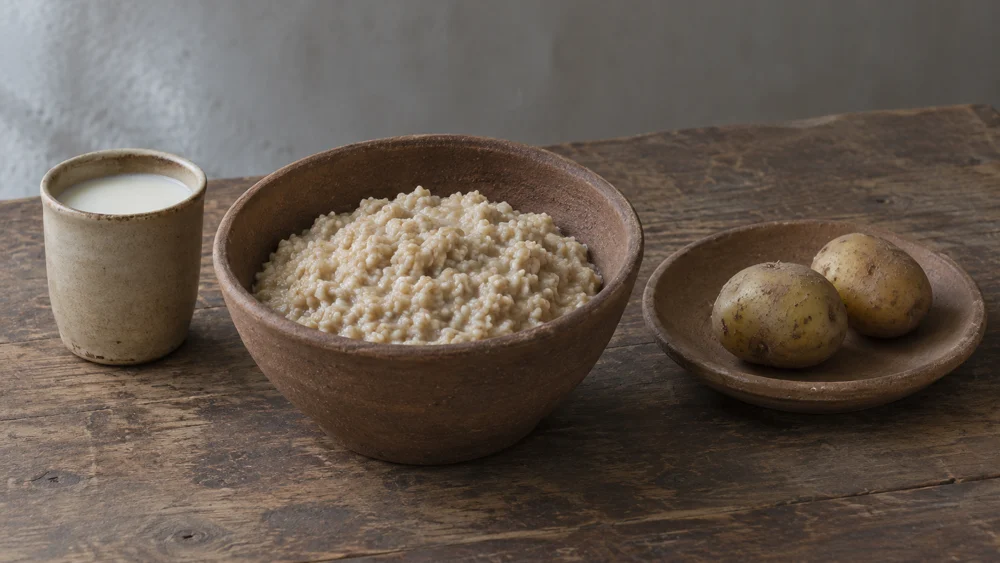
Breakfast in the workhouse’s early years was stirabout, a porridge made from oatmeal, with milk or buttermilk. Dinner was boiled potatoes. There was no evening meal in that diet. As the blight took hold, imported maize meal largely replaced potatoes.
In June 1843 someone proposed giving the women and girls doing hard labour an extra six ounces of bread and half a pint of milk each day. The request was refused. The reason entered in the minutes was discipline.
A notice to suppliers · April 1847
Before food could be handed out
A relief committee advertised for someone to supply its depot and distribute food. Suppliers had until 24 April to send terms to the Rev. James Franks at Manorhamilton. The quantities in the notice give a sense of the work behind a ration.
How suppliers were asked to price the food
| Food | Price requested by |
|---|---|
| Oatmeal and maize meal | Ton |
| Rice and peas | Hundredweight |
| Bread | Pound |
The notice calls maize meal “Indian meal”. It invited prices for two or three months, or a price that could change with the weekly market. Manorhamilton was the postal address for bids. The notice leaves the depot’s location, the successful supplier and the families who received food unidentified.
Find the reprinted Sligo Journal notice on printed page 33 ↗
We have yet to identify a relief application, workhouse admission or eviction record for this McPadden family during the Famine. In Tullynascreen, the next surviving evidence in this chapter counts people and houses.
Then the number rises
1851 · Tullynascreen
The later count is 159 people, with 29 inhabited houses. Tullynascreen’s recorded population had increased across the decade.
That is a real finding, and an unexpected one beside the wider history.
It is also a beginning, rather than an explanation.
The figures do not tell us how many people arrived or left, how many children were born, or how many residents died between the two counts. They do not show whether the increase occurred before, during or after the worst years of distress.
A growing population could include losses within individual families. More inhabited houses do not, by themselves, establish greater comfort or security.
The question becomes more precise: what happened here that these two totals cannot show?

A growing population could include losses within individual families.
Beyond the townland
Widen the view to Killanummery parish. Its population fell from 4,605 to 3,719 between the same census years.
The townland grew within a parish that became less populous. These are overlapping places, not competing accounts of what happened.
Nor is the parish’s decrease a death toll. It is the difference between two population totals, after births, deaths and movements of people had all played their part.
The contrast asks us to look more closely at the locality. It does not give us permission to describe Tullynascreen as untouched by the Famine—or to explain its growth through a benevolent landlord, an influx of refugees or a particular family’s good fortune without further records.
What we can carry forward
For James and Elizabeth or Betty Murphy’s possible family, this remains an interval in which our knowledge is uneven. The baptisms give us names before the Famine. Later marriages and households offer possible ways to follow some of those people afterwards.
The bridge between them must be made one person at a time.
We should not give them an invented story of hunger simply because they lived in this period. We should not turn the absence of a personal account into a story of safety either.
There is room here for both the weight of the history and the limits of what survives.
In the next chapter, the records become personal again: Thomas and Honora’s marriage in 1860, Michael and Mary Conlon’s in 1861, and Patrick Feeney and Mary McPadden’s in 1866. We will follow those adult households without assuming that every earlier name has already found its later life.