


Three households take shape
1860–1866 · Three marriages, with a later view of the farm
AI-generated imagined 1860s chapel setting · Not the actual churches or wedding locations.
From a count to a couple
The census left us with a number for Tullynascreen. A marriage entry lets us ask a smaller question. On one particular day, who stood beside whom?
Between 1860 and 1866, three couples appear in the records. In two of those marriages the bride was named Mary. Mary Conlon married into the McPadden name. Mary McPadden brought that name with her when she married Patrick Feeny. We can follow both women into the years when they had children of their own. Whether all three households connect back to the children in the earlier parish book is still an open question.
Thomas McPadden and Honora Cosgrave
13 May 1860 · Drumlease Catholic parish
The marriage entry calls the groom Thomas McFadden. Beside his name and Honora Cosgrave’s are the names of two witnesses, Patrick McFadden and Michael Flynn. Here is a Patrick who was present for the wedding. The priest left no indication of how he knew the couple. The entry also leaves out the ages and parents of the bride and groom.
Five years later a birth at Tullynascreen brings us inside the household. A baby boy was given his father’s name, Thomas. His mother appears in the civil entry as Hannah, formerly Cosgrave. When their son Michael was born in 1867, the same parental names appeared again. Taken together, the records let us follow Honora of the marriage entry as Hannah in the birth registers.
The boys’ father was recorded as a labourer in 1865 and 1867 and as a farmer when James was born in 1870. We can date the change in wording. What it meant for the family’s income is harder to recover. The identification of this father with the Thomas baptised in 1834 to James and Betty Murphy remains probable.
Michael McPadden and Mary Conlon
25 November 1861 · Killenummery Catholic parish · transcribed date
This is the Mary whose sons James and Thomas would later make lives in Bridgeport and Scotland. On her wedding day the name to look for is Mary Conlon. The parish page is so faint that even with the right page open, a reader can struggle to pick out the line. The date and the two witnesses, John Conlan and Bridget Conlan, come from family-history contributor Anne Burgess’s transcription. Their surname gives us a lead. Their relationship to Mary remains unknown.
Thirteen years later the writing is clearer. James’s civil birth entry records him at Tullynascreen on 11 October 1874 and names his parents, Michael McPadden and Mary formerly Conlon. His mother’s name before marriage is what lets us recognise her across the two records. Her own parents have yet to be identified. A later American birth date for James conflicts with the Irish entry.
A later Leitrim memory · Drumkeeran district
When the strawboys came to dance
In a Drumkeeran account collected in the 1930s, the celebration took place at the bride’s home the night after the marriage. Friends brought drink. Then came the strawboys, visitors in disguise who danced for hours. Their arrival was taken as a sign of good luck.
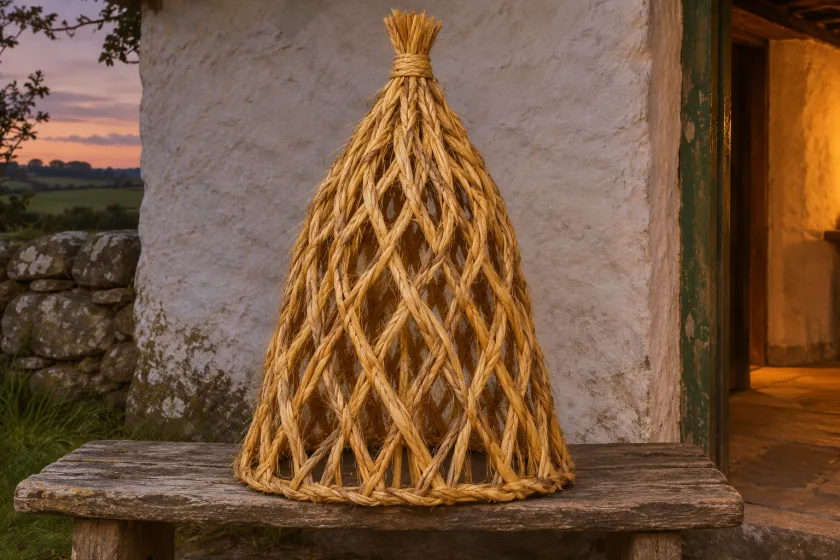
Imagine trying to recognise a neighbour through a lattice of straw. A surviving wedding hat from nearby Ballintogher gives a sense of the disguise. Who joined the dancing at any of our three weddings remains an open question.
Read the Drumkeeran wedding account at Dúchas ↗ Hear the music of a Leitrim gathering →
Patrick Feeny and Mary McPadden
2 March 1866 · Catholic Chapel of Killanummery
This time the bride is Mary McPadden. She gave her residence as Tullynascreena. Patrick Feeny’s was Greaghnafarna. Read as two lines on a form, those addresses can sound a world apart. The townlands share a boundary.
By their son James’s birth in June 1868, the family was recorded at Greaghnafarna. His mother appears as Maria, formerly McPadden. Years later the census would find the widowed Mary there with her sons. That is a life we can trace across decades, even while the question of her childhood remains open.
Read the 1866 civil entry · Residence and parentage
Their townlands shared a boundary
Look across Mary’s row from her residence to her father. The clerk recorded James McPadden, a farmer. On Patrick’s row, in the same column, he recorded Martin Feeny, also a farmer. The form gives us the names of two fathers. It leaves both mothers unnamed.
Why does the bride’s age matter?
The entry gives Mary’s age as 20 on 2 March 1866. In the earlier parish book there is a baptism for a Mary, daughter of James and Betty Murphy, on 30 June 1840. That child had already been baptised more than 25 years before the wedding.
The father’s name fits, and Mary’s later reported ages fall closer to 1840. We can follow the bride into her married life while leaving open whether she was Betty’s daughter.
Find the earlier Mary’s baptism on the parish page ↗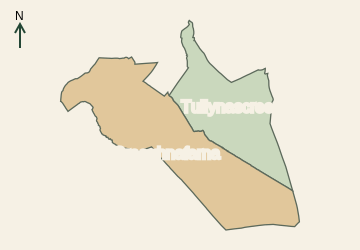
Mary/Maria’s farm at Greaghnafarna
A later view of the household
A marriage entry gives us a day. The valuation books let us follow a holding through years of changes.
In the early twentieth-century volume, Maria Feeny is entered for a house and eleven acres, two roods and thirty-five perches at Greaghnafarna—nearly twelve acres. This is a strong candidate for Mary McPadden’s later household: the censuses place the widowed Mary or Maria there as a farmer. The valuation does not give her maiden surname or name her children. The identification rests on those records read together.
Earlier books list Martin Feeny on a larger holding of twenty-three acres, two roods and thirty-five perches. Patrick’s marriage entry had named his father as Martin Feeny, a farmer. The name and locality make a probable connection. They do not tell us how the land passed between the people entered in the books.
A later page divides that earlier acreage into two portions: Maria’s eleven acres, two roods and thirty-five perches, and another twelve acres. The altered names and coloured dates need a closer reading before we give each change an exact year. We cannot call the division an inheritance on this evidence.
In 1906, a change is recorded beside Maria’s entry. George Lane Fox’s name in the lessor column is replaced by “In fee”, and the row carries an L.A.P.—Land Act Purchase—stamp. This records a change to land-purchase status. It brings the wider history of tenant purchase into the story of a particular holding. The entry does not supply a purchase price or the exact day the transaction was completed.
The woman described as a farmer in the census now has a probable holding to set beside her name. Her earlier family identity remains a separate question.
What the witnesses leave us
A witness can put someone beside a couple on a particular day. A child’s birth entry can carry a mother’s earlier surname into the next generation. Each gives us a way to follow a family without guessing how everyone in the parish was related.
In the next chapter the language changes. Two people registering deaths actually say how they were related to the person who died. One is recorded as a brother, the other as a sister.