
Leitrim · Speaking, reading & writing
Two languages.
A witnessed mark.
A person could speak two languages and still need someone else to write. What can a few entries on a page tell us about that wider world?
Follow the evidenceMary’s 1904 document · Family collection · Supplied photograph, date partly clipped; original or reproduction unresolved. Body writer unidentified. Look closer ↓
In one census column: “Irish and English.” In another: “Cannot read or write.” These entries belong to the same woman. There is no contradiction. They answer different questions.
One return · Different questions
Read across the columns.
1901 · Language column
“Irish and English”
Which languages could she speak?
Mary’s language entry records both Irish and English. It does not measure fluency or tell us which language she preferred or used at home.
Modern typesetting and editorial summary of the household return; not a census facsimile.
01 · Start with the entries
A spoken life.
A written record.
Mary McPadden was recorded in 1901 as a widowed farmer and head of a household in Tullynascreen, near Dromahair. The census gives us a small but revealing example of how language, literacy and record-making could sit alongside one another.
Speaking was one ability; reading and writing were others. Mary’s return records two spoken languages, but neither reading nor writing. Her son Martin, recorded as able to read and write, witnesses her mark at the foot of the census. See the separate columns and signature block (opens in a new tab)
A mark did not mean a person had no knowledge or no part in a decision. It was a way their participation could appear in writing. Nor does speaking two languages tell us which one Mary used with a neighbour, at home or on census night.
The family behind this example
Mary is the woman at the centre of this reading. Martin and Michael, mentioned in the census panel, are her sons. The language ditto marks beside the sons are less secure than Mary’s entry, so we do not use them to make equally certain claims about their speech.
County Leitrim · 1901
4,004 people.
Two recorded languages.
People returned as speaking Irish and English, by age. Choose a bar to look closer.
2,106 of 4,004: 52.6% of the recorded bilingual population. More than half were sixty or older.
Each bar is a share of all 4,004 bilingual speakers, not a rate within that age group. County totals, not one village or household.
02 · From a household to a county
Listen across
the generations.
Mary’s entry was part of a wider language landscape. Across Leitrim, 4,004 people were returned as speaking both Irish and English in 1901. Of these, 2,106 were sixty or older: more than half of the recorded bilingual population. Read the county figures (opens in a new tab)
The table is a snapshot of people of different ages, not a film of language disappearing year by year. It makes transmission between generations an important question. It cannot tell us why a particular family learned, kept or stopped using Irish.
What could change a language’s place?
Researchers examine several interacting pressures: schooling; the usefulness of English for work and migration; state administration; and communities disrupted by death and emigration. These forces could reinforce one another. Modern census research explores their effects, but the reasons within Mary’s household remain unknown. Research on language change (opens in a new tab)
Language and literacy are different measures. The county report placed 12.1% of residents aged five and over in its category “illiterate”—neither reading nor writing. That label did not measure spoken ability, practical knowledge or judgement. Read the literacy table (opens in a new tab)
We do not place Mary in a chart age band: her stated age in 1901 conflicts with other evidence about her life.
Irish in national-school policy
A changing place
in the classroom.
- 1878Irish could be taught as an extra subject outside school hours.
- 1883Irish could help teachers teach English in Irish-speaking areas.
- 1904A bilingual programme offered a further place for Irish in schools in Irish-speaking districts, under special conditions.
National policy milestones. These do not establish practice in a particular Leitrim classroom.
Read the history of these policies (opens in a new tab)03 · Learning inside and outside school
Which language
belonged in school?
The National Education Board was established in 1831. A growing school system brought reading and writing into more lives, but the language of instruction mattered too. National-school policy gave English the central place; Irish gained a changing, often limited role. School records (opens in a new tab) · Language policy (opens in a new tab)
Language education also became a public cultural campaign. The Gaelic League, founded in 1893, promoted Irish and bilingualism. The policy changes alongside this text help explain why language belongs within Ireland’s cultural history as well as its classroom history. They do not show that Mary took part in that movement. The wider language revival (opens in a new tab)
Written learning
Registers record enrolment. Roll books and daily reports can help establish attendance. A name entered and a child regularly present are different findings.
Spoken knowledge
Place names, crafts, stories and customs could pass through conversation. A literacy column could not inventory everything a person knew.
In 1937–39, decades after Mary’s records, the Schools’ Collection asked children to gather knowledge from parents, grandparents and neighbours. Spoken knowledge became a written archive. It cannot recover Mary’s own voice, but it offers another way to look beyond a census literacy label. Explore the collection’s origins (opens in a new tab)
Explore the skills that sustained a home →Sewing, food, water and everyday work around DromahairWhat do we know about schools nearby?
The census recorded 194 pupils—111 male and 83 female—at three mixed national-school establishments in Killanummery electoral division during the week ending 11 May 1901. This is a weekly attendance total across three establishments, not one class, all local children or proof of Mary’s schooling. An electoral division also differs from a parish. The local census row (opens in a new tab)
Mary’s adult literacy entry cannot establish whether she never attended, attended briefly or had another experience.
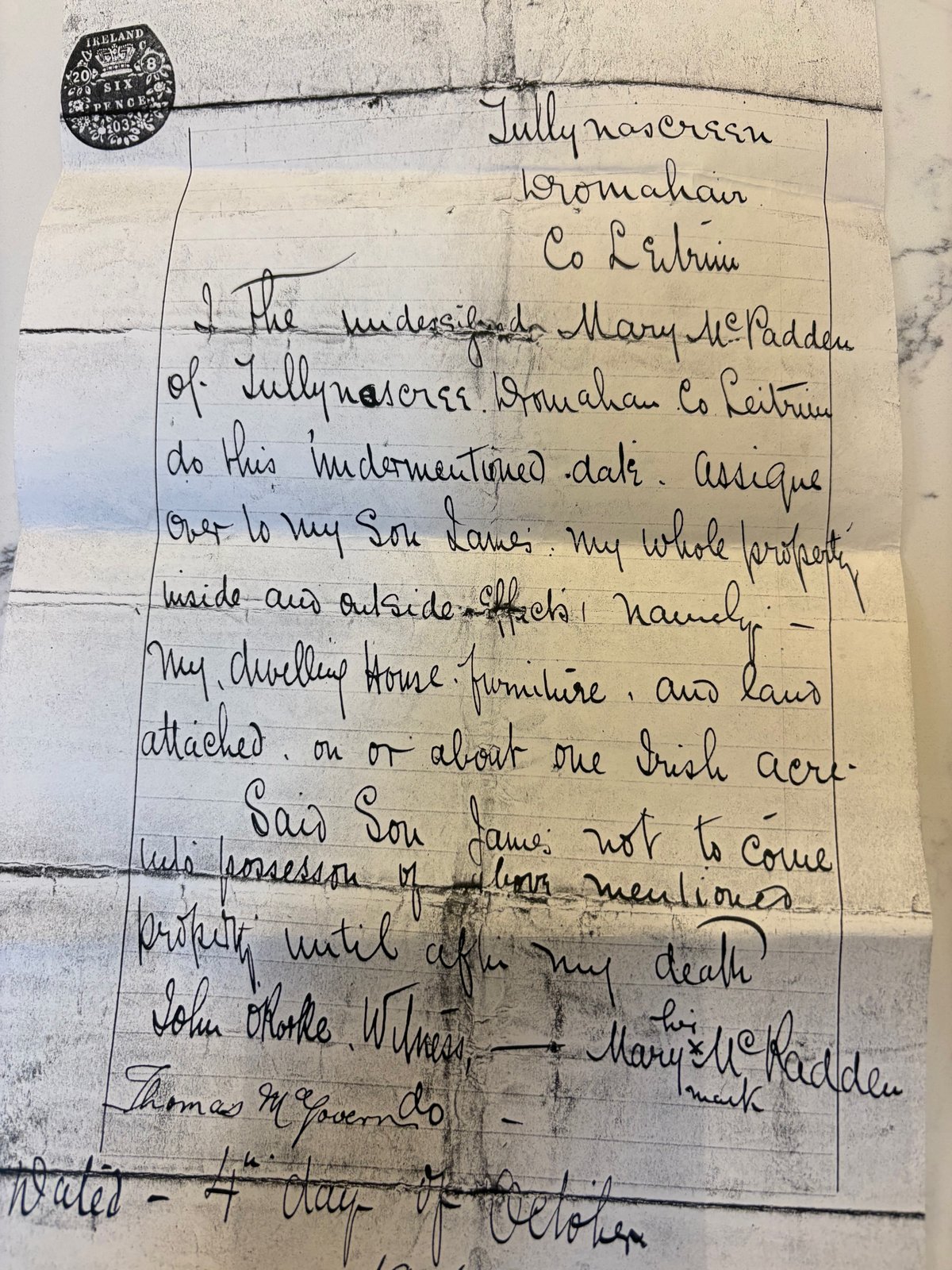
Look at the outlined area
Words written on someone’s behalf
The body names Mary, her son James, and a dwelling, effects and land. We have not identified the writer. The words should not be presented as Mary’s own handwriting.
Family collection · Supplied photograph; the date is clipped at the foot. Whether this is an original or a reproduction remains unresolved. Outlines are editorial aids; the photograph is unchanged.
Open the supplied photograph (new tab) ↗04 · Look closely at a written act
The words.
The mark.
The witnesses.
A written page could involve more than one person: someone writing the text, someone participating by mark, and people witnessing the act. Looking for those different roles helps us read a document without assuming the named person wrote it.
In the family-held document dated 4 October 1904, Mary’s witnessed mark accompanies words naming her son James, a dwelling, effects and land. The body writer has not been identified. The witness names remain unresolved. Read the source findings
- 1901
- A census return. Mary’s son Martin witnesses her mark.
- 1904
- A separate document concerning property. Different witness entries, still unresolved.
The page shows participation in written record-making. It does not, by itself, establish that a legal transfer was completed, who explained its words, or the language spoken when the mark was made.
Read alongside the census, it brings several parts of a life into view: a bilingual speaker, a woman recorded as unable to read or write, and a participant in a witnessed written act. Each source contributes something different.
Try a source reading
Could this mark, on its own, tell you whether Mary spoke Irish?
Open the reading
No. The mark records an act, not a spoken language. The 1901 language column supplies the evidence for Irish and English; its education column separately records literacy. Even together, these sources cannot identify the language Mary used at home.
Follow the evidence
The sources behind
this reading.
Personal records and county history answer different questions. Open a note for its precise location and scope.
Source links marked ↗ open in a new tab. Stories, readings and sections open here; your story chapter stays available through the return link.
Irish, English and national-school policyThomas Walsh · Maynooth University research repository
“Revival or bilingualism?”, Paedagogica Historica 59:2 (2023), pp. 249–262; first online 2021. Printed pp. 255–256, especially p. 256 (PDF p. 8).
What it supports. Irish-language policy milestones in 1878, 1883 and 1904; the Gaelic League’s founding in 1893 and promotion of Irish and bilingualism.
How to read it. National policy and cultural history, not evidence of local classroom implementation, Mary’s schooling or her participation in the revival.
Reuse. Brief original paraphrase and source link; no reproduced pages.
Open source (new tab) ↗Source MCP-CONTEXT-IRISH-SCHOOL-POLICY · Checked 2026-11-05Research on the retreat of IrishFernihough, Colvin & McLaughlin · QUCEH
“Mind Your Language: Explaining the Retreat of the Irish Language Frontier”, Working Paper 24-07, July 2024; especially pp. 10–15 on competing explanations.
What it supports. Educational, economic, administrative and demographic pressures considered by researchers studying language change.
How to read it. A modern working paper studying broad patterns, not proof of Mary’s motives or a single settled cause. The Leitrim age snapshot does not itself establish causation.
Reuse. Brief original paraphrase and source link; no reproduced pages.
Open source (new tab) ↗Source MCP-CONTEXT-LANGUAGE-SHIFT · Checked 2026-11-05Spoken knowledge and the Schools’ CollectionNational Folklore Collection · Dúchas
Collection overview, “The Schools’ Collection”, 1937–1939.
What it supports. Children gathered local history, place names, crafts, games, stories and customs from parents, grandparents and neighbours.
How to read it. A later collecting project, not a recording of Mary or proof of her particular knowledge or practices.
Reuse. Brief original paraphrase and source link; no collection images, audio or item transcripts reproduced.
Open source (new tab) ↗Source MCP-CONTEXT-ORAL-KNOWLEDGE · Checked 2026-11-05Mary’s household return, 1901National Archives of Ireland
31 March 1901; Leitrim, Killanummery DED, Tullynascreen, house 10, Form A; image nai000978483, record 6973660. Rows 1–3 and signature block.
What it supports. Mary’s recorded Irish and English; literacy entries for Mary, Michael and Martin; Mary’s census mark witnessed by Martin McFaddin.
How to read it. Spoken ability is not a measure of fluency, preference or language used at home. The sons’ language ditto marks are less secure. Mary’s recorded age conflicts with other life evidence.
Reuse. Archive link and an explicitly labelled editorial summary. The census scan is not reproduced here; image reuse review is separate.
Open source (new tab) ↗Source MCP-IRL-1901-MARY · Checked 2026-10-29Mary’s witnessed document, 1904Family-held document · The McPadden Project
Document dated 4 October 1904; text naming a dwelling, effects and land, and the mark and witness block.
What it supports. Mary’s participation by witnessed mark in a written document concerning property.
How to read it. The body handwriting is not established as Mary’s. The witness names remain unresolved; Martin is identified as witness on the 1901 census, not this document. The document alone does not establish completion of a legal transfer.
Reuse. Existing public source record under scoped family permission. The existing supplied photograph is displayed unchanged, with editorial outlines and faithful layout, under the same educational-display permission. Body writer and witnesses remain unresolved; the date is clipped. No open image license or other reuse is implied.
Open source →Source MCP-FAM-1904-MARY-PAGE · Checked 2026-10-29Irish speakers in Leitrim, 1901Census of Ireland · Central Statistics Office historical archive
Census of Ireland 1901, County of Leitrim, printed page 90, Table XXXVII (PDF page 98). Administrative county as constituted under the 1898 Act.
What it supports. 4,004 persons returned as speaking Irish and English: under 3, zero; ages 3–9, 25; 10–17, 79; 18–29, 243; 30–59, 1,551; 60 and over, 2,106. Under-18 total of 104 and percentages are calculated from these counts.
How to read it. County totals are not Tullynascreen totals. Returns record stated speaking ability, not mother tongue, domestic use or measured fluency; age distribution does not establish an individual’s age or a cause of language change.
Reuse. Source: Census of Ireland, 1901, County of Leitrim, Table XXXVII, digitised by the Central Statistics Office. Figures transcribed and selected by the McPadden Project. No report scan reproduced. CSO statistical information: CC BY 4.0.
Open source (new tab) ↗Source MCP-CONTEXT-1901-LEITRIM-LANGUAGE · Checked 2026-10-29Reading and writing in Leitrim, 1901Census of Ireland · Central Statistics Office historical archive
County of Leitrim report, printed page 75, Table XXXIII (PDF page 83); published summary on page viii.
What it supports. Of 62,669 county residents aged five and over, 7,597 were classified as “Illiterate”; the report gives 12.1%.
How to read it. The age-five-and-over denominator matters: the all-age category includes all children under five. The census category concerns reading and writing, not intelligence, practical knowledge or spoken ability.
Reuse. Source: Census of Ireland, 1901, County of Leitrim, Table XXXIII and summary, digitised by the Central Statistics Office. Figures selected by the McPadden Project. No report scan reproduced. CSO statistical information: CC BY 4.0.
Open source (new tab) ↗Source MCP-CONTEXT-1901-LEITRIM-LITERACY · Checked 2026-10-29School attendance in Killanummery, 1901Census of Ireland · Central Statistics Office historical archive
County of Leitrim report, Table XXXVIII, printed pages 90–91 (PDF pages 98–99), Killanummery electoral-division row; classification note on printed page 92.
What it supports. Three mixed national-school establishments, with 111 male and 83 female pupils (194 total), in attendance during the week ending 11 May 1901.
How to read it. An electoral division is not the same boundary as a parish. This is attendance during one week, not enrolment, average daily attendance or all local children. It does not name Mary’s school or establish her attendance. The report’s educational classifications are historical, not a direct map to modern school levels.
Reuse. Source: Census of Ireland, 1901, County of Leitrim, Table XXXVIII, digitised by the Central Statistics Office. Figures transcribed and summed by the McPadden Project. No report scan reproduced. CSO statistical information: CC BY 4.0.
Open source (new tab) ↗Source MCP-CONTEXT-1901-KILLANUMMERY-SCHOOLS · Checked 2026-10-29How school records workNational Archives of Ireland
Education records research guide; National Education Board and school registers, roll books and daily report books.
What it supports. The National Education Board dates to 1831; different school records document enrolment and attendance.
How to read it. A national institutional history does not establish Mary’s childhood, school attendance or the reason for her recorded literacy.
Reuse. Link and original paraphrase only; no archive images or extended extracts reproduced.
Open source (new tab) ↗Source MCP-CONTEXT-NATIONAL-SCHOOL-RECORDS · Checked 2026-10-29
Reviewed · Guided source reading, census age comparison, school-language policy and oral-knowledge context. Suggest a correction or share local knowledge.