

09 / Bridgeport · around 1904
A city already
in motion.
James had crossed an ocean.
Now he had to begin a life.
Not an actual Bridgeport view.
AI-generated period illustration · an imagined New England industrial street, not an actual Bridgeport view, James’s workplace or his route. Creation and evidence notes ↗
The world around a newcomer
The city was not
a blank page.
Rail lines crossed a growing industrial city. Factories drew workers. Streets and rented rooms held families from Ireland and many other places.
Bridgeport already had its rhythms, its work and its communities. The records let us glimpse that world. They do not tell us what James felt as he entered it.
Three questions. Uneven evidence.
What does it take
to begin again?
Choose a question to follow a real record. These are lenses on his life—not three known steps in his arrival.
1917A documented point—not the whole story
A trade appears. The first job does not.
Factories were part of the city James entered. By 1917, more than a decade after his arrival, his Connecticut military census records a drop-forging trade and an address at 498 Howard Avenue.
This is evidence of his later working life—not the name of his first employer, or proof of where he worked in 1904.
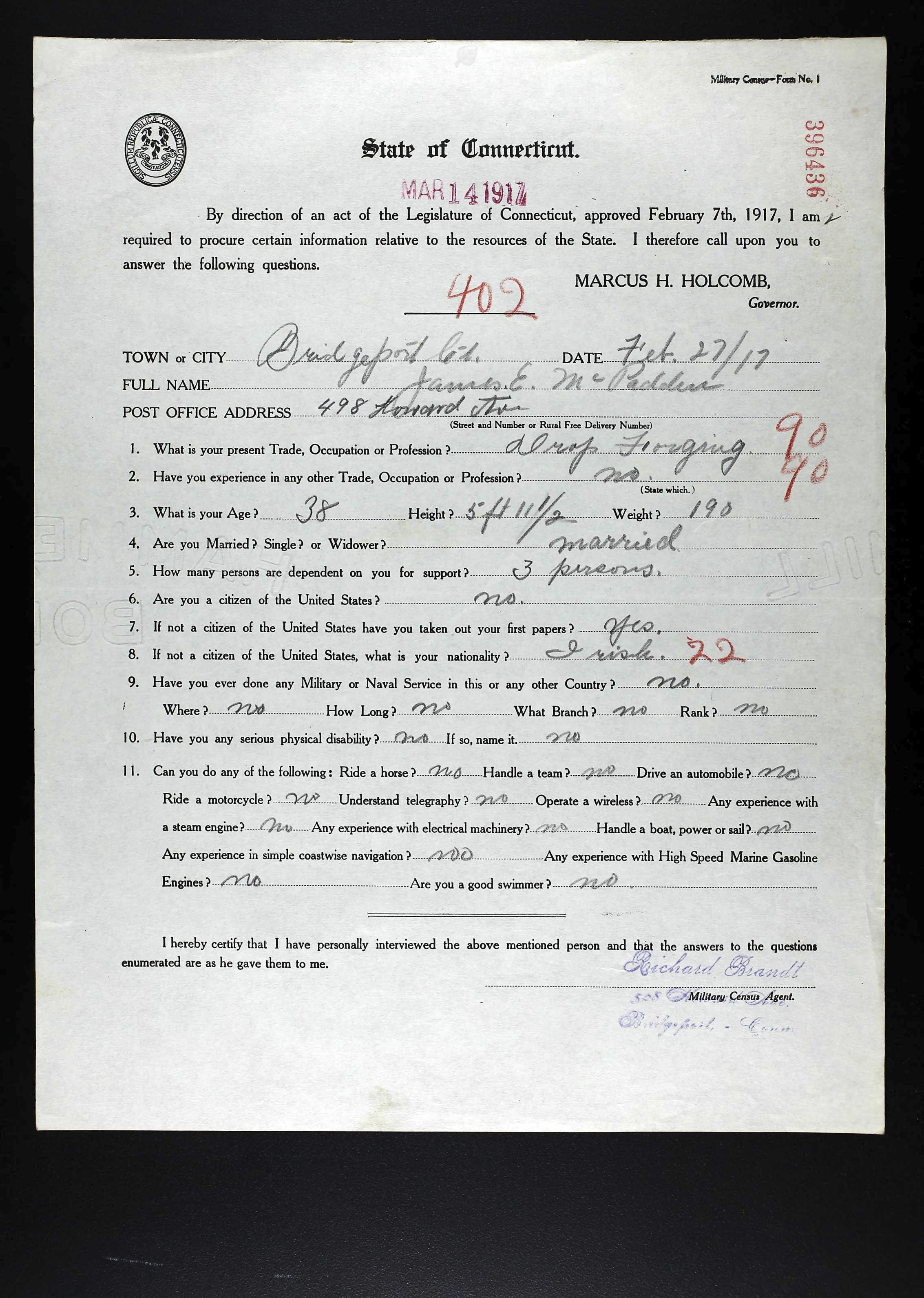 Examine the preserved record ↗
Beyond the city’s silhouette
We can see the city.
Not yet his first years.
Knowing the setting is not the same as knowing the life. Between the passenger record and the wedding, the personal story still has missing pages.