


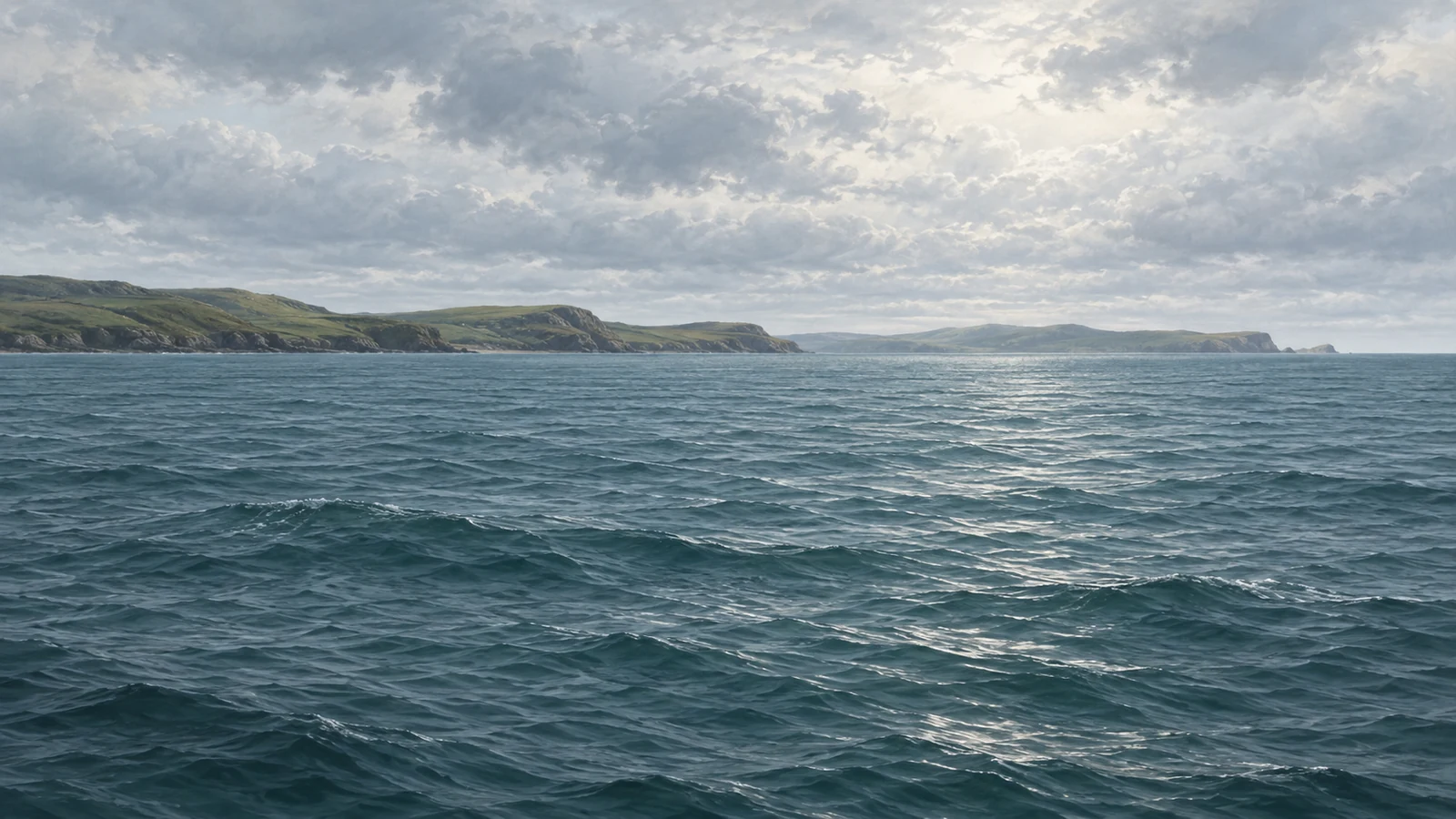

James McPadden · aboard Teutonic · 13 October 1904
When home becomes
the horizon.
Behind him, Ireland. Ahead, an ocean—and a sister in Bridgeport.
Scroll slowly to leave the shore
Or go straight to the crossingThe distance grows.
The people remain.
AI illustration · a period-inspired stern view
This imagined viewpoint places us behind a liner’s railing, looking back along its wake. It is not a verified reconstruction of the Teutonic’s aft deck, James’s position aboard, the departing coastline or the weather.
Titanic Belfast records an elliptical stern and twin screws. Those details do not establish the railing, deck access or exact view in 1904.
Teutonic: ship details ↗Museum collection: On Deck, Steamer Teutonic, 1891 ↗13–20 October 1904 · James’s crossing
Seven days between
two shores.
James’s arrival record gives us two firm anchors: Queenstown on 13 October, New York on 20 October 1904. Between them lies a week we cannot read in his own words.
The journey now had a different rhythm. Not another railway station or a road to follow, but another day at sea. For a week, the ship was his world.
A place to sleep. Something to eat. A way to pass the hours. The great change in James’s life still had to be lived one ordinary day at a time.
Life aboard · ship history and a passenger’s voice
A world with
water on every side.
Teutonic was built in Belfast and entered service in 1889. Her crossing depended on steam: she was White Star’s first twin-screw vessel, built without a backup set of sails.
The ocean passage was also a stay in an unfamiliar place. Where to settle your belongings, how meals arrived, where to spend a waking hour: small things became part of a much larger journey.
James’s passenger class and berth remain unestablished. The glimpse below comes from a different voyage.
Meet the actual ship · Titanic Belfast ↗A glimpse from another crossing
Mary Antin, a young Jewish emigrant, described her 1894 voyage to Boston on Polynesia. This is her experience—not James’s, and not a description of Teutonic.
A berth in an unfamiliar place
Antin recalls upper berths in a section for families. Her family put their belongings in order before going on deck.
We have not established James’s accommodation, who slept nearby, or how well he rested.
Read her account · printed pp. 62–65 ↗Room for reflection · not James’s recorded thoughts
Between two lives.
This was not simply a journey from one country to another. On either side of the ocean were people who belonged to the same family.
His mother. The family and home he was leaving.
His sister. The person named at his destination.
Did he talk about Catherine with another passenger? Think about Mary’s days at home? Wonder how long it would be before he saw Ireland again?
The relationships are established. These thoughts are questions, not words recovered from James. We have no account of his feelings at sea or a promise that he would return.

What would you look forward to?
What would you find hardest to leave?
20 October 1904 · New York
The ocean ends.
The beginning doesn’t.
Try imagining the approach: the first land after days at sea, a city still unfamiliar, the question of what comes next. This is an invitation to picture arrival—not a description of what James saw or felt.
Teutonic reached New York on 20 October. James’s entry records ten dollars and a destination beyond the city: his sister, Mrs James Kelly, at 11 Warren Court, Bridgeport.
That formal name was Catherine McPadden Kelly. Beyond the new city and its unfamiliar streets, James had a familiar name to ask for.
Arrival did not finish the journey. There were still the formalities of entry and the onward passage to Bridgeport—and a life to make after them.
The address is documented. A meeting at the dock, his precise onward route and his first night’s lodging are not established.
Next in James’s story
Ten dollars.
One familiar name.
Follow James into New York, with Catherine’s address ahead of him.