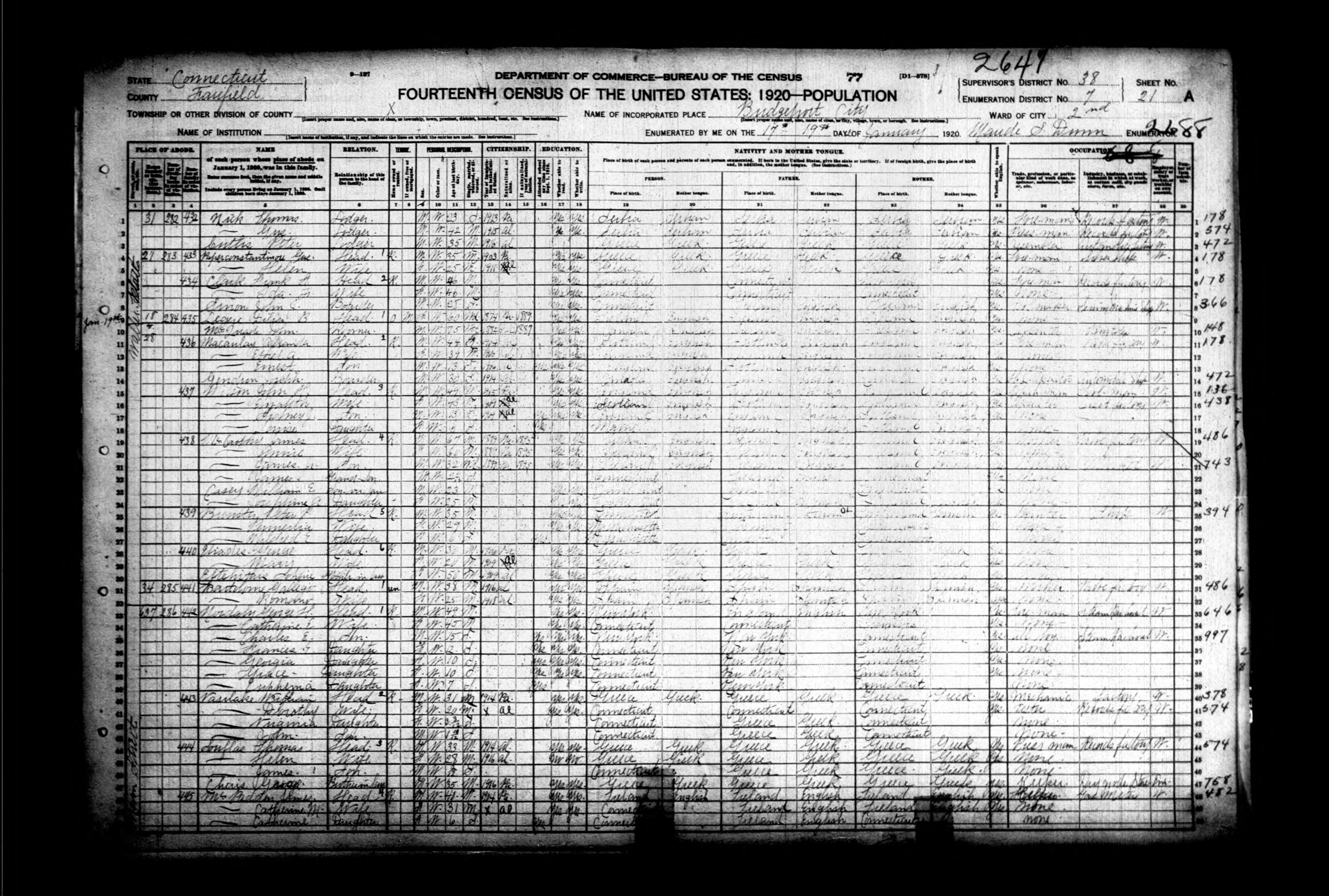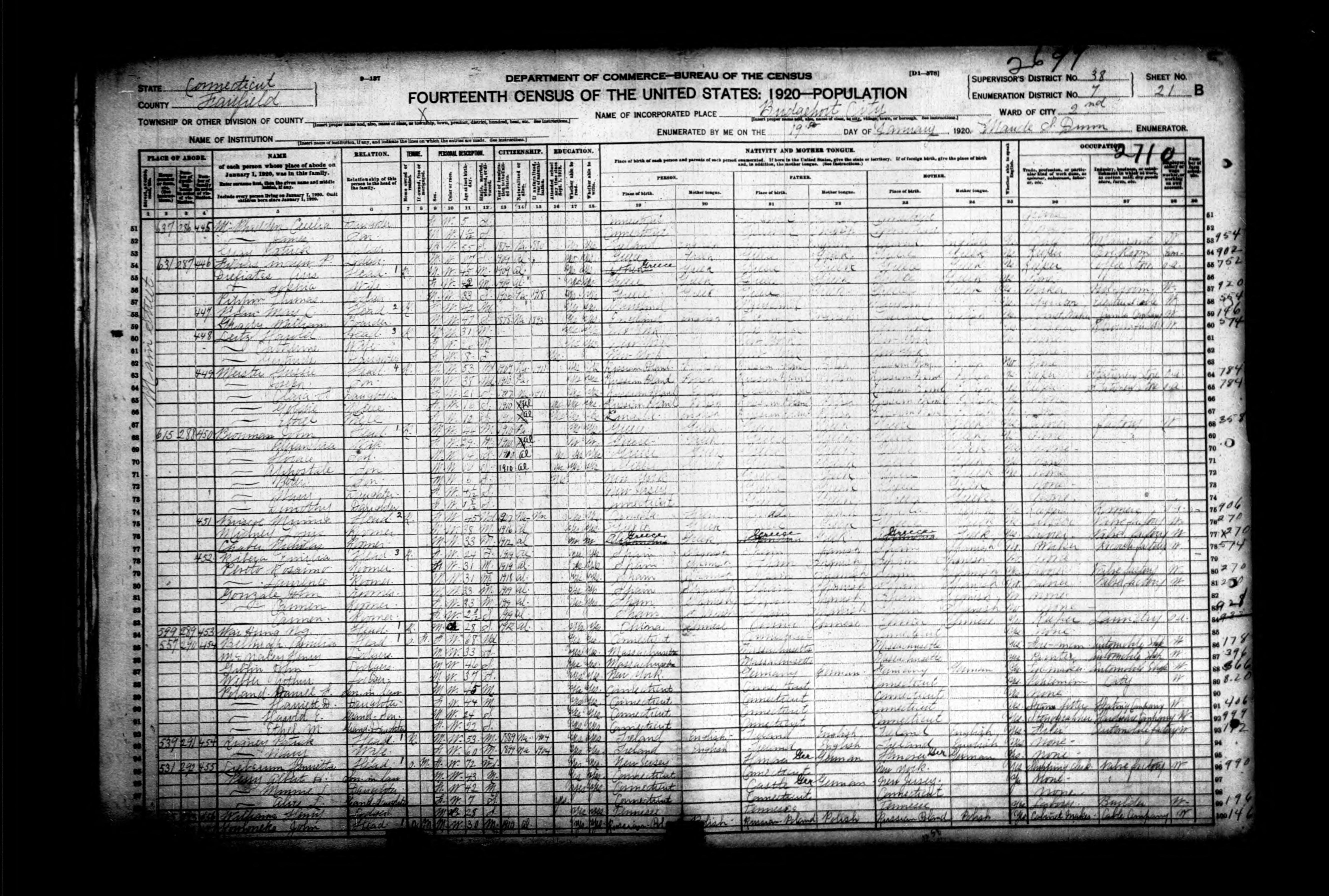
Bridgeport · January 1920
The page ends.
The household continues.
Two parents. Three children. And someone else sharing their address.
Follow the handwriting across two sheets.
James McPadden and Catherine McNiff’s family · Street address unresolved
01 · The parents
The couple we have been following.
By January 1920, the wedding is almost eight years behind them. Near the bottom of a Bridgeport census sheet, James appears on line 48. Catherine follows on line 49, recorded as his wife.
This is Catherine McNiff McPadden—the woman he married in 1912, not his sister Catherine Kelly. The form places the couple together. It cannot tell us how they divided their days, what made them laugh or what worried them.
Lines 48–49 · our readingJames McPadden · head / Catherine M. · wife
02 · Their daughter
Another Catherine. Another life beginning.
On the very next line is a second Catherine: their daughter. The same first name, but a different generation. The relationship column is what lets us distinguish mother from child.
She is more than the next name in a tree. This is a child growing up in Bridgeport, with a father whose early home was in rural Ireland. We can see the family connection; her memories of that childhood are not preserved on this page.
Line 50 · our readingCatherine · daughter
03 · Turn the page
The paper stops. Their lives do not.
Catherine occupies the last line on sheet 21A. Turn to 21B and the family continues: Cecelia, recorded as five, then a young son named James. Three children now come into view across the two sheets.
The repeated family number, 445, connects the pages. “Jr.” is our way of distinguishing the son from his father; the handwritten entry simply says James. His age includes a difficult fraction, so we are not turning it into a precise birthday.
Lines 51–52 · our readingCecelia · daughter / James · son
04 · Someone else at home
The household was more than a family tree.
One more person follows the children before the family number changes: Patrick Casey, recorded as a boarder. His line makes the household larger than the parents and their children alone.
We do not yet know how Patrick came to live with them, whether he was related, or what place he held in their lives. The census gives us a name and a relationship to the household—not a friendship, a rent agreement or a memory of an evening together.
Line 53 · our readingPatrick Casey · boarder · recorded age 55
What the two sheets establish
Six recorded people.
More lives to understand.
The number 445 is the census family number, not a house number. Sheet 21B repeats house number 637 and dwelling number 286. The street reading still needs confirmation; we are not assigning this household a map point.
The next family number, 446, begins on line 54. Together, the two sheets record the parents, three children and Patrick Casey. That is a census household—not a complete account of everyone who mattered to them.
Look closer at the census: guided reading and full sheet
The page ends. The family continues.
Start with the marks themselves. We will locate the household, read each visible line and follow family number 445 from sheet 21A onto 21B.
Our rule: the transcription may guide your eye, but it never replaces the original document.
Inspect both complete sheets, column headings and source locators